

Are Traditional Sushi Conveyors Still Usable? Differences Between 3 Generations of Commercial Sushi Conveyor Equipment
Industry Upgrade Background: Traditional Models Being Restructured by Technology
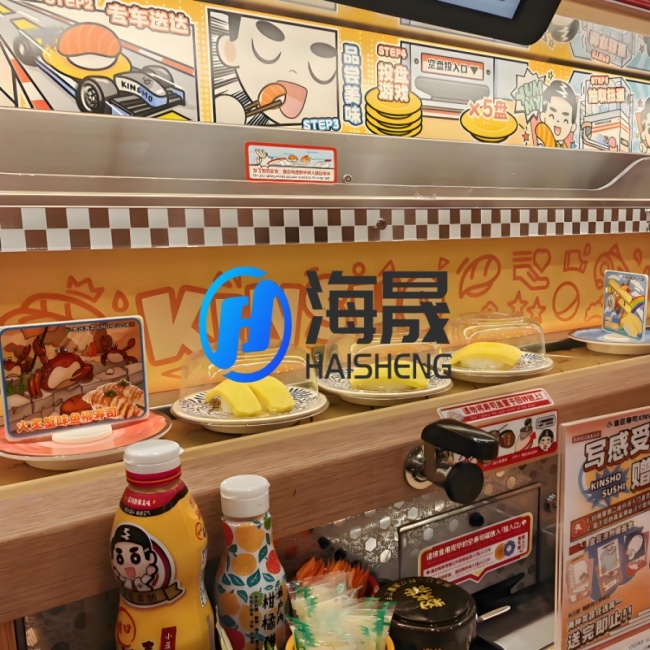
Traditional rotating sushi equipment once stood out for operational efficiency. However, amid today’s high-cost and high-standard catering operation environment, its drawbacks have become increasingly prominent. Excessive food material waste, heavy reliance on labor, and monotonous dining experience have created an urgent industry demand for more advanced solutions.
The new generation of Rotating Sushi Equipment goes beyond simple material conveying, redefining restaurant operation models from a systematic perspective.
Evolution of Three Generations of Equipment: From Machinery to Systematic Operation Platform
The first-generation commercial sushi conveyor equipment was essentially a simple mechanical structure, only solving basic conveying problems but failing to address restaurant management pain points.
The second generation saw improvements in structural stability and visual experience, yet still lacked systematic control over operational data, delivery routes and overall efficiency.
The third generation integrates intelligence and systematization, upgrading conventional equipment into a comprehensive restaurant operation platform and realizing the leap from hardware tools to intelligent management systems.
HaiSheng Core Equipment: System-level Rotating Sushi Equipment Solutions
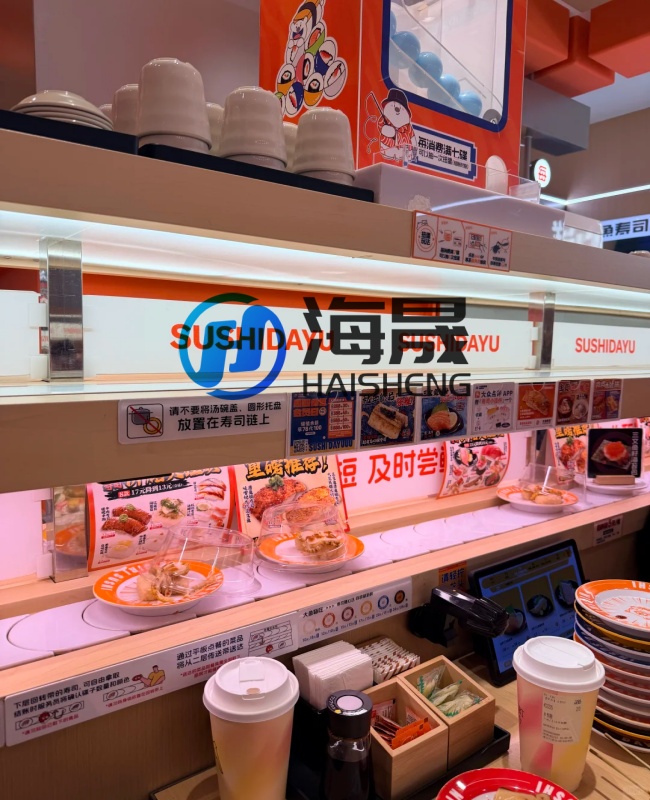
The new-generation commercial sushi conveyor equipment developed by HaiSheng Intelligent Technology Co., Ltd. is essentially a highly integrated intelligent conveying and operation system.
Structurally, it adopts an upgraded double-layer stable frame structure. Mechanical optimization ensures stable performance under long-term high-frequency operation. The whole system meets industrial standards in load-bearing capacity, shock resistance and continuous operation, perfectly fitting the long-term operation needs of high-foot-traffic restaurants.
Its modular design greatly improves on-site installation efficiency and supports flexible combination for different spatial layouts. The equipment can be precisely arranged according to restaurant circulation lines to maximize space utilization.
Transmission System Upgrade: Full Breakthrough in Noise Reduction, Durability and Smooth Operation
For the core transmission system, HaiSheng adopts high-performance acrylic chains to replace traditional materials. While ensuring structural strength, the material features a lower friction coefficient and higher wear resistance, enabling the Rotating Sushi Equipment to maintain smooth and stable operation in long-term service.
Meanwhile, optimized mute performance greatly enhances the dining environment, keeping low noise even during high-frequency operation — a critical advantage for high-end catering scenarios.
Intelligent Rail System: Redefining Food Delivery Efficiency
Different from the passive transmission mode of traditional equipment, the intelligent rail food delivery system adopted by HaiSheng endows commercial sushi conveyor equipment with active distribution capabilities.
Built-in path calculation algorithms automatically plan the optimal delivery route based on order locations for precise food serving. The equipment supports automatic track changing, obstacle avoidance and error correction during operation, with multi-dimensional sensor control ensuring stable running performance.
In terms of power control, optimized acceleration, deceleration and steering curves effectively reduce operational vibration, guarantee food stability during transportation and lower the risk of spillage.
Intelligent Restaurant System Integration: Equipment as an Operation Platform
HaiSheng’s core advantage lies not only in standalone equipment, but also in powerful system integration capabilities. The complete set of Rotating Sushi Equipment can seamlessly connect with ordering systems, cashier systems and freshness management systems to form a closed-loop smart catering ecosystem.
After customers place orders, the system automatically triggers food preparation and delivery processes, achieving true unmanned food delivery. This model not only boosts operational efficiency, but also lays a data-driven foundation for restaurant digital management.
Long-term Value: From Equipment Investment to Sustained Profit Returns
Structural optimization and systematic upgrades enable HaiSheng equipment to deliver significant improvements in service life, maintenance costs and operational efficiency.
For restaurant operators, it means lower daily maintenance expenses and more stable long-term profitability, turning equipment investment into a sustainable profit-generating asset.
Conclusion
From mechanical transmission to intelligent systematic operation, the upgrading of commercial sushi conveyor equipment is reshaping industry rules. With the new generation of Rotating Sushi Equipment, HaiSheng provides the catering industry with a highly competitive solution oriented to future development.