

Dual Tracks in Parallel, Leading the Future Intelligently: HaiSheng Hybrid Commercial Automatic Rotating Sushi Equipment Reshapes the Dining Experience
When Tradition Meets Innovation: The Design Philosophy of the Dual-Track System
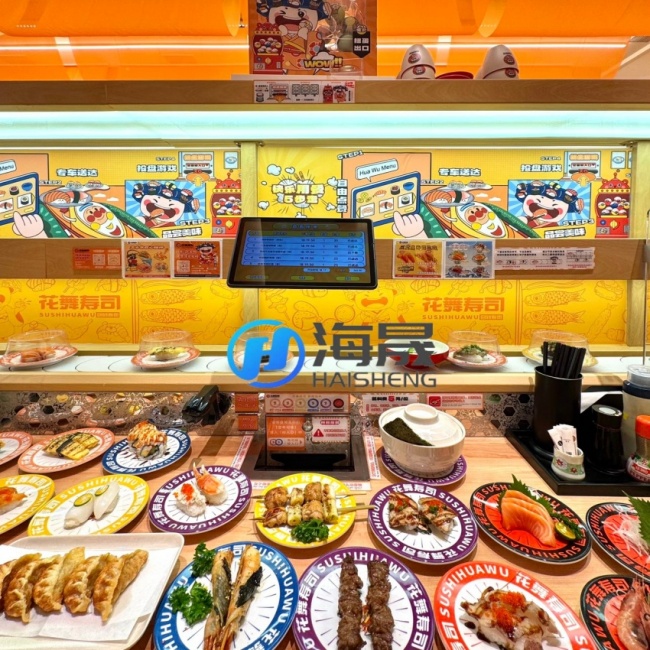
Step into a modern rotating sushi restaurant, and you will witness the following scene: on the lower rotating conveyor, colorful sushi plates flow like a ribbon, continuously passing by customers and stimulating their appetite; on the upper track, uniquely designed delivery vehicles pull up precisely at designated seats, delivering made-to-order dishes straight to customers.
This is exactly the experience presented by HaiSheng hybrid commercial automatic rotating sushi equipment. Behind this design lies the HaiSheng technical team’s profound understanding of catering consumer psychology.
The value of the traditional rotating conveyor lies in visual appeal. Human eyes are naturally drawn to moving objects, and the continuous flow of sushi on the conveyor takes full advantage of this instinct. Colorful sushi appears to parade in a line, and this ever-changing visual charm instantly arouses guests’ appetite and eases the anxiety of waiting. More importantly, customers can directly see the color and portion of each sushi — physical display is often more tempting than menu images.
The value of the Shinkansen delivery system lies in precision service. For high-end dishes highly sensitive to freshness, as well as beverages and desserts requiring special handling, circulating on the rotating conveyor is far from optimal. Through the upper track system, these items are prepared to order and delivered precisely, ensuring customers enjoy them at their best quality.
From Visual to Taste: How the Hybrid Model Solves Traditional Pain Points
Despite its unique visual appeal, the traditional rotating sushi model faces several unavoidable operational pain points.
First is food waste. To keep the conveyor looking abundant, restaurants must continuously replenish sushi. However, unsold sushi that exceeds its freshness window must be discarded. This unavoidable food waste to maintain an attractive display is a hidden cost killer in the traditional model.
Second is the challenge of freshness management. As a fresh food, sushi is highly sensitive to temperature and air exposure. Prolonged circulation on the conveyor rapidly degrades its texture. To uphold food safety standards, sushi on the conveyor is subject to strict shelf-life limits — even if it still looks appealing, it must be thrown away.
HaiSheng’s hybrid model is engineered to address these pain points. The lower rotating conveyor maintains a lively visual atmosphere, carrying only long-lasting, high-demand basic dishes. The upper delivery vehicles handle all made-to-order items, ensuring every dish arrives in peak condition. This clearly defined division retains the charm of the traditional rotating conveyor while thoroughly solving problems of food waste and freshness control.
Intelligent Delivery Vehicles: From Delivery Tools to Fun IP
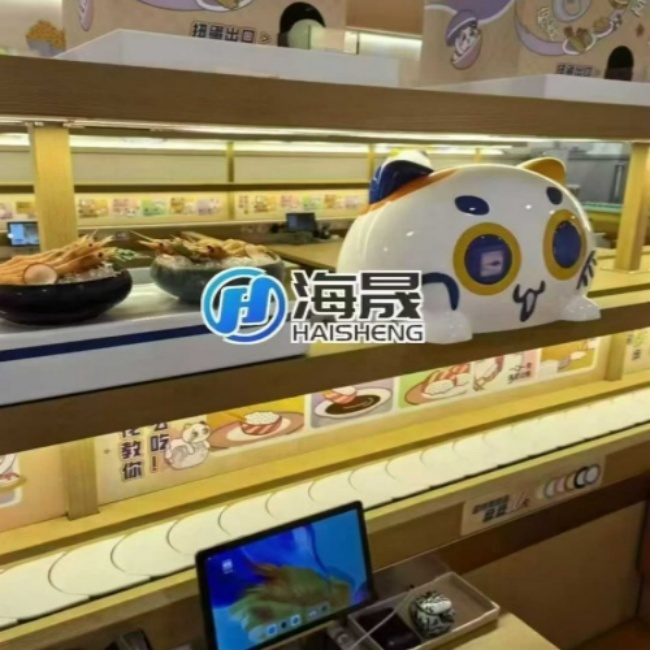
In HaiSheng’s commercial automatic rotating sushi equipment, intelligent delivery vehicles are more than just delivery tools — they serve as engaging IP carriers.
Vehicle designs can be customized to match restaurant themes: they can resemble speeding Shinkansen trains, futuristic spaceships, or cute cartoon characters. When a dish arrives on such a unique “little train”, the delivery itself becomes a mini-show, prompting customers to take photos and share on social media.
This design of dining entertainment aligns with a key trend in the modern catering industry. In the social media era, a restaurant’s “shareability” often determines its viral reach. HaiSheng’s intelligent delivery system turns every delivery into a potential social topic, generating free brand exposure for restaurants.
Plate Recycling & Gashapon System: Turning Dish Clearing into a Game
Beyond food delivery, HaiSheng adds fun to the plate recycling process. The recycling system uses specially designed plates with embedded chips. After dining, customers simply insert empty plates into the recycling port; the system automatically scans and records consumption, then transports empty plates to the kitchen via a water-circulating conveyor.
Even more ingeniously, this system can be linked with a gashapon machine. Customers earn one gashapon chance for every set number of empty plates, with random small toys inside. This food-and-play integrated model turns the chore of clearing dishes into a game, especially popular among family customers. Many children actively ask parents to order more sushi to collect enough plates for gashapons, effectively increasing the restaurant’s average check value.
Track Switching Technology: Algorithm-Driven Precision Delivery
The technical core of HaiSheng’s intelligent delivery vehicle system is its track switching technology. Unlike traditional vehicles limited to fixed tracks, HaiSheng’s system features switchable track diverters at intersections. The system automatically calculates the optimal route based on order destinations and controls diverters to switch before vehicles arrive.
This technology overcomes multiple technical challenges: avoiding path conflicts among simultaneous running vehicles, recalculating routes in real time, and precisely controlling vehicle spacing. After hundreds of simulation tests, the HaiSheng technical team has achieved:
- Vehicle spacing controlled within 0.5 seconds
- Track switching response time reduced to 0.2 seconds
- Vehicle positioning accuracy within 5 millimeters
The equipment can also adjust operating parameters for different floor conditions, ensuring stable performance in complex environments and minimizing food spillage from movement. The automatic computing system plans the best delivery routes according to target positions, greatly improving operational efficiency.
Food Safety Certifications: Strict NSF and CE Standards
Food safety is an uncompromising bottom line for all catering equipment. HaiSheng’s Rotating Sushi Equipment has obtained EU CE certification, US NSF certification, and UL certification, meaning the equipment meets international standards in electrical safety, material safety, and hygiene requirements.
Taking NSF certification as an example, it imposes extremely strict requirements on food-contact materials. HaiSheng follows NSF standards from material selection to welding processes, ensuring international-level food safety. For equipment exported to Europe and the United States, HaiSheng also adapts voltage to local grid standards and adds extra protective circuits.
In addition, HaiSheng prioritizes easy cleaning and maintenance in equipment design. Conveying channels, loading platforms, and other components of track delivery devices are easily detachable for cleaning, removing food residue and odors. The system is also equipped with proper ventilation to promote air circulation, dissipate residual odors, maintain fresh internal air, and reduce cross-flavor issues.
Conclusion: Technology-Driven New Dining Experience
From traditional rotating conveyors to modern intelligent delivery systems, from simple serving tools to engaging IP carriers, HaiSheng Intelligent Technology Co., Ltd. has consistently stayed at the forefront of catering equipment innovation.
With 16 years of industry experience, a 10,000-square-meter manufacturing factory, and a technical team of over 100 professionals, HaiSheng provides global catering operators with one-stop services from design and planning to installation and maintenance, enabling every rotating sushi restaurant to create unforgettable dining experiences through the power of technology.