

I. Europe's Hospitality Labour Shortage: From Temporary Hurdle to Structural Crisis
According to a position paper published by HOTREC (the umbrella association of hotels, restaurants, bars, and cafés in Europe) in January 2026, the European hospitality industry is missing an average of 10% of its labour force. The situation varies by country but is uniformly severe: France had over 120,000 unfilled restaurant positions in 2025; Italy reported approximately 35,000 vacant posts; Greece's tourism and hospitality sector faced a shortage of about 80,000 workers; Poland saw a 10%–12% labour gap; and the United Kingdom was short of around 73,000 catering employees.
The FIPE 2025 catering industry report shows that 90.2% of businesses that sought or planned to recruit staff said they found it difficult to find suitable candidates. Data from France's labour authority indicates that 43.8% of recruitment projects in 2026 were considered "hard to fill" by employers. Since the onset of the COVID‑19 pandemic, staff turnover in the French catering sector has exceeded 50%.
Why is Europe's hospitality industry trapped in a cycle of recruitment and retention difficulties? Demographic shifts and a post‑pandemic reshuffle of the labour market are fundamental drivers. In Italy, the average net monthly salary in the catering sector is €1,731 (paid over 12 months), translating to an annual income of just over €11,000—among the lowest in Europe's hospitality industry. Long working hours, weekend shifts, and holiday duties are the norm. "No young person will return to work in a restaurant for €1,500 a month," lamented one Italian industry professional—a sentiment that echoes across the continent. Rising labour costs combined with persistent shortages have led to tighter shift schedules, higher overtime and replacement costs, and severely weakened service capacity during peak seasons. An increasing number of restaurants are shortening their opening hours or even closing on weekends—a counter‑intuitive choice driven by the need to retain existing staff.
II. The Other Side of the Coin: Europe's Hot Pot Market Is Booming
In stark contrast to the labour shortage, the European hot pot market is experiencing explosive growth.
According to market data, the European hot pot market was valued at US$2.03 billion in 2025, expected to reach US$2.18 billion in 2026, and projected to hit US$3.84 billion by 2034, with a CAGR of 7.34%. The United Kingdom leads Europe with a 28.8% market share, followed by Germany, while France, the Netherlands, Spain, and other countries are seeing significant growth.
The pace of Chinese culinary exports is accelerating. The overseas Chinese restaurant market is projected to grow to US$409.5 billion by 2026, at a CAGR of 9.4%. Globally, the hot pot market exceeded RMB 1.8 trillion in 2025, with a CAGR of 9.3%. Hot pot, with its high standardisation potential and suitability for chain expansion, has become a leading category in the wave of Chinese food going global. In Europe, the Chinese cuisine market reached RMB 870 billion in 2024 and is expected to hit RMB 1.36 trillion by 2029, at a CAGR of 9.34%. Notably, Xiaolongkan Hot Pot has seen non‑Chinese local customers account for over 65% of its European diners, with its Düsseldorf store approaching 80%.
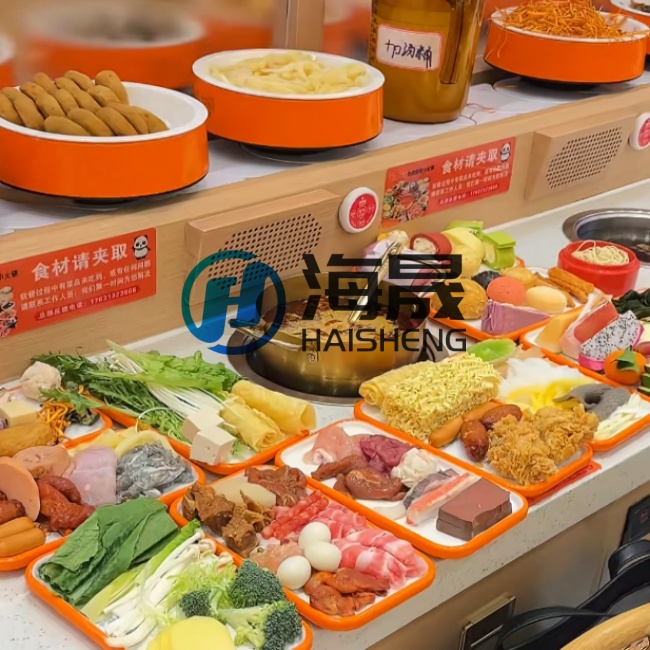
The market is expanding, but the workforce is shrinking—this contradiction is forcing European hot pot operators to seek new solutions.
III. Automation Equipment: A Key Path to Overcoming Labour Constraints
When "cannot find staff" becomes the norm, reducing dependence on manual labour becomes an imperative. HaiSheng Intelligent Technology Co., Ltd.'s Restaurant Rotating Hot Pot Conveyor Belt Equipment is designed precisely to meet this need.
With 16 years of manufacturing experience in rotating hot pot and conveyor belt sushi equipment, HaiSheng operates a 10,000‑square‑meter smart factory and employs an engineering team of over 100 professionals. The company offers a full‑service package—from design planning, R&D and manufacturing, production testing, to installation and maintenance. Its products have been exported to more than 20 countries and regions, including the United States, Canada, Mexico, New Zealand, Australia, Malaysia, Thailand, France, the United Kingdom, Germany, Spain, and Portugal. The equipment holds CE certification, NSF food equipment certification, and UL safety certification, meeting the most stringent food safety and electrical safety standards required in the European market.
At the core technology level, HaiSheng's Restaurant Rotating Hot Pot Conveyor Belt Equipment offers several competitive advantages:
Twin‑Layer Stabilised Frame Structure. Adopting Japanese craftsmanship with continuous engineering upgrades, the twin‑layer frame greatly enhances load‑bearing capacity. Even when the rotating hot pot conveyor belt exceeds 30 metres in total length, the system remains stable and smooth, effectively eliminating common issues such as vibration, abnormal noise, and chain jamming.
Acrylic Silent Chain. The rotating chain is made of acrylic silent material, providing smooth, wear‑resistant, and stable operation. Idle noise is kept to a very low level, creating a quiet and comfortable dining environment—a critical advantage as noise control regulations become stricter across Europe.
Adjustable Tension Mechanism. The innovative adjustable tension device allows operators to flexibly adjust chain tightness according to actual usage, effectively extending equipment service life and reducing maintenance costs, thus ensuring long‑term operational stability.
Modular Design. The entire system is built on a modular architecture, with components manufactured in modules at the factory and assembled quickly on site. Should any section of the conveyor belt require repair, only the affected module needs to be replaced—without dismantling the entire line, allowing other seating areas to continue operating normally. Given the high cost of labour in Europe, this modular approach significantly reduces installation and maintenance labour requirements.
IV. Smart Delivery System: Replacing Manual Labour with Technology
HaiSheng's Restaurant Rotating Hot Pot Conveyor Belt Equipment can be integrated with a variable‑track intelligent food delivery car system, further reducing reliance on human staff.
The smart delivery cars operate on independent tracks, equipped with embedded chips that connect to the restaurant's control system and receive orders from customers' ordering terminals. Once an order is placed, the car departs from the kitchen and navigates precisely to the designated table. The entire process enables accurate delivery, U‑turns, obstacle avoidance, and intelligent error correction—one smart delivery car can replace at least two manual servers.
In terms of delivery efficiency, the variable‑track system combines advanced track‑switching and conveyance technology, enabling smooth navigation through curves and complex paths. The automatic routing system calculates the optimal delivery route based on the order's destination, significantly improving overall work efficiency.
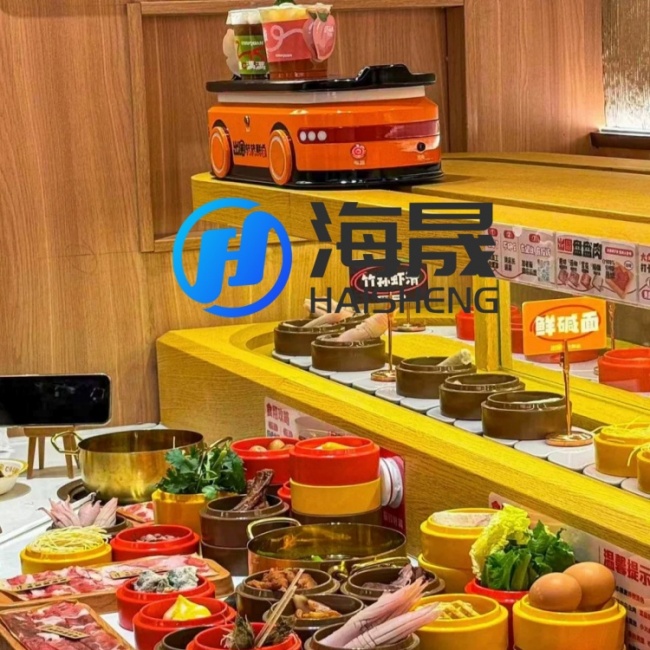
For operational stability, the delivery platforms are engineered with anti‑slip and anti‑tilt features, reinforced with protective barriers and optimised surface flatness to minimise dish displacement during transit. The power control system ensures smooth acceleration, deceleration, and steering, reducing vibration and preventing spillage. The equipment can be calibrated to perform reliably on different floor surfaces, maintaining a stable operating posture even in complex environments.
For hygiene maintenance, the conveying channels and load platforms of the track‑based delivery system are easy to clean thoroughly on a regular basis, removing residual food debris and odour molecules. Built‑in ventilation units promote air circulation and keep the internal environment fresh.
For dining experience enhancement, the smart delivery cars can be custom‑designed to resemble trains, spaceships, or other themed characters—adding visual appeal and interactive fun that are especially popular among younger European consumers.
V. Customised Solutions: Tailored to Every Restaurant's Needs
Rotating hot pot restaurants in Europe are increasingly located in prime commercial areas, where irregular floor plans, supporting pillars, and other spatial constraints are common. Maximising seating capacity within limited space directly impacts revenue and profitability.
HaiSheng's Restaurant Rotating Hot Pot Conveyor Belt Equipment can be customised according to each restaurant's operational requirements, spatial structure, and investment budget. Regardless of floor area or layout complexity, the company provides precise space‑adaptation solutions. In addition to the core conveyor system, supporting accessories such as ambient LED lighting, overhead exhaust systems, and multi‑functional drawers are available to help restaurants create a distinctive dining environment.
VI. Global Presence, Trusted by Leading Chains
HaiSheng's Restaurant Rotating Hot Pot Conveyor Belt Equipment has obtained CE, NSF, UL, and other international certifications, ensuring compliance with the world's most rigorous food‑contact standards. Its export network covers more than 20 countries across North America, Europe, Oceania, and Southeast Asia.
Leading chains such as Haidilao, Little Sheep, Shengxiangting, Yiwei Feiniu, Longge Small Hot Pot, Xijia Self‑Service Hot Pot, and Maguangguang Rotating Hot Pot have established long‑term partnerships with HaiSheng. As the European hot pot market continues to expand—projected to reach US$3.84 billion by 2034—and as the labour shortage shows no signs of abating in the near future, demand for high‑quality, intelligent, and customisable Restaurant Rotating Hot Pot Conveyor Belt Equipment will only intensify. HaiSheng Intelligent Technology Co., Ltd. remains committed to leveraging its 16 years of technical expertise and global service experience to help European and international restaurant operators overcome labour challenges with automated equipment and thrive in an increasingly competitive market.