

From Labour Headache to Profit Driver: How HaiSheng’s Intelligent Rotating System Cuts Front-of-House Staff by 3 per Restaurant
Introduction: When “We’re Hiring” Signs Never Come Down
In December 2025, the National Restaurant Association reported that 70% of restaurant operators were still struggling to fill open positions, while 45% lacked sufficient staff to handle existing customer demand. Across North America and Europe, the pattern is stubbornly consistent: hiring is harder, turnover is higher, and the gap between service expectations and labour availability only continues to widen.
Hot pot restaurants—by their very nature labour-intensive—are among the hardest hit. Between plate delivery, broth refills, table-side service and guest interaction, a typical hot pot operation demands more front-of-house (FOH) hands than almost any other dining format. But a quieter shift is already underway. Across major markets, restaurant owners are turning not to recruitment agencies but to automation, not to replace people but to free them up for work that actually matters.
HaiSheng Intelligent Technology Co., Ltd. has spent 16 years refining rotating conveyor systems for food service. By integrating intelligent delivery technology into the rotating hot pot conveyor belt equipment framework, the company offers hot pot restaurants something more valuable than new machinery: a leaner, more resilient operating model.
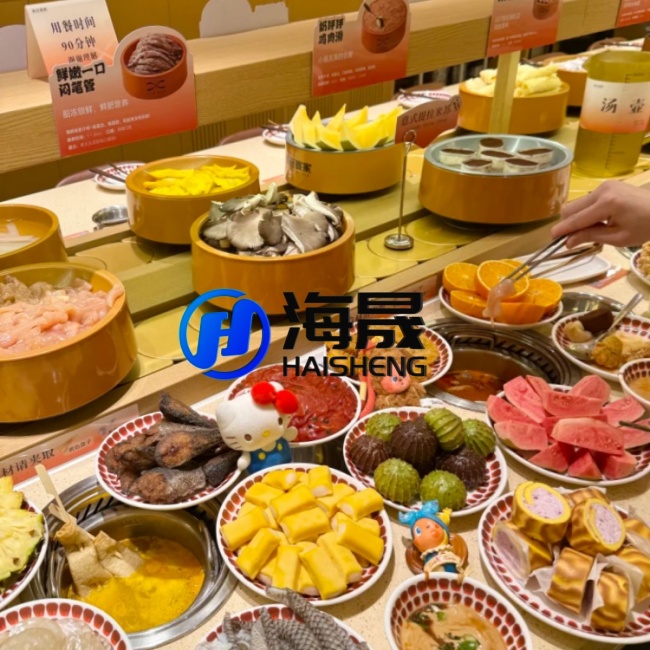
1. Re-engineering the Front-of-House Workflow: From “People Running” to “Smarter Running”
In a traditional hot pot restaurant, delivery tasks occupy roughly 40% of a server’s time. That’s 40% of your labour budget spent on moving plates from point A to point B—a purely mechanical task that adds little to the customer experience.
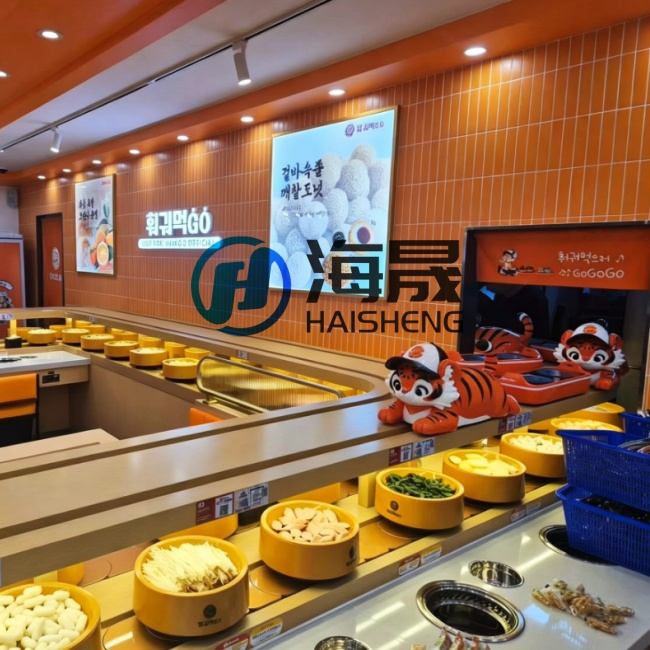
HaiSheng’s system changes that equation. Through a dual-track design, the rotating hot pot conveyor belt equipment separates delivery into two distinct channels:
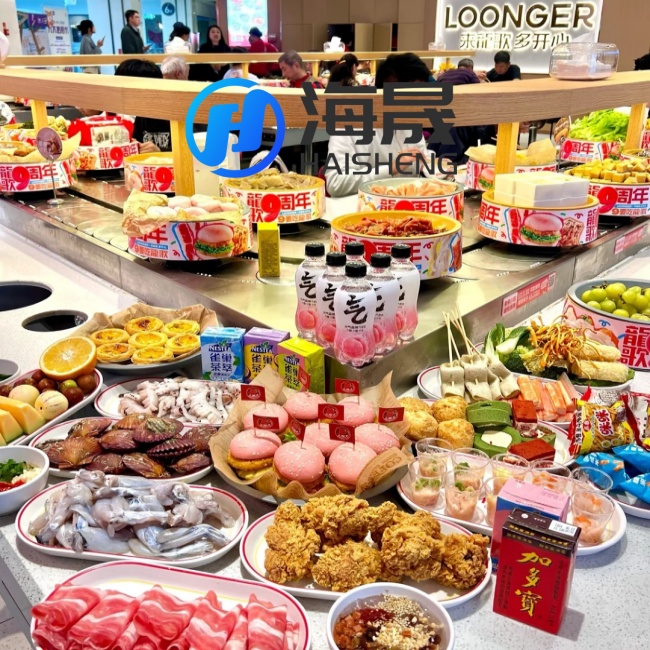
- Lower-level rotating belt: Handles high-frequency, self-service items such as vegetables, tofu, noodles and common proteins. Customers simply pick what they want as the belt glides past.
- Upper-level express delivery track: Handles point-to-point delivery of ordered items. Customers place orders via tablet, and the system sends the dishes directly to their table via an express lane—no servers needed.
The impact is immediate and measurable. Servers are no longer weaving through crowded aisles with trays. Instead, they focus on higher-value tasks—broth management, guest interaction, handling special requests, and maintaining service quality during peak hours. Restaurants already using the HaiSheng system report a reduction of 2 to 3 FOH staff per location, with customer satisfaction scores showing no decline—and, in many cases, measurable improvement.
2. Turning New Hires into Productive Team Members—Fast
High turnover in the restaurant industry isn’t just a staffing problem. It’s a training problem. In the US, server and bartender roles turn over at 90–120% annually, with median tenure sitting at just six months. Every departure means a new hire who needs to learn table layouts, delivery protocols, kitchen coordination—the whole playbook.
HaiSheng’s intelligent rotating system short-circuits this cycle. By standardising and automating the delivery process, the system reduces the experience required to be productive. New hires no longer need to memorise table numbers, worry about carrying heavy trays through narrow aisles, or scramble during busy periods. The process is simple: kitchen staff load prepared dishes onto the delivery track; the system handles the rest.
For multi-unit operators, this “de-skilling” of the delivery role is transformative. Training time shortens. Consistency across locations improves. And the business becomes less dependent on finding and keeping highly experienced FOH staff—arguably one of the hardest positions to fill in the current labour market. (Restaurant turnover rates have improved from their pandemic peaks, but remain significantly elevated compared to the all-sector average of 47%. In quick-service and fast-casual segments, annual turnover still exceeds 100%.)
3. Peak Hours Without Peak Headcount
For any restaurant owner, the math is maddening. Staff for the weekend dinner rush, and you’re overstaffed on Tuesday lunch. Staff for the average, and you’re understaffed when it matters most.
HaiSheng’s system solves this with elastic capacity. During peak hours—think Friday and Saturday evenings—the rotating hot pot conveyor belt can be run at full capacity, shouldering the majority of delivery work. During slower periods, the system can be scaled back or partially shut down, conserving energy and reducing wear. This flexibility means restaurants no longer need to carry an expensive peak-hour crew that sits idle 60% of the week.
Data from operators using HaiSheng equipment shows meaningful operational improvements:
Average customer wait times reduced by 5–8 minutes during peak periods
Table turnover rates improved by 15% or more
Labour cost as a percentage of revenue fell by 5–8 percentage points, with several operators moving from 30–35% of revenue down to the 22–26% range
These aren’t marginal gains. In a segment where every percentage point of margin matters, these shifts go straight to the bottom line.
4. From Cost Centre to Smart Investment: The ROI Case for Automation
Equipment purchases face one question from any restaurant owner: How fast do I get my money back?
Take a mid-sized hot pot restaurant with approximately 100 seats as an example. After adopting the HaiSheng intelligent rotating system, front-of-house staffing can typically be reduced by 2–3 positions. Based on an estimated fully-loaded annual cost of US 50,000–60,000 per employee, this translates to annual savings of US 100,000–180,000.
Add to that:
Increased table turns (more guests served per hour)
Reduced plate breakage and food waste (automated delivery is gentler and more consistent)
Lower training costs (faster onboarding for new hires)
And the total annual benefit often lands in the range of US$ 200,000–300,000 per location.
The upfront investment in a HaiSheng rotating hot pot conveyor belt system is typically recovered in 12 to 24 months. After that, every dollar saved—every labour hour not spent on delivery—drops directly to net profit. By this measure, automation is not an expense. It is one of the highest-return investments a hot pot operator can make.
5. The Global Market Context: Why Now Is the Time to Act
Data speaks volumes. The global market size of rotating sushi and conveyor belt systems stood at approximately 365 million US dollars in 2024, and is projected to reach 501 million US dollars by 2031, with a compound annual growth rate (CAGR) of 4.7%.
The rotating hot pot equipment market boasts an even faster growth rate. Its market value is expected to rise from 1.85 billion US dollars in 2025 to nearly 4 billion US dollars by 2034, registering a compound annual growth rate of 8.8%.
More importantly, the adoption of conveyor-based automation is rapidly accelerating across Western markets. In the US, Kura Revolving Sushi Bar—the nation’s largest revolving sushi chain—is expanding aggressively, with a new Florida location opening in April 2026 and additional sites planned across the country. In New Jersey, the Shinjuku Station revolving sushi chain opened its first location in April 2025 and now has four more locations “coming soon”. In South Carolina, Revolving Sushi Kingdom is bringing animal-shaped delivery trains and automated conveyor technology to Mount Pleasant Towne Centre.
The message for hot pot operators is clear: customers are already embracing automated dining formats, and early-mover advantages are real. The question is no longer whether to adopt smart delivery systems, but when—and how soon before your competitors do.
Conclusion: Let Machines Handle the Repetitive Work. Let People Do What They Do Best.
The restaurant industry is not suffering from a shortage of good people. It is suffering from a surplus of repetitive, low-value tasks that drain those good people of time and energy. The industry is quietly rebalancing itself—and automation is at the centre of that shift. From AI drive-thru ordering to robot runners to conveyor-based delivery, the smartest operators are learning that technology doesn’t replace people. It amplifies them.
HaiSheng Intelligent Technology has spent 16 years building exactly this kind of amplification. By integrating intelligent delivery systems with rotating hot pot conveyor belt equipment, the company helps restaurants do more with less: fewer staff, lower costs, more consistent service, and stronger financial performance.
If your hot pot restaurant is tired of “help wanted” signs and endless recruiting cycles, HaiSheng offers a different answer. Not a band-aid. Not a quick fix. A smarter way to run a restaurant.