

I. Global Conveyor Belt Sushi Market: Unprecedented Growth
The conveyor belt sushi industry is experiencing a remarkable global expansion. According to Emergen Research, the global conveyor belt sushi market was valued at USD 8.24 billion in 2025 and is expected to register a revenue CAGR of 9.1% through 2035, reaching an estimated USD 19.67 billion. QYResearch reports that the global Conveyor Belt Sushi market was estimated at US3.65billionin2024andisforecasttoreachUS3.65billionin2024andisforecasttoreachUS 5.01 billion by 2031.
This growth is not confined to Asia. While the market remains concentrated in Japan, China, South Korea, and Taiwan, urban centers in North America are seeing rapidly increasing adoption. Conveyor belt sushi restaurants use automated belt systems, touch panel ordering, and high table turnover models to serve sushi with lower labor intensity than conventional dine-in formats.
Japan External Trade Organization data shows overseas expansion of Japanese restaurant chains has accelerated over the last five years, particularly across Southeast Asia and the United States. Leading chains are racing to capture international market share:
- Sushiro aims to grow its overseas restaurant count to 320 by 2026, up from 182 in the previous year. Foreign markets are expected to account for 35% of revenue by fiscal year 2026. In the nine months ended June 2025, overseas operations generated nearly half of operating profit despite contributing just 30% of revenue.
- Kura Sushi USA targets 20% annual store growth in the United States, with locations expected to surpass 100 and a long-term goal of approximately 300 restaurants. The company plans to open 16 additional restaurants in fiscal 2026, sustaining an annual growth rate above 20%.
- Hamazushi operates more than 700 locations globally.
- The Sushi Restaurants Market as a whole is projected to grow from USD 9.61 billion in 2024 to USD 12.84 billion by 2030 at a CAGR of 4.94%.
As these chains expand into new territories, they face a common challenge: maintaining consistent quality, service efficiency, and operational standards across hundreds of locations. This is where reliable Commercial Sushi Fixed-Point Conveyor Belt Equipment becomes essential.
II. The Shift Toward Smart, Automated Sushi Equipment
Urban foodservice operators are adopting conveyor belt sushi formats because they reduce front-of-house labor requirements while increasing table turnover rates in high-rent commercial districts. Automated plate delivery, touchscreen ordering, and centralized kitchen preparation allow restaurants to serve more customers with fewer service staff. Japan's Ministry of Health, Labour and Welfare reported continued pressure on hospitality labor availability, encouraging restaurant chains to expand semi-automated formats.
Consumer preference for experiential dining is also increasing adoption, particularly among younger customers seeking quick-service concepts with entertainment value and visible food preparation. In April 2025, Kura Sushi USA announced expansion plans for additional technology-enabled restaurants across major metropolitan markets with upgraded express belt delivery systems.
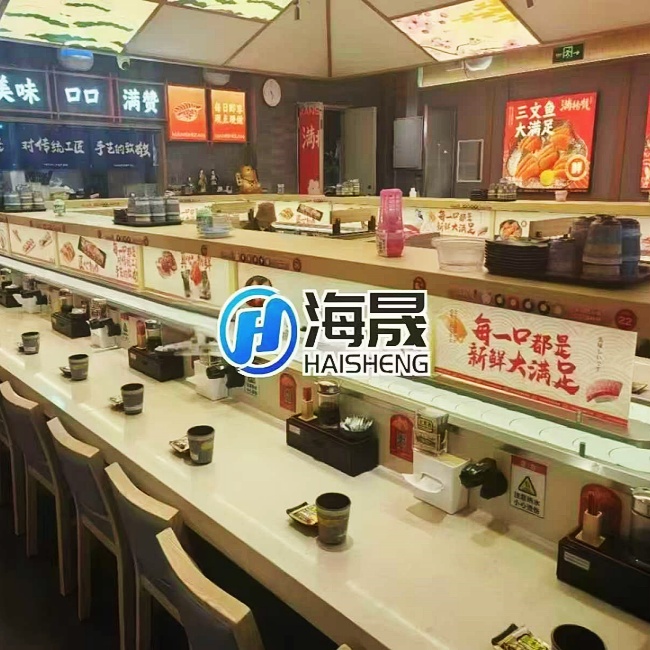
HaiSheng Intelligent Technology Co., Ltd. has been at the forefront of this transformation. For 16 years, the company has manufactured rotating hotpot equipment, conveyor belt sushi systems, Sushi Fixed-Point Conveyor Belt Equipment, sushi machines, fryers, grills, and complete back-of-house solutions. With a 10,000-square-meter smart factory and an engineering team of over 100 professionals, HaiSheng delivers Commercial Sushi Fixed-Point Conveyor Belt Equipment that meets the demands of today's most sophisticated global restaurant operations.
III. Smart Track Delivery: Replacing Labor with Technology
HaiSheng's Commercial Sushi Fixed-Point Conveyor Belt Equipment can be integrated with variable-track intelligent food delivery systems — a technology that is reshaping the sushi dining experience.
HaiSheng's Commercial Sushi Fixed-Point Conveyor Belt Equipment can be integrated with variable-track intelligent food delivery systems — a technology that is reshaping the sushi dining experience.
Precision Navigation and Efficiency. The variable-track system combines advanced track-switching with conveyance technology, enabling smooth navigation through curves and intersecting paths. The automatic routing system calculates the optimal delivery route based on the order's destination, significantly improving overall work efficiency. The delivery platforms are engineered with anti-slip and anti-tilt features, with protective guards that prevent dish displacement during transport. The power control system ensures smooth starts, stops, and steering, minimizing vibration and preventing spillage.
Adaptability to Complex Environments. For restaurant operators concerned about uneven flooring or complex layouts, HaiSheng's systems can be calibrated to perform reliably across different surface types, maintaining stable operation even in challenging settings. The system's intelligent error-correction capabilities allow vehicles to identify and avoid obstacles, reroute automatically, and recover from unexpected interruptions.
Hygiene and Maintenance. The conveying channels and load platforms are designed for easy regular cleaning, removing residual food debris and odour molecules. Built-in ventilation units promote air circulation and keep the internal environment fresh, minimizing flavour transfer between dishes.
Hygiene and Maintenance. The conveying channels and load platforms are designed for easy regular cleaning, removing residual food debris and odour molecules. Built-in ventilation units promote air circulation and keep the internal environment fresh, minimizing flavour transfer between dishes.
The entire system operates with minimal human contact. Customers order through tablets, and dishes are delivered via automated track-based vehicles — completely contactless. This approach not only reduces labor requirements but also provides an added layer of health safety for customers and staff alike.
IV. Engineering Excellence: Built for Global Standards
Beyond smart technology, HaiSheng's Commercial Sushi Fixed-Point Conveyor Belt Equipment is engineered for durability, reliability, and international compliance.
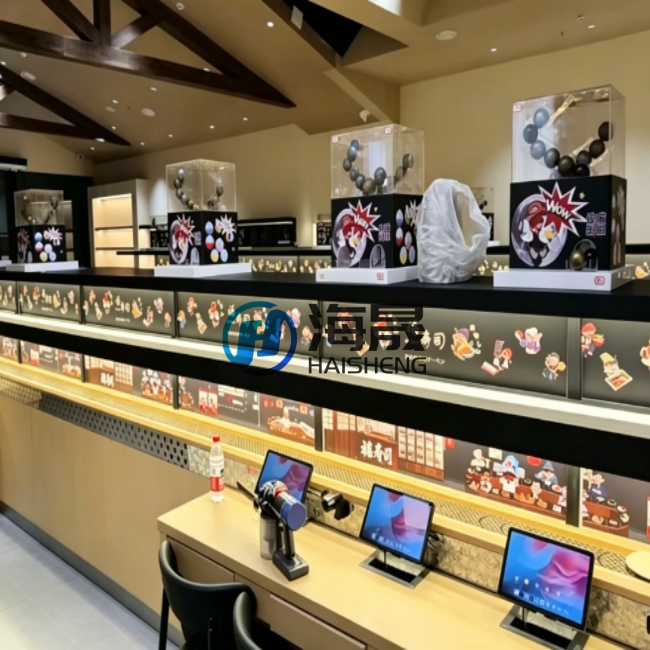
Twin-Layer Stabilized Frame Structure. Adopting Japanese manufacturing craftsmanship with continuous engineering improvements, the twin-layer frame provides exceptional structural integrity that minimizes vibration and ensures consistent operation over extended periods. Even when the conveyor belt system exceeds 30 meters in total length, the equipment remains stable and smooth — effectively eliminating common issues such as vibration, abnormal noise, and chain jamming.
Acrylic Silent Chain. The rotating chain is made of premium acrylic silent material, delivering smooth, wear-resistant performance with minimal operational noise. Acrylic silent chains are widely recognized in the industry as a premium choice, offering quiet operation and aesthetic appeal with minimal post-installation maintenance issues. This is a critical advantage as noise control regulations for dining establishments become increasingly stringent across regions.
Adjustable Tension Mechanism. HaiSheng's proprietary adjustable tension device allows operators to flexibly adjust chain tightness according to actual usage conditions. This design effectively extends equipment service life and reduces maintenance costs, providing reliable assurance for long-term store operations.
Modular Design. The entire system is built on a modular architecture, with components manufactured in modules at the factory and assembled quickly on site. Installation timelines are significantly shortened compared to traditional methods. Should any section of the conveyor belt require repair, only the affected module needs to be replaced — without dismantling the entire line, allowing other seating areas to continue operating normally. This modular approach significantly reduces the time and labour costs associated with store expansion and maintenance.
V. Global Certifications and Worldwide Reach
HaiSheng's Commercial Sushi Fixed-Point Conveyor Belt Equipment holds CE certification for the European market, NSF certification for foodservice applications, and UL certification for electrical safety — ensuring compliance with the most stringent international safety and hygiene standards.
The company's products have been exported to more than 20 countries and regions, including the United States, Canada, Mexico, New Zealand, Australia, Malaysia, Thailand, France, the United Kingdom, Germany, Spain, and Portugal.
Whether you're opening your first location or expanding a global chain, HaiSheng provides the design, manufacturing, installation, and after-sales support you need to succeed in the rapidly growing global sushi market.