

The Industry Is at a Turning Point
The global rotating sushi market continues to expand, but the rules of the game have changed. What was once the standard simple open conveyor belt for ordinary sushi restaurants is gradually losing its competitive edge. Industry data show that orders for purely mechanical conveyor belts have declined significantly, while conveying systems integrated with intelligent ordering, fixed‑point delivery, and automated management have become a basic requirement for newly opened sushi restaurants.
What is driving this shift? Three major pressures: food safety, labor costs, and consumer expectations.In 2023, a series of “sushi terrorism” incidents severely damaged public trust. According to NHK reports, as many as 62% of Japanese consumers no longer trust open conveyor belts, and 45% have reduced their frequency of visits to rotating sushi restaurants. The problem is not limited to Japan – as recently as March 2026, multiple chain brands experienced consecutive food safety incidents, including rodents running on conveyor belts. Traditional open conveyor belts also force restaurants to prepare large quantities of sushi in advance, leading to enormous waste. At Genki Sushi alone, the annual value of ingredients discarded due to expiration of freshness reached ¥1.2 billion (approximately US$8 million). Meanwhile, the widespread labor shortage in the food service industry makes manual monitoring, restocking, and cleaning increasingly unsustainable.
The solution is clear: smarter, safer, and more efficient conveying systems that enhance customer experience while reducing waste and labor costs.
Engineering Advantages: Built for Performance and Durability
HaiSheng Intelligent Technology Co., Ltd. has 16 years of manufacturing experience in the food service machinery industry, operates a 10,000 m² specialized manufacturing plant, and employs a technical engineering team of over 100 professionals. The company provides one‑stop services from design and planning, R&D and manufacturing, production testing, to installation and maintenance, ensuring that every piece of equipment undergoes rigorous quality control from factory to operation.
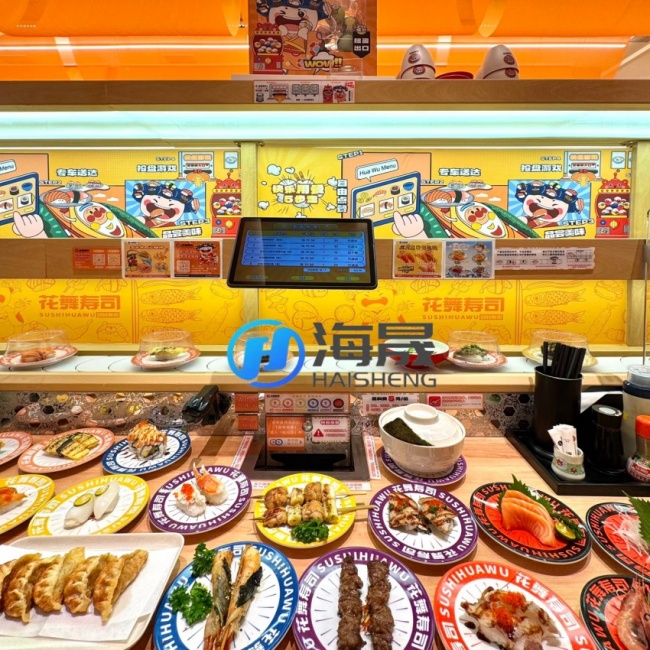
At the mechanical core of every HaiSheng system lies an optimised structural design developed in reference to Japanese manufacturing standards. The company has developed an upgraded dual‑layer stable frame structure that improves overall rigidity and reduces structural deformation under long‑term continuous operation. All conveyor sections follow a modular design principle, facilitating rapid on‑site assembly during store renovation and easy future layout adjustments.
Across both the rotating sushi and rotating hotpot product lines, each system is equipped with a self‑developed adjustable tension device. This device allows fine‑tuning of belt tension over time, reducing component wear, extending the overall service life of the system, and lowering routine maintenance and parts replacement costs for restaurant operations.
To create a quieter front‑of‑house dining atmosphere, all conveyor chains are made of high‑density acrylic silent material, featuring smoothness, wear resistance, and low operating noise, providing a more comfortable dining experience for customers.
Fixed‑Point Delivery + Rotating Mode: Synergy of the Dual‑Layer Intelligent Conveying System
In traditional rotating sushi restaurants, all dishes are displayed on a single rotating belt in continuous circulation, and customers passively wait for their desired items to come within reach. This model has three inherent shortcomings: first, popular dishes are often “intercepted” by customers at the front, leaving those at the back empty‑handed; second, pre‑prepared dishes that remain on the belt for too long suffer quality deterioration, and those exceeding the time limit must be discarded, causing ingredient waste; third, high‑value dishes ordered on‑demand share the same track as traditional rotating items, limiting delivery efficiency.
HaiSheng Intelligent’s dual‑layer intelligent conveying system – “lower rotating self‑service + upper fixed‑point delivery” – is an integrated solution designed precisely to address these pain points.
Lower rotating self‑service handles approximately 70% of regular menu items. Dishes are displayed on a traditional rotating belt, allowing customers to freely pick according to their preference. The dynamic rotating belt itself is visually appealing, creating the unique dining atmosphere of traditional rotating sushi, while eliminating the need for dedicated servers to guide or deliver items, effectively reducing staffing requirements.
Upper fixed‑point delivery, on the other hand, handles freshly prepared dishes ordered by customers via large screens or tablets. Dishes travel from the kitchen on a dedicated upper track at a speed significantly faster than the lower rotating belt, heading directly to the ordering seat and stopping precisely at the designated point. Customers no longer have to wait passively on the belt – they can simply order what they want via the large screen.
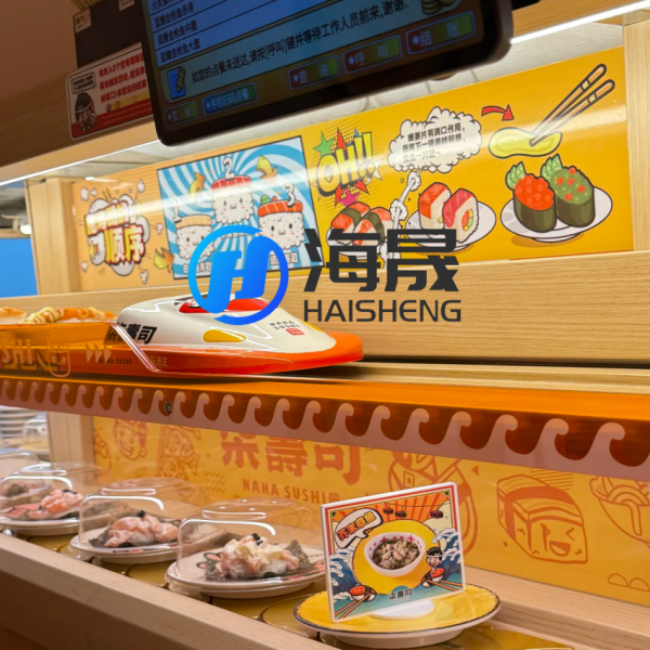
This “rotating display + fixed‑point delivery” dual‑layer model delivers five core operational advantages:
1. Higher efficiency, faster service. The intelligent fixed‑point delivery system enables direct transport from kitchen to table, eliminating the wait for belt circulation and ensuring that freshly ordered items arrive quickly. Application of track‑switching technology allows delivery cars to automatically select the optimal route based on track occupancy, further reducing delivery time.
2.Labor savings and cost optimisation. Regular dishes are presented on the rotating belt, while freshly ordered items are delivered via the fixed‑point conveyor; customers order and retrieve food by themselves, minimising manual intervention throughout the process. For overseas markets facing recruitment difficulties and high labour costs, this model offers clear practical benefits.
3.Reduced contact, enhanced safety. From kitchen exit to table arrival, dishes are transported entirely through dedicated tracks, greatly reducing direct contact between servers and food, as well as between customers and servers, lowering cross‑infection risks.
4.Less waste, better cost control. Ingredients no longer sit on the rotating belt for extended periods; made‑to‑order preparation eliminates losses from pre‑made dish waste. At the same time, order data is automatically aggregated, providing accurate references for kitchen stock preparation and menu adjustments, reducing ingredient waste at the source.
5.Data‑driven, refined management. The self‑service ordering system not only improves front‑end experience but also provides back‑end management with valuable data – which dishes have high order rates, which time periods see concentrated orders, and customer taste preferences. This data helps restaurants more accurately control stock volumes and optimise menu structures.
Intelligent Meal Delivery: An Extension of Hygienic and Efficient Service
In addition to fixed‑point conveyors, HaiSheng systems can also be equipped with track‑switching intelligent delivery car technology as a supplement to rotating and fixed‑point modes. After customers place orders via large screens or tablets, dishes are delivered directly to the table by intelligent delivery cars. These cars are capable of precise destination arrival, automatic turning, obstacle avoidance, and intelligent error correction. Advanced path‑planning algorithms compute optimal routes in real time, offering significantly higher efficiency than fixed‑track systems.
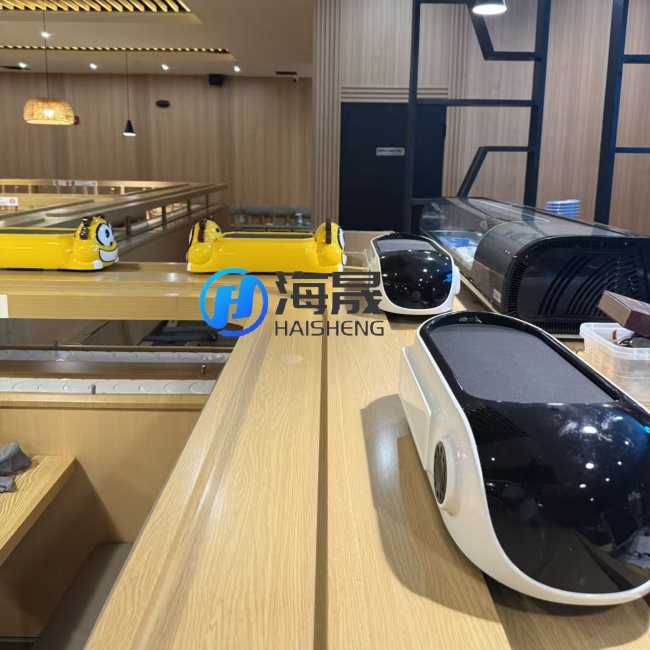
A single intelligent delivery car can complete 200‑300 delivery tasks within a 12‑hour shift, equivalent to the workload of two full‑time service staff. The system supports customised exterior designs – from trains to spaceship shapes – adding an element of fun to the dining experience. The entire delivery process involves no human contact, saving labour while safeguarding customer health and safety.
Intelligent delivery cars are designed with ride stability in mind – reinforced load platforms with anti‑slip and anti‑tilt features, protective fencing, optimised surface flatness to minimise tableware displacement, and proactive avoidance of obstacles and uneven sections to prevent abrupt acceleration, deceleration, or sharp turns. The power control system is also optimised to ensure smooth start‑stop and turning operations, reducing body vibration. Operating parameters are adjusted for different floor conditions to maintain stable movement even in complex scenarios, reducing spillage due to motion irregularities. Conveying paths and load platforms are regularly and thoroughly cleaned to remove food debris and odour molecules, and ventilation units are installed within the system to keep internal air fresh.
Export Standards: Triple International Certifications for HaiSheng Intelligent Equipment
For restaurants planning to enter the North American or European markets, equipment certification is a non‑negotiable requirement. Leveraging 16 years of manufacturing experience and a mature export system, HaiSheng Intelligent’s export‑standard sushi fixed‑point conveyor belt equipment is executed from material procurement to final testing in accordance with the highest standards of destination markets (such as the EU, North America, Australia/New Zealand, etc.).
The equipment holds three key international certifications:
EU CE Certification: Confirms that the equipment meets European safety, health, and environmental protection standards; a mandatory compliance mark for products entering the EU market. CE certification covers core requirements including electrical safety (Low Voltage Directive) and electromagnetic compatibility (EMC Directive).
US NSF Certification: The “gold standard” for food service equipment entering the North American market, signifying that the equipment’s hygienic design and material safety meet international public health standards. NSF/ANSI standards address not only material safety but also cleanability design and microbial control requirements.
US UL Certification: The benchmark for electrical safety in the North American market. HaiSheng’s sushi equipment has long held UL certification, paving the way for overseas exports.
In terms of specific export adaptability, HaiSheng’s export‑standard equipment features the following:
- Wide voltage compatibility: Supports 110–240V global voltages, with plugs customisable for target markets (US, European, UK standards, etc.) – plug‑and‑play.
- Modular quick‑assembly design: Tracks adopt a modular fast‑assembly structure, reducing sea freight volume by 30% and facilitating rapid installation and store deployment.
- High‑precision control: Equipment docking precision of ±1 cm, adjustable speed range of 0.5–1.8 m/min, with RFID recognition and LED status indicators.
- Multi‑language support: Provides English manuals, multilingual software interfaces, and overseas video guidance, lowering cross‑border communication and operational barriers.
With CE, NSF, and UL triple certifications and broad voltage adaptability, HaiSheng’s export‑standard sushi fixed‑point conveyor belt equipment has successfully entered more than 20 countries and regions, including the United States, Canada, Mexico, New Zealand, Australia, Malaysia, Thailand, France, the United Kingdom, Germany, Spain, and Portugal.
For investors planning to open sushi restaurants overseas, choosing equipment with export‑standard certifications means that the equipment can pass local food safety and electrical safety inspections without additional modification or secondary certification upon entry, significantly shortening the pre‑opening preparation cycle and reducing compliance risks.
A Comprehensive Ecosystem of Supporting Modules
In addition to the core conveying and delivery systems, HaiSheng offers a rich selection of supporting modules for sushi restaurants:
- Plate return and counting system – automatically collects empty plates and counts consumption, reducing front‑of‑house labour by up to 50%
- Hot water circulation system – supports automated cleaning processes
- Constant‑temperature freshness preservation system – continuously maintains ingredient quality (optional)
- Bridge system – connects different conveyor sections to accommodate complex traffic flows
- Freshness monitoring system – real‑time ingredient status tracking (optional)
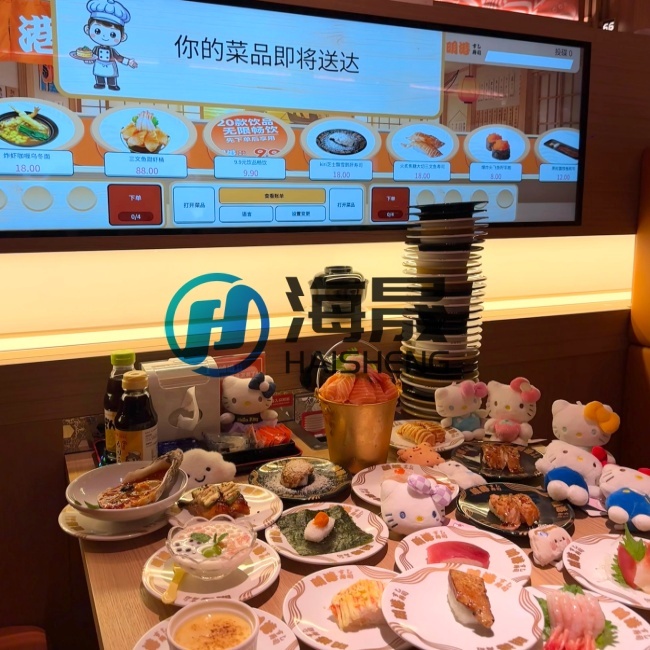
- Self‑service ordering large‑screen system – customers can order directly from their seats
- Automated checkout and settlement system – automatically calculates charges based on plate count or colour
For the rotating hotpot format, optional additions include track‑switching intelligent delivery cars, ambient lighting strips, overhead smoke extraction systems, and multifunctional drawers.
Tailor‑Made for Every Restaurant
Every restaurant is unique. HaiSheng offers fully customisable rotating sushi equipment configurations, capable of replicating the conveyor specifications of major international chain sushi brands – including the belt system used by Hamazushi, the layout of Sushiro, and the rotating equipment of Kura Sushi. Each project is custom‑designed based on the restaurant’s specific floor plan, customer capacity, and investment budget. Whether you are opening a new sushi outlet, expanding an existing chain, or upgrading current equipment, HaiSheng can provide a flexible solution that fits your needs.
Conclusion
The global sushi market is expanding rapidly, and the demands on conveying equipment are becoming increasingly sophisticated. From single open conveyor belts to the “rotating display + fixed‑point delivery” dual‑layer intelligent system, the industry’s direction is clear: efficiency must be higher, service must be more hygienic, and equipment must be more compliant.
HaiSheng Intelligent Technology Co., Ltd. introduces its export‑standard sushi fixed‑point conveyor belt equipment, which merges the visual appeal of traditional rotating belts with the precision and efficiency of fixed‑point direct delivery, complemented by CE, NSF, and UL international certifications and wide‑voltage adaptability. This offers overseas sushi restaurants a solution that retains traditional charm while meeting modern standards. 16 years of manufacturing experience, a 10,000 m² factory, and a technical team of over 100 professionals stand behind the reliability of every piece of equipment.