

The Industry Is Moving Away from Open Conveyors. HaiSheng Is Already There
The most consequential change in the rotating sushi sector is the retreat from full-loop open conveyors toward on-demand, point-to-point delivery. At FABEX Tokyo 2026, renovation orders for Japanese rotating sushi restaurants rose 41.7% year on year, and 72% of those projects adopted fixed-point sushi conveyor systems rather than traditional full-loop belts. More than 60% of newly opened sushi restaurants in Japan’s Kanto and Kansai regions now run smart rail delivery carts.
Three pressures are driving this: persistent labor shortages, front-of-house wages rising 7% to 12% annually, and consumer trust in open conveyors eroding after high-profile hygiene incidents. Sushiro has expanded its digital ordering and dedicated express-track model across roughly 170 stores worldwide, while Kura Sushi has deployed AI cameras on its belts to monitor abnormal plate handling. For restaurant operators outside Japan, the practical question is no longer whether to adopt fixed-point delivery, but which equipment partner can deliver it with the structural integrity, certifications, and customization flexibility that local markets demand.
HaiSheng’s answer is a dual-layer architecture that separates self-service display from targeted delivery—and it is built into the equipment, not retrofitted after the fact.
Structural Engineering That Solves the Real Failure Points of Rotating Sushi Equipment
The reliability of a Rotating Sushi Equipment system is determined less by its control software than by its frame, its chain, and its tension management. HaiSheng’s equipment uses a double-layer stable frame structure developed with Japanese manufacturing methods, distributing operating pressure across the frame so that plates remain stable even during peak-hour loading. The main body is constructed from 2.0 mm food-grade 304 stainless steel, with each load-bearing point rated to support up to 20 kg. Welded structural joints keep the system aligned under continuous operation, reducing the shaking and spillage that plague lighter-duty conveyor builds.
The conveyor chain itself is a high-toughness acrylic silent material, polished for smooth travel and paired with a low-noise drive motor that keeps operating sound at or below 50 dB—roughly 30% quieter than conventional systems. Guests can hold conversations without mechanical noise competing with the dining experience.
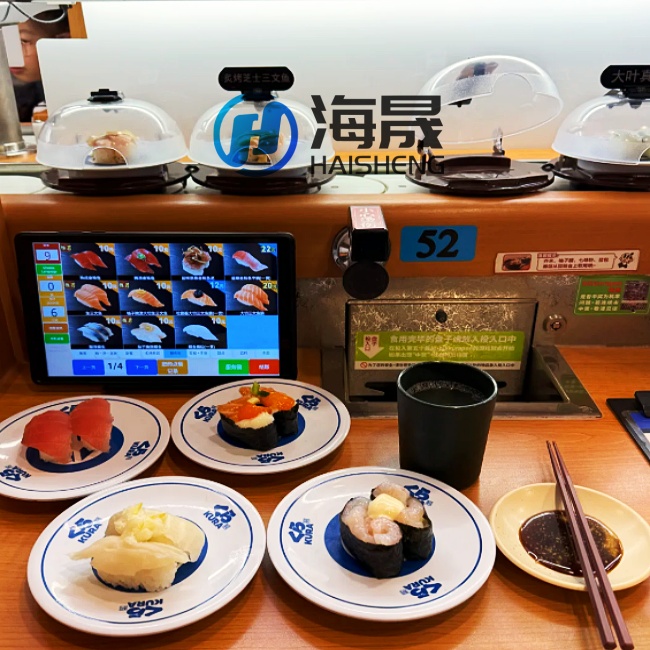
More consequential for lifecycle cost is HaiSheng’s independently developed adjustable tension device. Conveyor chains naturally stretch with use, and when tension is not corrected, jamming and uneven plate movement follow. HaiSheng’s tension mechanism compensates for that stretch, extending service life by approximately 25% and reducing annual maintenance costs by nearly 30%. The same adjustable-tension logic applies across HaiSheng’s rotating hot pot equipment, giving multi-format operators a consistent maintenance approach.
Modular Installation and Certification Readiness for International Markets
Overseas deployment fails for predictable reasons: installation complexity, voltage mismatch, and missing certifications. HaiSheng addresses each at the equipment-design stage. The modular structure allows tracks, supports, motors, and drive systems to be installed and replaced independently, raising installation efficiency by 40% and allowing circular, L-shaped, or U-shaped layouts without major structural rework. Equipment supports a wide voltage range of 110V–240V, covering North American, European, Australian, and Southeast Asian grid standards without external transformers.
On compliance, the Commercial Sushi Train Equipment and rotating conveyor systems hold EU CE, US NSF, and UL certifications, with full documentation supplied for customs and local food-safety inspections. That certification set is not a marketing footnote—it is what allows a restaurant operator in Texas, Bavaria, or New South Wales to specify HaiSheng equipment and clear regulatory review without redesigning the installation around compliance gaps.
The Intelligent Variable-Track Delivery System: Where Commercial Sushi Train Equipment Becomes a Service Platform
HaiSheng’s most differentiated contribution to Commercial Sushi Train Equipment is its variable-track intelligent food delivery cart system. Orders placed through a tablet or QR code are routed from the kitchen to the designated seat via an enclosed overhead track, with no open exposure and no cross-circulation of prepared food. The carts perform automatic lane changes, U-turns, and obstacle avoidance, calculating optimized routes in real time and lifting serving efficiency by more than 40% compared with full-conveyor circulation during peak periods.
The engineering details matter because they determine whether the system survives daily restaurant reality. The anti-spill design combines a non-slip platform with heightened protective baffles, so acceleration, deceleration, and turning do not produce soup overflow or plate displacement. The power control system is tuned for smooth start-stop and turning behavior, reducing vibration amplitude and allowing the carts to maintain stable posture on different floor conditions. A system that moves fast but spills is not efficiency—it is waste and complaint risk.
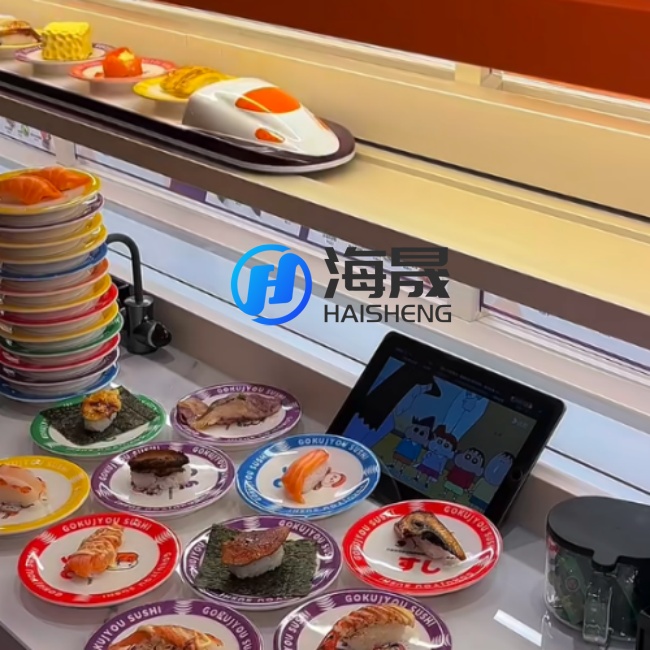
The delivery carts can be customized into Shinkansen train, spaceship, or brand-mascot shapes, turning the delivery system into a visible, shareable part of the dining experience rather than a hidden utility. For operators building a Kura-inspired format, HaiSheng integrates gashapon game machines, plate-return conveyors, and gamification elements into the same equipment ecosystem. For a Sushiro-style operation, the system pairs digital ordering with express upper-deck delivery and fixed-point sushi conveyor belts. Hamazushi-style belt configurations and Sushi Zanmai-inspired layouts are also available as customization references, with the final specification shaped by the restaurant’s floor plan, seating density, and investment budget.
The labor arithmetic is straightforward. A 150-seat restaurant using HaiSheng’s dual-layer system can reduce front-of-house staffing from 6–8 workers to 2–3, with monthly labor expense dropping from approximately US$52,000 to US$24,000 and a payback period of 10–12 months. A plate-return conveyor further removes the need for staff to circulate through the dining room collecting dishes, saving 1–2 labor positions per store while reducing cross-contamination.
A Manufacturer Built for Customization, Not Catalog Sales
HaiSheng’s 16-year production history and 10,000 m² factory support a level of customization that catalog suppliers cannot match. The company produces not only rotating sushi conveyors and fixed-point sushi belts but also sushi machines, fryers, griddles, and rotating hot pot equipment, providing a one-stop equipment scope that simplifies coordination for multi-unit restaurant groups. More than 100 technical engineers handle design planning, R&D, production testing, and installation and maintenance, so customization is a manufacturing process rather than a specification sheet.
That capability has translated into long-term supply relationships with chain restaurant groups including Sushiro-related formats, Wansui, Sushizou, Hemachi, Hezhixian, and Dalixi, and equipment operating in more than 20 countries and regions, including the United States, Canada, Mexico, New Zealand, Australia, Malaysia, Thailand, France, the United Kingdom, Germany, Spain, and Portugal. For operators evaluating Rotating Sushi Equipment and Commercial Sushi Train Equipment for a new store or a format upgrade, the relevant question is whether the manufacturer can translate a brand’s service logic—express delivery, gamified dining, self-service display, or a hybrid—into a certified, installable system. HaiSheng’s answer is built on structural stability, adjustable tension, modular installation, and a delivery architecture that is already aligned with where the global market is heading.