

FABEX Tokyo 2026 closed with a set of figures that restaurant equipment buyers could not ignore: renovation orders for Japanese revolving sushi stores rose 41.7% year on year, and 72% of those projects selected fixed-point conveyor belt equipment instead of traditional full-loop belts. Meanwhile, more than 60% of newly opened sushi restaurants in Japan’s Kanto and Kansai regions were equipped with smart rail delivery carts. These numbers reflect a structural change in how sushi restaurants operate—and what they now expect from their equipment suppliers.
The shift has been building since 2023, when a series of hygiene incidents in Japan severely damaged consumer trust in open conveyor belts. Industry research found that 62% of Japanese consumers no longer trusted exposed belts, and 45% reduced their visits to revolving sushi restaurants. Traditional full-loop belts also create a less visible problem: pre-made dishes circulate continuously whether or not anyone takes them, steadily losing freshness. At one major chain alone, ingredients discarded due to expired freshness reached ¥1.2 billion annually. The equipment logic is changing from “making plates move” to “delivering the right dish to the right seat at the right time.”
Engineering the Response: Structure and Chain Design
HaiSheng Intelligent Technology Co., Ltd. has spent 16 years manufacturing rotating hot pot equipment and Rotating Sushi Equipment, operating a 10,000-square-meter production facility with a technical engineering team of over 100 specialists. The company’s response to the fixed-point delivery trend is grounded in mechanical reliability first.
Every Automatic Revolving Sushi Conveyor System from HaiSheng uses an upgraded dual-layer stable frame structure developed with reference to Japanese manufacturing standards. The main frame is built from thickened 304 stainless steel, maintaining dimensional stability under continuous high-frequency operation. The modular design principle applied across all conveyor sections shortens on-site assembly time during store fit-out and allows layout adjustments after opening without replacing the entire system.
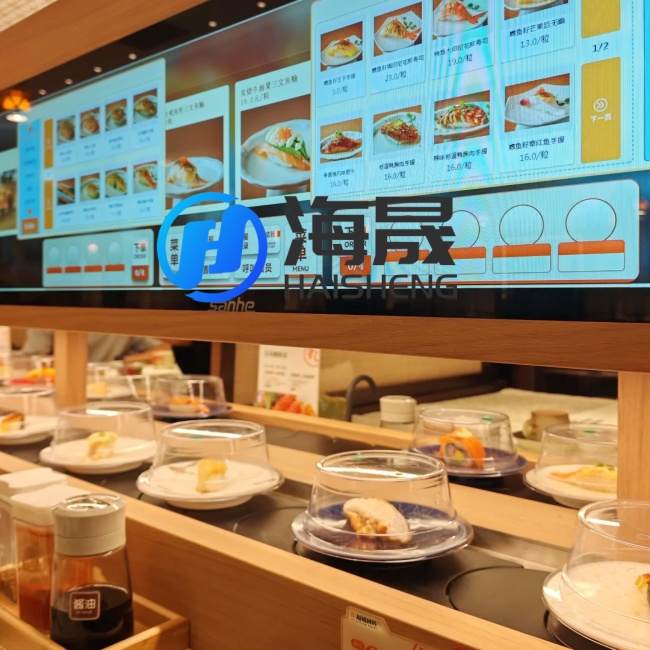
The conveyor chain itself uses high-density acrylic silent material rather than traditional metal chains, balancing smooth glide, abrasion resistance, and low operational noise in the front-of-house dining area. More importantly for long-term maintenance, both the rotating sushi and rotating hot pot lines are equipped with an independently developed adjustable tensioning device. Operators can fine-tune belt tension as components settle over time, slowing chain aging and extending the system’s service life while reducing recurring parts-replacement costs.
Fixed-Point Delivery and Variable-Track Smart Carts
The company’s Export Standard Rotating Sushi Conveyor Equipment is designed around a dual-layer logic: a lower rotating layer for the traditional self-selection experience, and an upper fixed-point delivery track for ordered items. When a dish is completed in the kitchen, it travels directly to the designated table exit without passing other seats, eliminating the food loss caused by empty circulation. A freshness detection system tracks delivery time for each dish in real time; if an item exceeds its preset window, the system prompts staff to remove it, helping keep waste below 3%.
For restaurants with irregular floor plans, multiple dining zones, or long distances between kitchen and seating, HaiSheng offers a variable-track intelligent delivery cart system. The cart combines track-switching and conveyor technology to perform precise delivery, turns, obstacle avoidance, and automatic error correction. A route calculation system determines the optimal delivery path based on destination, improving efficiency compared with fixed-track systems. The carrying platform incorporates anti-slip and anti-tilt features—raised guardrails and optimized surface flatness reduce utensil displacement during movement. Power control is tuned to smooth start-stop and turning behavior, lowering vibration and reducing spillage risk. Parameters can be adjusted for different floor conditions, maintaining stable operation in complex environments.
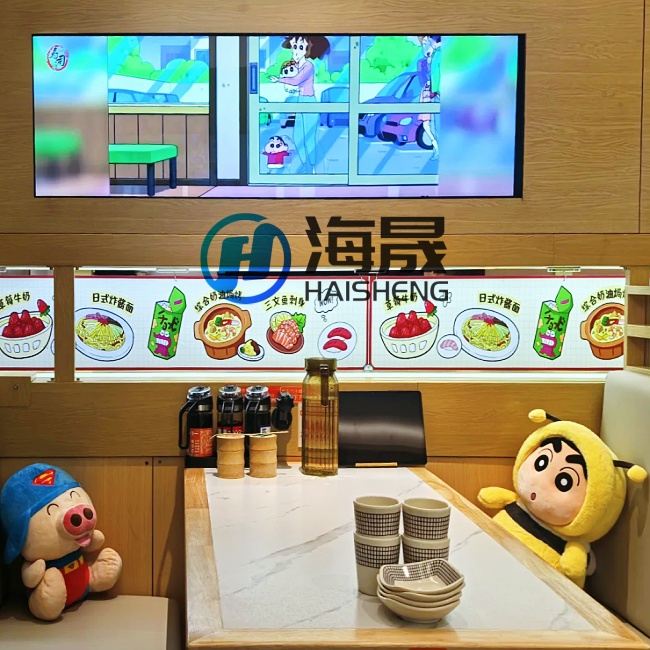
The cart’s appearance is customizable—train, spacecraft, or branded IP characters—adding a visual and interactive element that standard belt systems cannot provide. An intelligent tablet ordering flow completes the experience: guests place orders on a screen, and the cart delivers without staff contact, reducing front-of-house labor needs while addressing hygiene expectations.
Hygiene, Modularity, and Certification for Export Markets
Beyond core conveying mechanics, HaiSheng’s Rotating Sushi Equipment supports over ten optional intelligent modules: temperature-controlled freshness systems for raw fish and rice, plate return and automatic counting units, capsule toy game machines, cross-bridge transfer tracks, self-ordering touchscreens, and automated checkout terminals. Semi-enclosed or enclosed track designs further protect dishes during transit, an advantage for restaurants targeting premium hygiene positioning.
For restaurant groups expanding across multiple countries, the company holds EU CE, US NSF, and UL certifications, with full documentation supplied to satisfy catering authority inspections and customs clearance requirements in Europe, North America, and Oceania. The company exports to more than 20 countries and regions, including the United States, Canada, Mexico, New Zealand, Australia, Malaysia, Thailand, France, the United Kingdom, Germany, Spain, and Portugal. Long-term cooperative partners include established chain brands such as Xinyifan, Wansui, Sushi Jiang, Heting, Hezhixian, and Dalixi, alongside Japanese cuisine brands in overseas markets.
Customization covers the major format references restaurant investors ask for: Hamazushi-style belt systems, Sushiro-style layouts, Kura-style revolving setups with gamification elements, and Sushi Craftsman-style configurations. Each project is adjusted to the specific floor plan, passenger flow, and investment budget of the venue. For a 150-seat restaurant, the operational data behind these systems show monthly labor expense dropping from approximately USD 52,000 to USD 24,000, with a payback period ranging from 10 to 12 months.
As the global revolving sushi market moves toward an estimated USD 5.34 billion by 2032, the equipment decisions restaurant operators make today will determine whether their venues can compete on freshness, labor efficiency, and guest experience simultaneously. HaiSheng Intelligent Technology’s 16-year manufacturing background and full one-stop service—design planning, R&D, production testing, installation, and maintenance—position it as a supplier built for that transition.