

From Conveyor Belts to Smart Tracks: HaiSheng Intelligent Technology Leads the Global Sushi Equipment Upgrade
The revolving sushi industry has reached a turning point. According to exhibition data released at FABEX Tokyo 2026, refurbishment orders for revolving sushi restaurants in Japan increased 41.7% year over year, with 72% of projects adopting point-to-point sushi conveyor equipment rather than traditional full-loop conveyor belts. Meanwhile, more than 60% of newly opened sushi restaurants in Japan's Kanto and Kansai regions are equipped with smart rail delivery carts. This is not merely an equipment upgrade; it represents a fundamental shift in the operating logic of sushi restaurants—from "continuous circulation of dishes" to "precise on-demand delivery."
For restaurant operators and investors around the world evaluating Rotating Sushi Equipment, understanding this structural change is crucial. Traditional full-loop conveyor belts are simple in principle: sushi is placed on the belt and circulates throughout the restaurant until a customer takes it or it is discarded. A piece of sushi may travel for tens of minutes, steadily declining in freshness, and is ultimately thrown away. The 2023 Japanese sushi industry incident further intensified consumers' concerns about hygiene on open conveyor belts, prompting major chain brands to reconsider how food is presented to customers.
Sushiro was among the first major chains to pivot, launching "Express Lane" delivery and a digital conveyor experience called Digiro, replacing traditional physical conveyor belts with on-demand delivery and interactive touchscreen ordering. Hama-Sushi adopted a two-tier conveyor system, with dishes delivered on two levels and stopping directly in front of customers after ordering, effectively reducing food waste and improving operational efficiency. Kura Sushi, known for its "dining entertainment" model, retains a two-tier conveyor system, including a rotating conveyor belt and an Express Belt for made-to-order dishes; its patented Mr. Fresh food safety cover uses RFID technology to monitor freshness.
The common thread among these industry leaders is clear: the core value of sushi equipment is no longer just "making plates move," but "delivering the right dish to the right seat at the right time."
How HaiSheng Intelligent Technology Addresses the Industry's Core Challenges
HaiSheng Intelligent Technology Co., Ltd. is headquartered in Guangdong, China, and has spent 16 years manufacturing rotating hot pot equipment, Rotating Sushi Equipment, point-to-point sushi conveyor equipment, sushi machines, fryers, griddles, and complete back-of-house equipment. The company operates a 10,000-square-meter manufacturing plant and has a team of more than 100 technical engineers, providing one-stop services including design planning, R&D and manufacturing, production testing, and installation and maintenance.
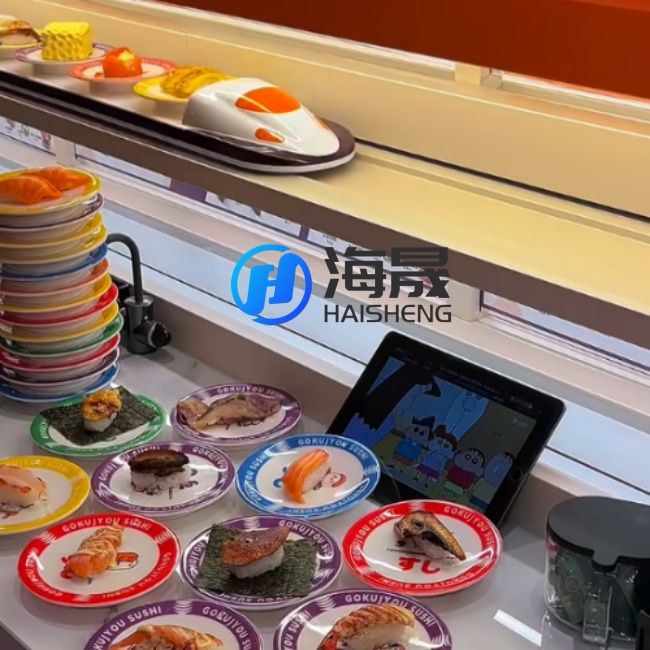
The key to HaiSheng's Rotating Sushi Equipment standing out in an increasingly competitive global market lies in its engineering foundation. The equipment adopts a double-layer stabilized frame structure, combining Japanese craftsmanship standards with innovative structural upgrades to ensure long-term resistance to deformation under high-frequency continuous operation. The entire system uses a standardized modular structure, allowing each functional unit to be independently assembled, replaced, or adjusted, significantly simplifying container shipping and shortening on-site installation time for overseas restaurant projects.
This modular approach extends to key wear parts. The conveyor chain uses silent acrylic material rather than traditional metal links, balancing smooth operation, wear resistance, and quiet performance. White acrylic links offer high gloss, low weight, and excellent impact resistance, maintaining stable performance even when running 12 to 14 hours a day. Compared with PVC, acrylic has better wear resistance; compared with metal chains, it is lighter and easier to transport and install. Operating noise is far below the industry average, providing customers with a refined dining environment.
For restaurant operators focused on total cost of ownership, what matters more is that both the Rotating Sushi Equipment and rotating hot pot equipment are equipped with a self-developed adjustable tensioning device. This mechanism allows operators to fine-tune belt tension according to actual usage, keeping the equipment in optimal working condition and proactively extending its service life. Combined with wear-resistant silent acrylic chains, HaiSheng equipment can achieve a service life of more than 8 years, significantly outperforming traditional systems that experience a 30% drop in wear resistance after only three years of use.
Track-Switching Smart Delivery System: Precision, Safety, and Interaction
The most prominent innovation in HaiSheng's product line is the track-switching smart delivery cart system. Unlike traditional conveyor belts that only move in a fixed loop, track-switching delivery equipment is designed to assist delivery carts in achieving precise delivery, U-turns, obstacle avoidance, and intelligent error correction during the delivery process. The system combines advanced track-switching and conveying technology to improve delivery efficiency while strengthening the anti-slip and anti-tilt performance of the carrying platform. Through protective guards and optimized surface flatness, the platform reduces the displacement of tableware during movement and avoids obstacles and uneven sections in advance.
The track-switching system also optimizes the power control system, ensuring smooth operation of the robot during starts, stops, and turns, reducing body vibration and maintaining a stable operating posture even in complex floor environments. An automatic calculation system can determine the optimal delivery route based on delivery locations, significantly improving work efficiency. In daily operations, a smart delivery cart can complete 200 to 300 delivery tasks within a 12-hour shift, equivalent to the workload of two full-time servers.
From the customer experience perspective, the smart delivery cart's appearance can be customized into trains, spaceships, and other IP characters, adding fun to the dining process. This marks a meaningful departure from the monotonous rotating conveyor belt model of traditional sushi restaurants, introducing an advanced restaurant equipment system that brings unprecedented freshness and smart interaction to revolving sushi dining. Customers simply place orders on a smart tablet, and dishes are delivered by the smart rail cart. The entire process involves no human contact, saving substantial labor while also safeguarding customer health and safety.
Comprehensive System Integration: Beyond the Conveyor Belt Itself
HaiSheng's Rotating Sushi Equipment is a modular platform, not a single product. The Rotating Sushi Conveyor With Plate Return System can be configured with a variety of supporting modules to meet each restaurant's specific operational needs. These include gachapon machines, hot water systems, plate return systems, constant-temperature freshness preservation systems, bridge systems, freshness detection systems, automatic ordering large-screen systems, and automated checkout and settlement systems.
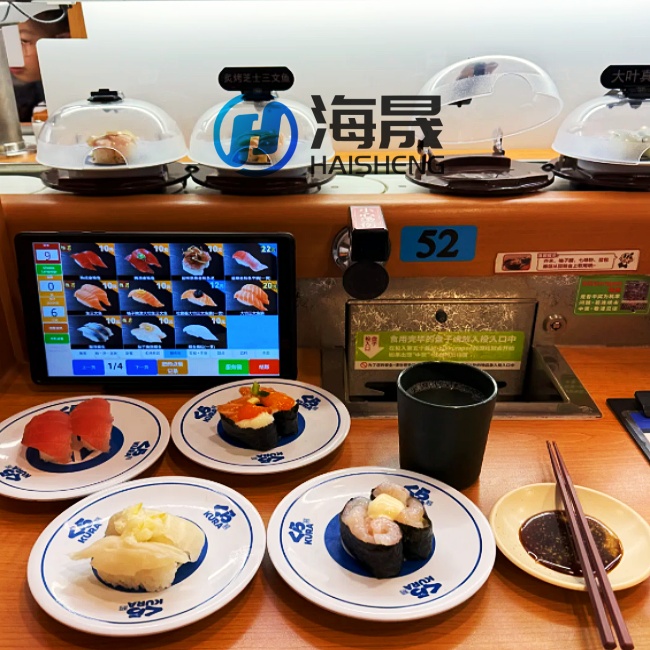
For rotating hot pot restaurants, HaiSheng offers track-switching smart delivery cart systems, ambient light strips, upward exhaust systems, and multifunctional drawers as supporting equipment. The versatility of this modular approach means that one HaiSheng system can serve the operational needs of both sushi restaurants and hot pot restaurants, providing restaurant groups with a unified equipment platform across different food service formats.
In terms of hygiene maintenance, the system is designed to support thorough cleaning of conveying channels, carrying platforms, and internal components, effectively removing residual food particles and odor molecules. The equipment system has a reasonably designed built-in ventilation and air exchange device that promotes air circulation, promptly discharges residual odors, keeps internal air fresh, and reduces the environmental conditions for cross-odor contamination.
Customization Capabilities and Global Market Coverage
HaiSheng provides comprehensive customized solutions based on restaurant needs, space structure, and investment budget. The company can supply Sushiro-style sushi belt equipment, Kura Sushi-style revolving sushi equipment, Hama-Sushi-style conveyor systems, and Sushi Sho-style equipment configurations. This flexibility enables chain brands to maintain operational consistency across multiple locations while adapting to the specific spatial constraints of individual restaurant sites.
All Rotating Sushi Equipment and Rotating Sushi Conveyor With Plate Return System products hold EU CE, US NSF, and UL certifications. These three qualifications meet EU and North American food safety and electrical regulations. Across the entire industry, fewer than 8% of equipment manufacturers hold all three certifications simultaneously, eliminating the risk of inspection failure for overseas restaurant owners and ensuring smooth market entry.
HaiSheng equipment is currently exported to more than 20 countries and regions, including the United States, Canada, Mexico, New Zealand, Australia, Malaysia, Thailand, France, the United Kingdom, Germany, Spain, and Portugal. The company has established long-term partnerships with Sushiro-style, Kura Sushi-style, and other major sushi and hot pot operators. For restaurant operators in North America, Europe, and Asia-Pacific seeking reliable Rotating Sushi Equipment with proven export compliance capabilities, HaiSheng offers factory-direct sales, eliminating middleman markups while maintaining full certification coverage.
The Road Ahead: Smart Restaurant Automation Becomes the New Standard
The 2026 Global Casual Dining Automation White Paper, released alongside FABEX Tokyo 2026, reports that major markets such as the United States, Canada, Germany, and Japan have faced restaurant industry labor shortages for five consecutive years, with front-line server costs rising 7% to 12% annually. For a typical mid-sized revolving sushi restaurant, introducing a point-to-point conveyor belt combined with a Shinkansen-style delivery system can reduce front-of-house staffing needs by more than 30%, improve delivery efficiency by 35%, and increase table turnover by 15% to 30%, with equipment investment paid back within 10 to 12 months.
Against this backdrop, HaiSheng Intelligent Technology continues to invest in R&D to ensure that its Rotating Sushi Equipment and Rotating Sushi Conveyor With Plate Return System remain at the forefront of the industry's technological evolution. The combination of Japanese-standard manufacturing processes, modular structural flexibility, comprehensive international certifications, and an extensive global service network makes the company a reliable partner for restaurant brands transitioning from traditional conveyor belt operations to smart point-to-point delivery systems.
For restaurant operators considering equipment upgrades or establishing a new revolving sushi concept, HaiSheng Intelligent Technology offers a complete product matrix and a proven track record in more than 20 international markets. The company's design planning, manufacturing, testing, and installation teams work directly with restaurant owners to develop customized Rotating Sushi Equipment solutions that meet their specific space, budget, and operational needs.