

I. From Hygiene Crisis to Industry Opportunity
In 2023, a 17‑year‑old boy in Japan filmed a prank video at a Sushiro restaurant – licking shared soy sauce bottles, drinking from shared teacups, and even smearing his saliva‑covered hands onto sushi on the conveyor belt. The video went viral across the internet, causing Sushiro's market value to plummet by 800 million RMB in a single day.
Cornered by the crisis, Sushiro launched a comprehensive overhaul: replacing all shared sauce bottles, installing transparent protective barriers, completely removing the public revolving counter, and fully implementing electronic ordering with dedicated track delivery. This crisis-forced overhaul turned into an opportunity for brand renewal – after the transformation, ingredient waste was reduced to nearly zero, serving efficiency doubled, and the menu expanded from over 100 items to more than 200. In 2024, Sushiro's annual revenue reached 301.7 billion yen (approximately 15 billion RMB), a year‑on‑year increase of 13.6%. Hamazushi, which followed a similar model upgrade, saw its profits surge by 35%.
This revolution, ignited by a hygiene crisis, has completely rewritten the rules of the revolving sushi industry.
II. The "Three Fatal Flaws" of Traditional Revolving Counters
The rise of smart delivery systems stems from the fundamental defects of traditional chain/belt‑driven revolving counters.
①Single point of failure risk: A central motor drives the entire chain – if either the motor or any part of the chain fails, the entire delivery line shuts down completely.
② The dilemma between speed and safety: Speeding up delivery causes plates to wobble and makes it difficult for customers to pick up items, forcing operators to maintain low speeds, which indirectly limits table turnover efficiency.
③ Virtually zero expansion flexibility: Once the revolving counter's length is set, it is difficult to adjust, and seating layout is rigidly constrained by the chain's path.
Labor shortages, high rents, and increasingly stringent hygiene requirements are driving restaurant operators worldwide to shift from "chain/belt‑driven" systems to a new generation of delivery architecture powered by independent robotic units.
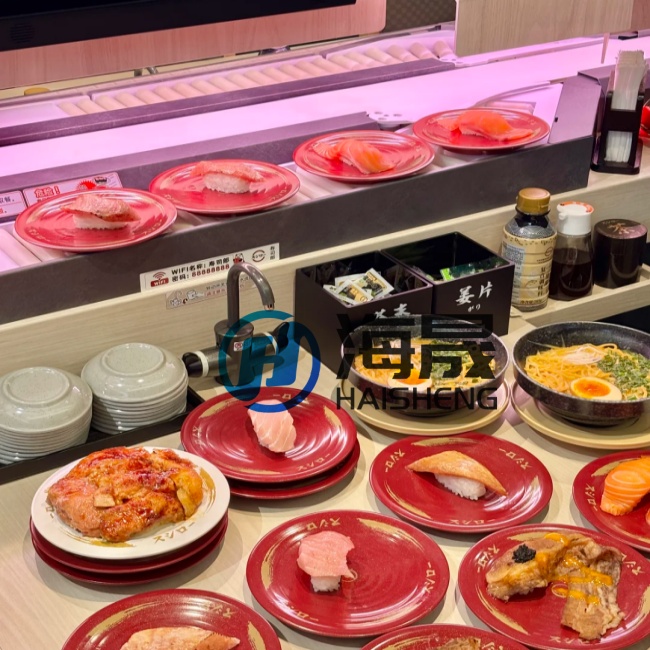
III. HaiSheng "Shinkansen" Smart Delivery System: Born to Lead the Change
In this revolution from "passive turntable" to "active delivery," Guangdong HaiSheng Intelligent Technology Co., Ltd. , with sixteen years of manufacturing expertise, has become a trusted partner in the global Rotating Sushi Equipment sector.
Manufacturing strength builds quality foundation. HaiSheng owns over 15,000 square meters of standardized production facilities, with an annual capacity of 1,000+ sets of various smart dining equipment. As an original factory, all equipment is supplied directly to purchasing clients, eliminating intermediaries. Standard models can be delivered within 7‑10 days, while customized orders ship in 15‑20 days. All factory‑shipped equipment holds multiple international certifications including CE, NSF (USA), and UL. Incorporating mature Japanese craftsmanship and a dual‑layer reinforced stainless steel frame, the equipment operates at below 30 decibels – far below the industry average.
What truly sets HaiSheng equipment apart is the systematic solution provided by the "Shinkansen" smart delivery system to industry pain points. This Automatic Revolving Sushi Conveyor System breaks through the limitations of traditional belt transmission, upgrading "passive rotation" to "active delivery."
The "single point of failure" issue of traditional revolving counters is completely eliminated in HaiSheng's architecture. Our intelligent dispatching system uses a distributed drive design – each delivery vehicle operates independently, so a single unit's malfunction does not affect overall operations. Launched in 2025, the smart scheduling system further optimizes delivery routes to effectively reduce track congestion. The automatic route‑calculation system plans the optimal path based on each delivery destination, avoiding the "one‑break‑all‑stop" disaster of traditional belt drives.
The anti‑slip and anti‑tilt design is also worth highlighting. To resolve the traditional trade‑off between "spills at high speed and low efficiency at slow speed," HaiSheng strengthens the carrying platform with protective barriers and optimizes surface flatness, significantly reducing dish displacement during movement. The system proactively identifies obstacles and uneven track sections, while the optimized power control system ensures smooth starts, stops, and turns, markedly reducing body vibration – even on sharp curves, spillage is effectively controlled. Operating parameters can be adjusted to suit different floor conditions, maintaining stable performance even in complex restaurant environments.
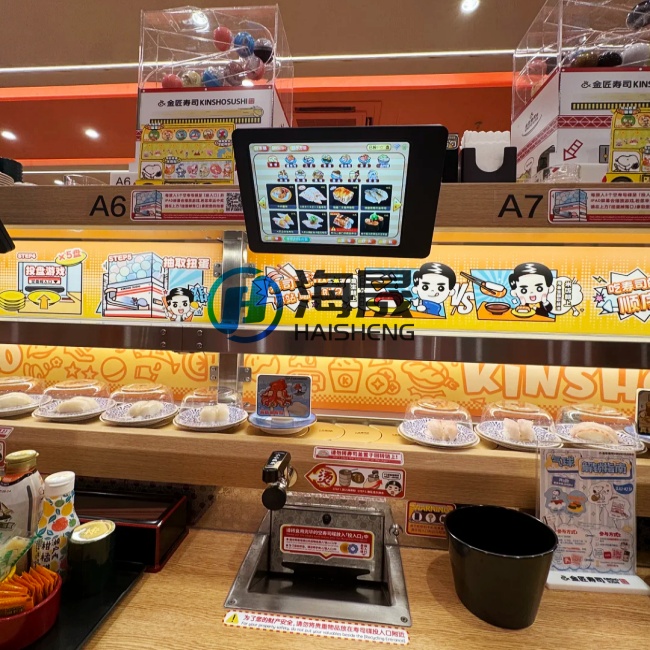
Hygiene assurance is systematically integrated into equipment design. The Sushiro incident of 2023 shows that food safety is a lifeline of the industry. HaiSheng incorporates proper ventilation units into its track delivery systems, promoting air circulation and promptly expelling residual odors to keep the internal atmosphere fresh, thereby reducing cross‑contamination at the source. The delivery channels and carrying platforms are made of easy‑to‑clean materials, and regular cleaning removes food debris and odor molecules. The entire process involves no human contact, saving labor while providing reliable health and safety protection for customers.
Beyond efficiency and safety, HaiSheng equally focuses on enhancing the dining experience. The smart delivery vehicles can be customized to resemble trains, spacecraft, or other IP characters, adding fun and visual appeal to the meal. After ordering via tablet, dishes are precisely delivered by track‑mounted vehicles, with capabilities for accurate stopping, automatic U‑turns, obstacle avoidance, and intelligent error correction. This dining method, which breaks away from the traditional revolving belt model, not only boosts the restaurant's technological appeal but also simplifies operational workflows.
From design planning to installation and maintenance, HaiSheng's team of over 100 technical engineers provides full‑service support, tailoring equipment solutions to each restaurant's spatial layout, investment budget, and brand positioning. Leading chain brands including Shin Yi Fan, Banzai, Sushi Sho, Wa Ting, He Zhi Xian, and Dali Xi have established long‑term partnerships with HaiSheng. Our products are exported to more than 30 countries and regions, including the United States, Canada, the United Kingdom, Germany, Australia, and Southeast Asia. Whether clients require standard Rotating Sushi Equipment or highly customized Automatic Revolving Sushi Conveyor Systems , HaiSheng offers one‑stop solutions from design to delivery.
IV. Conclusion
From Sushiro's hygiene crisis to the widespread adoption of the "Shinkansen" smart delivery system, the revolving sushi industry is undergoing a profound transformation. Traditional belt‑driven systems are giving way to smarter, more efficient, and more hygienic next‑generation products.
Guangdong HaiSheng Intelligent Technology Co., Ltd. , with its 15,000‑square‑meter manufacturing base, team of over 100 engineers, international certifications, and customer trust in more than 30 countries, provides restaurant operators with comprehensive solutions – from conventional revolving equipment to the "Shinkansen" smart delivery system. Whether you are opening a new location or upgrading an existing one, HaiSheng can tailor the most suitable equipment solution for you.