

Interactivity: The Plate Drop Is No Longer the End—It Is the Start of a Game
In a traditional conveyor sushi restaurant, a customer finishes a plate, leaves it near the edge of the table, and has no further connection to what happens next. The Rotating Sushi Conveyor With Plate Return System changes that relationship. Each seat has a dedicated plate-drop slot. When a customer inserts an empty plate, the system scans and counts it at the entry point, syncs the consumption data to the ordering tablet in real time, and updates the bill accordingly. The plate drop now has immediate feedback—customers can see how many plates they have eaten, and how many more they need before the next interaction.
What makes the interactivity real is the gachapon linkage. The system can be set by the store to trigger a game animation on the tablet after a certain number of plates have been inserted. When the customer wins, a physical capsule drops from the gachapon machine. For families and younger diners, this “eat—drop—play” rhythm breaks the meal into short feedback loops, turning plate return from a staff task into a step customers actively participate in. HaiSheng includes the gachapon machine as a companion module within the Rotating Sushi Conveyor With Plate Return System. Stores can decide whether to enable it and how many plates should trigger a play, rather than being locked into a fixed interactive format.
Interactivity also shows up in data visibility. Automatic counting replaces manual plate counting, and settlement data syncs with the ordering system. Customers gain more confidence in the bill, and the front desk reduces the explanation cost caused by plate-count disputes. The plate return system is therefore not just a device for “collecting plates”—it is a quiet but continuous exchange of information between the store and the customer.
Convenience: From the Drop Slot to the Kitchen, One Automatic Loop
For the interactive experience to work, the underlying return channel must be smooth enough. Empty plates in the Rotating Sushi Conveyor With Plate Return System are sent directly back to the rear kitchen through a water-circulation channel. This reduces how often front-of-house staff need to walk back and forth to clear plates, and it reduces the space occupied by empty plates piling up on tables. The drop slot is planned together with the conveyor track and seating circulation, so it is within easy reach for customers and staff do not need to weave between seats repeatedly to collect plates.
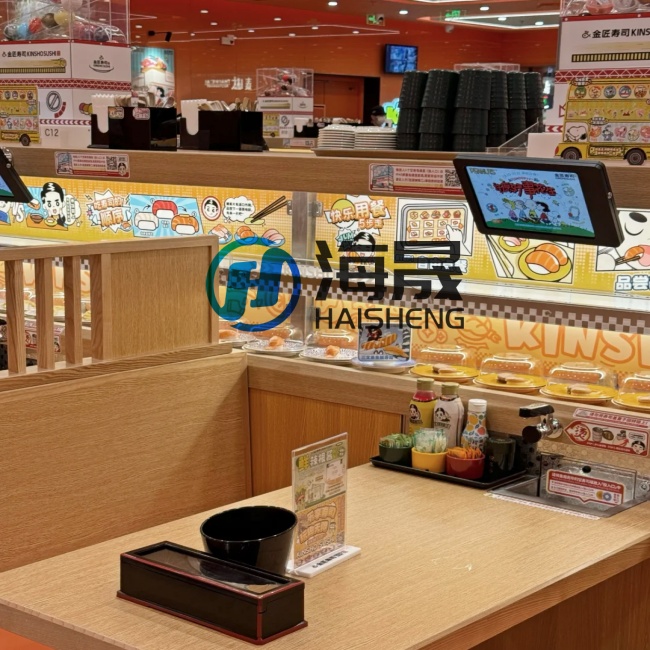
Convenience also appears on the maintenance side. HaiSheng uses an adjustable tension device on its Rotating Sushi Equipment. When the chain naturally loosens after long operation, staff can restore tension through the adjustment mechanism instead of waiting for the entire chain to be scrapped or calling for frequent repairs. The acrylic silent chain balances smoothness and wear resistance, reducing operating noise and wear on the track and sprockets. Modular design allows the track, supports and drive system to be installed and replaced independently. When a store adjusts its layout or performs partial maintenance, it does not need to overturn the entire system. For multi-store chains, these details turn equipment maintenance from sudden breakdowns into planned routine actions.
The system can also be paired with automatic ordering screens, automatic checkout and settlement, temperature-controlled freshness systems, hot water systems and bridge systems. Customers order on the tablet, and dishes arrive via the conveyor track or intelligent delivery cart. After the plate is inserted into the return slot, counting and recovery are completed. Ordering, delivery, return and settlement form one continuous chain. Stores can choose the depth of configuration based on their space structure and investment budget, rather than being tied to a fixed set of equipment.
Customization and Manufacturing Base: Making Interactivity and Convenience Work in Real Stores
Different brands have different interactive logic. HaiSheng can provide custom solutions based on restaurant needs, including sushi belt equipment comparable to Hamazushi, equipment comparable to Sushiro, Kura-style rotating sushi equipment and Sushizanmai-style sushi equipment. The Rotating Sushi Conveyor With Plate Return System can be aligned with a brand’s existing track format, seating layout and gachapon mechanism. Intelligent delivery carts can also be customized into train, spaceship or other IP shapes as an extension module for track delivery, adding a visual memory point to the dining experience.
On the manufacturing side, HaiSheng is supported by a 10,000-square-meter factory and a technical engineering team of more than 100 people, covering design planning, R&D and manufacturing, production testing, installation and maintenance. The equipment holds EU CE, US NSF and UL certifications. Products have entered more than 20 countries and regions, including the United States, Canada, Mexico, Australia, New Zealand, Malaysia, Thailand, France, the United Kingdom, Germany, Spain and Portugal. The company has also maintained long-term cooperation with chain restaurant brands such as New Ichiban, Wansui, Sushizanmai, Hemachi, Hezhixian and Dalixi. For stores evaluating Rotating Sushi Equipment, interactivity determines whether customers are willing to return plates, and convenience determines whether the store can reliably receive those plates—both rest on the same customizable and maintainable track system.