

How to Break the “Three High Costs” Dilemma in the Restaurant Industry? HaiSheng’s Three Key Strategies for Cost Reduction and Efficiency Improvement
The Rise of Solo Dining: Why Rotating Models Are Winning
According to industry research, China’s solo dining market exceeded RMB 800 billion in 2024 and is expected to surpass the trillion mark in 2025, with a CAGR of 22.3%.
Behind this growth lies a major shift in lifestyle and consumption habits among younger generations.
In fast-paced urban life, dining alone has become the norm. However, traditional dining formats are not well-suited for solo diners:
- Order too much → food waste
- Order too little → limited choices
- Social pressure from staff interactions
The rotating dining model perfectly solves these pain points.Customers sit by the conveyor belt, visually inspect food freshness and hygiene, and freely select dishes based on their preferences—achieving a true “take what you want” experience.
Variety, flexibility, and affordability form the core appeal of rotating dining for younger consumers.
First Strategy: Automation Cuts Labor Costs by 50%
Labor cost inflation remains one of the biggest pressures for restaurants. In North America, labor typically accounts for 30%–35% of revenue, and is highly sensitive to staffing shortages and peak-hour inefficiencies.
HaiSheng’s Rotating Hot Pot Conveyor Belt Equipment uses full-process automation to address these challenges:
- Conveyor systems replace manual food delivery
- Dishes are automatically transported to all seats
- Customers pick food directly—no ordering or serving required
A well-designed rotating or hybrid system shifts repetitive tasks—walking, waiting, delivering—from staff to machines.
As a result:
- Labor ratio can drop to 20%–25%
- Dependence on food runners reduced by 30%–40%
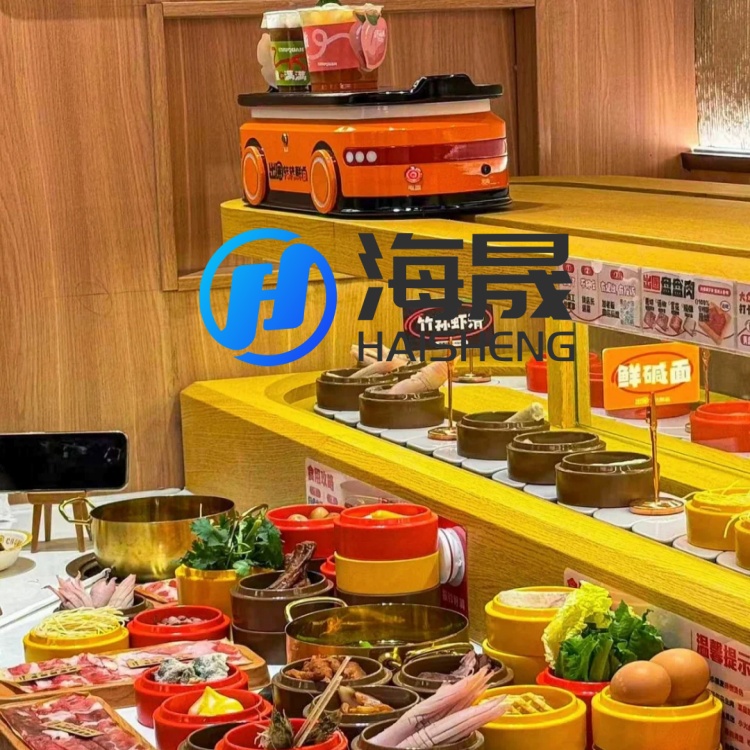
Additionally, HaiSheng’s intelligent track-changing delivery cart system offers:
- Precise delivery
- Automatic turning
- Obstacle avoidance
- Route correction
With a dual-mode system (lower conveyor + upper targeted delivery):
- 70% of dishes are self-service
- 30% are delivered directly
This reduces front-of-house staff by over 50%.For solo diners, this highly automated process—from seating to checkout—minimizes human interaction while significantly reducing labor costs.
Second Strategy: Smart Freshness Management Reduces Food Waste to 3%
Food waste is the second-largest cost burden for restaurant operations. In traditional buffet restaurants, food waste rates often exceed 10%, directly eroding profit margins.
HaiSheng’s Restaurant Rotating Hot Pot Conveyor Belt can be equipped with a freshness monitoring system and a constant-temperature preservation system, which track how long dishes remain on the conveyor in real time. When the preset time is exceeded, the system automatically alerts staff to remove the items, reducing food waste to below 3%, far lower than the industry average.
The system operates by embedding sensor chips beneath the conveyor belt to track the circulation time of each plate. When a dish remains on the belt longer than the preset duration (e.g., 30 minutes), the system automatically prompts staff to remove it, ensuring that customers always receive fresh food.
For hot pot applications, HaiSheng equipment also supports refrigerated conveyor tracks, enabling the safe transport of perishable items such as meat, seafood, and vegetables. Combined with a bridge system, the track length can be shortened during off-peak hours, reducing delivery distance and further enhancing food freshness.
In terms of hygiene management, HaiSheng has developed a scientific cleaning and maintenance system. Key components such as conveyor channels and load-bearing platforms are regularly and thoroughly cleaned to remove food residues and odor particles, preventing the buildup of unwanted smells inside the equipment. In addition, a well-designed ventilation system promotes air circulation, quickly expelling residual odors and maintaining a fresh internal environment, effectively reducing the risk of odor mixing.
Third Strategy: Visual Selling + Entertainment Experience Boosts Average Spending by 15%
The value of a rotating system goes beyond efficiency—it also lies in its ability to influence consumer behavior. The continuous movement of dishes, clear product presentation, and the feeling of “always available” naturally encourage impulse decisions and additional orders.
Many operators have observed a 10%–15% increase in average ticket size under the following conditions:
- Combining rotating systems with digital ordering
- Delivering limited-time or high-margin items via fast-track conveyors
- Replacing traditional “wait for staff recommendations” with dynamic visual presentation
HaiSheng fully understands this psychological mechanism and integrates multiple subtle yet powerful design features into its equipment:
Ambient Lighting System
The conveyor can be customized with color-changing lighting and ambient light strips. Whether it’s Japanese minimalism, Chinese elegance, industrial style, or trendy social-media aesthetics, the system seamlessly integrates with the restaurant’s interior design.
IP-Themed Delivery Carts
Smart delivery carts can be customized into creative IP designs such as trains or spaceships, adding fun and engagement to the dining experience. When a “food train” or “spacecraft” arrives at the table, it instantly sparks customers’ desire to take photos and share on social media.
Gachapon Game Interaction
The system supports optional capsule toy (gachapon) game features. Customers can participate by inserting used plates, significantly increasing dwell time and spending—especially among families and younger diners.
This “dining + entertainment” model boosts revenue without increasing food costs, further optimizing the return-on-investment cycle.
Full-Store Customization: Maximizing Space Efficiency with Tailored Solutions
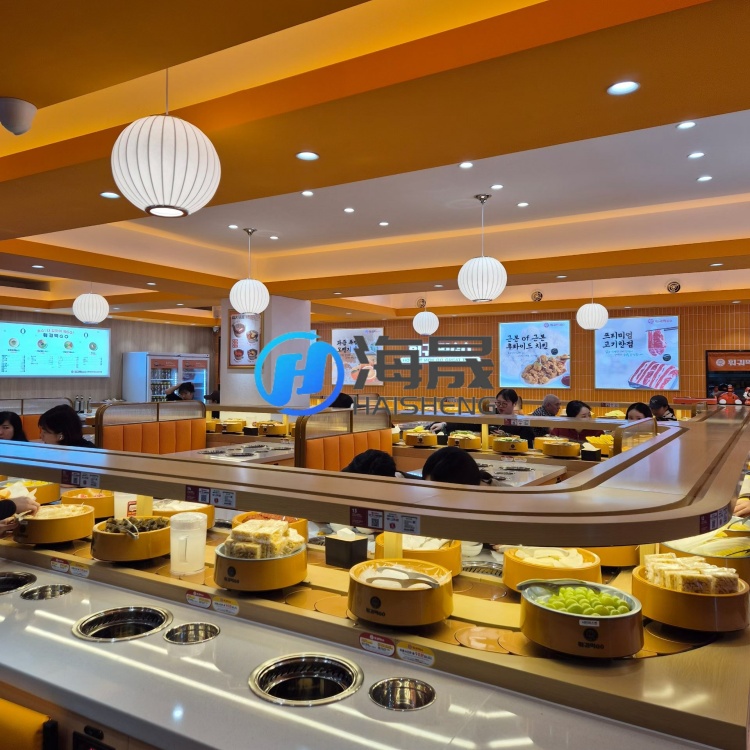
HaiSheng Intelligent adopts a modular design approach, enabling flexible customization based on store size, spatial layout, and investment budget. Configurations such as circular, U-shaped, S-shaped, L-shaped, and double-layer conveyor systems can be tailored accordingly.
Within the same floor area, more seating can be accommodated, increasing space utilization by over 30%.
For large chain brands, HaiSheng utilizes a standardized modular system to ensure consistency in equipment layout across multiple locations, while still adapting to the unique characteristics of each individual store—achieving a balance between scalable operations and personalized design.
In terms of functional customization, HaiSheng offers a wide range of modular components:
Hot Pot Scenario
Equipped with refrigerated conveyor tracks and smokeless-compatible design, with optional hidden plate collection systems to keep tabletops clean and organized.
Japanese Cuisine Scenario
Features a hot-and-cold zoned constant-temperature preservation system, precisely controlling storage temperatures for sashimi, sushi, and other delicate items.
Dessert Scenario
Includes LED-lit conveyor tracks and transparent display covers to enhance visual appeal and product presentation.
Multi-Cuisine Scenario
Supports dual-track or multi-track systems, enabling the separate delivery of hot and cold dishes for greater operational flexibility.
Conclusion
Amid the rapid rise of the solo dining economy and the ongoing pressure of the restaurant industry’s “three high costs,” the rotating hot pot model is entering an unprecedented period of growth.
With 16 years of technical expertise, HaiSheng Intelligent leverages its three core strategies—automation to reduce labor costs, smart freshness management to minimize food waste, and visual merchandising to increase average spending—to help restaurant investors worldwide overcome operational challenges, achieve faster return on investment, and build stable profitability.
Choosing HaiSheng is not just choosing a piece of equipment—it is choosing a proven methodology for success.