

The Secret Weapon Behind 4,000-Table Queues: When Conveyor Belt Sushi Becomes a "Money Printer," What is HaiSheng Doing Behind the Scenes?
The Comeback of a "Outdated" Model
Ten years ago, people said conveyor belt sushi was "outdated."
Ten years later, Sushiro and Hama-Sushi rose from the ruins of Japan's burst bubble economy, crossed the ocean, and became the "queue kings" in Chinese shopping malls. Even Haidilao is trying to learn how to make sushi, and F&B professionals are all asking: How did they do it?
Some say it's low prices, others say it's marketing. But step into the back kitchen of a Sushiro, and you'll discover a startling truth: This restaurant is essentially a precisely operating "food factory," and every customer is a "skilled worker" on this assembly line.
From the moment you scan the code to take a number, an efficiency game begins—self-service ordering, self-service plate collection, self-service tea brewing, self-service checkout... The front-of-house staff only need to do three things: clean, organize, and handle payments. You order, the conveyor belt delivers, you pay yourself.
The core of this model is the "one vertical, three horizontal" conveyor belt system. And HaiSheng Intelligent Technology is the invisible driver behind this "assembly line."
I. Efficiency Level 1: The Conveyor Belt – It's Not Just About "Spinning"
Many people think rotating sushi equipment is just a spinning belt. Wrong.
In Sushiro stores, the conveyor belt has "classes":
Upper Layer – "Express Track": Your order is delivered "one-to-one" via this track, arriving precisely in front of you like a train switching tracks.
Lower Layer – "Rotating Track": Sushi parades in line, waiting to be chosen.
This "double-layer shunt" design not only ensures the efficiency of "urgent orders" but also retains the fun of "browsing and eating". And to achieve such complex circulation, it is not magic, but hardware.
HaiSheng's Rotating Sushi Equipment, adopting Japanese craftsmanship + dual-layer stable frame structure, makes the upper layer's track switching as precise as a Shinkansen, and the lower layer's rotation as quiet as flowing water. The acrylic silent chain is smooth, wear-resistant, and doesn't "throw a tantrum" even during continuous peak operation—after all, customers queuing for 4 hours don't want to hear the conveyor belt "squeaking."
More importantly, HaiSheng's equipment supports modular installation. New store opening? Old store renovation? No need for major overhauls; assemble it quickly like building blocks, ready in a week. For chain brands, time saved is money.
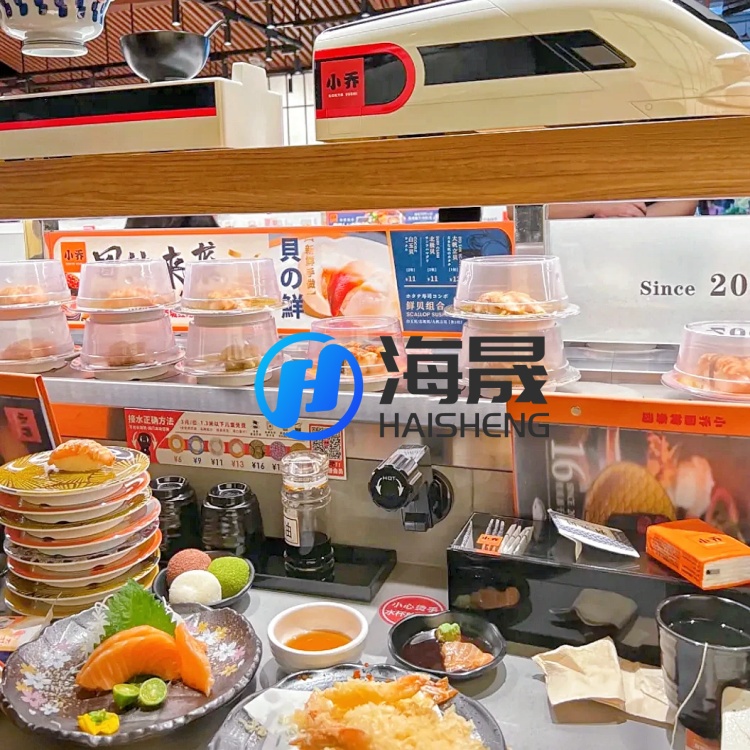
II. Efficiency Level 2: Smart Food Delivery Carts – Bringing the "Shinkansen" into the Restaurant
If the traditional rotating belt is a "bus," then HaiSheng's Intelligent Track-Switching Food Delivery Cart System is a "private car."
How smart is this system?Precise Delivery: After ordering, the system automatically calculates the optimal route, and the food cart heads straight to you like it has a GPS.Automatic Obstacle Avoidance: Encounter a "traffic jam" or obstacle? It can automatically turn around and re-route.Stable, Spill-Proof: Optimized power control system reduces sudden acceleration and braking, ensuring no spills during turns—not a single slice of fish on the sushi should fall off.What's even more remarkable? These food carts can be customized with IP images: little trains, spaceships, cartoon animals... whatever concept you want, HaiSheng's engineers can "magically" create it. The dining process is no longer just "eating" but an "immersive experience."
III. Efficiency Level 3: Back-of-House Automation – Turning "Newbies" into "Master Chefs" Instantly
In Sushiro's kitchen, the real "Sushi God" is a machine.
From the "antique" that molded 1,200 rice balls per hour in 1981 to the intelligent sushi robot that molds 4,800 per hour today, the level of automation directly determines a restaurant's "combat effectiveness."
What HaiSheng provides is not just a sushi robot, but a complete back-of-house solution: Fully automated rice cooking, vinegar mixing, and rice ball molding, resulting in complete grains and soft texture, with a bottom imitating a human hand mold—you can't taste the "machine feel." Everything for making gunkan, rolling sushi, boiling noodles, and frying is standardized with a full range of fryers and griddles.
What does this mean?
It means a newcomer who just joined two weeks ago can make sushi as consistent as a ten-year veteran. It means chain brands can expand without worrying about "people" holding them back. It means quality control is replicable, and efficiency is calculable.
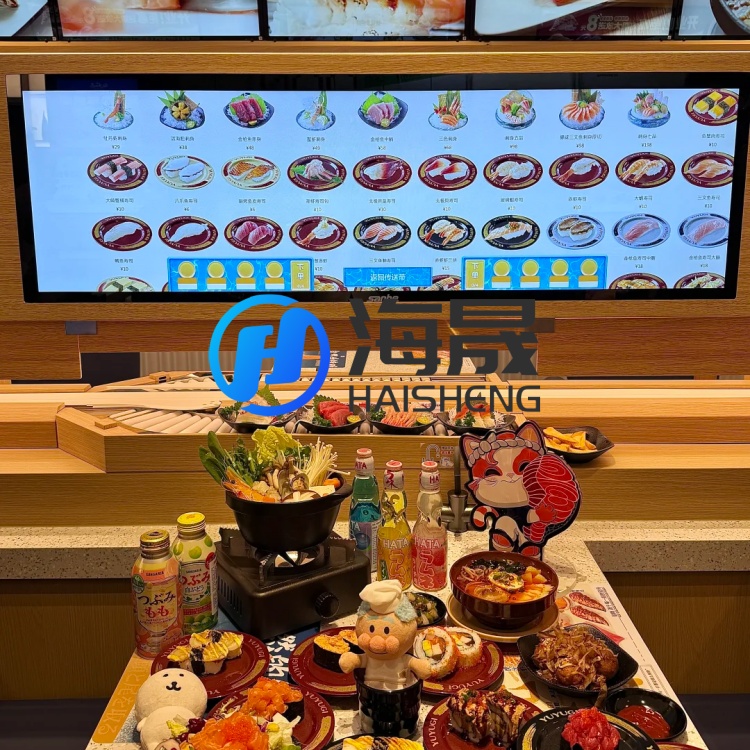
IV. Efficiency Level 4: Food Safety and Loss – Using "Technology" to Grip the Throat
In 2023, the Japanese conveyor belt sushi industry was hit hard by the "tampering incident," forcing many restaurants to halt their rotating tracks. Food safety became the industry's "lifeline."
Sushiro's response was "Digital Rotating" – using large screens to let sushi "rotate cybernetically," paired with express track delivery. HaiSheng quickly followed this trend, launching a compatible solution: retaining the intelligent track-switching system, integrating with automatic ordering screens, and supporting lottery and game interactions. Ensuring both food safety and experience.
Another pain point is "loss." Sushiro's plates have chips embedded. If sushi travels 350 meters (about 1 hour) on the track without being chosen, it's automatically "sentenced to death"—falling into the trash. This "freshness detection system," while harsh, protects the brand's reputation.
HaiSheng's equipment ecosystem also supports this type of IoT module. You can choose to install a freshness detection system, letting data tell you: which sushi sells slowly? When should you make less? Use algorithms to reduce waste and hardware to control costs.
V. Efficiency Level 5: Maintenance Costs – The "Invisible Profit" in the Details
What do chain F&B owners fear most? Not the high cost of opening a store, but the "unaffordable repairs" after opening.
Conveyor belts loosen over time, chains start to squeak, equipment failure halts the entire line—every minute of downtime is a real loss.
HaiSheng's engineers anticipated this long ago. They developed a seemingly inconspicuous but extremely practical device: the Adjustable Tension Device.
What does it mean?
It means when the conveyor belt gets loose from long use, there's no need for major dismantling and replacement. Just a simple adjustment, and it's back to normal. Maintenance costs drop drastically, and equipment lifespan extends significantly. For chain brands with hundreds of stores, this "small device" saves millions annually—real "big money."
Conclusion: When the F&B Industry Enters the "Manufacturing Era"
Sushiro's comeback isn't a victory of marketing; it's a victory of efficiency. It tells everyone in the F&B industry clearly: In today's era of price wars and closure waves, "competing on price" is not as good as "competing on efficiency".
And behind efficiency lies the support of hardware. HaiSheng Intelligent Technology, with its 10,000-square-meter manufacturing plant, a team of over a hundred engineers, and products exported to more than 20 countries including the US, France, and Australia, has done only one thing for 16 years: perfecting rotating sushi equipment.
From Xin Yi Fan, Ban Sushi, to He Zhi Xian, Da Li Xi, and to Sushizo, Hama-Sushi, and Sushiro counterparts worldwide—HaiSheng's equipment operates day and night in countless restaurants, supporting the birth of every "queue king."
Could the next one be you?