

The rotating hot pot sector is still growing, but the logic of competition has changed. Industry data shows that by the end of 2025, there were about 48,000 rotating mini hot pot stores in China, with a market size approaching RMB 40 billion, growing about 14% year on year, significantly higher than the overall hot pot industry. At the same time, the closure rate of rotating mini hot pot stores reached 24%. A number of stores that relied only on conveyor belts and lacked equipment stability and operational differentiation exited the market just months after opening. Equipment itself does not constitute a brand moat, but equipment instability is enough to become a bottleneck for scaled expansion. For operators currently purchasing or upgrading Commercial Hot Pot Conveyor Belt Equipment, the question has changed from “whether to adopt rotating equipment” to “what kind of equipment can run continuously for more than three years without eating profits away through maintenance.”
This shift is particularly clear in 2026 industry developments. Haidilao’s “Xunxian Island” opened in Nanjing does not follow the traditional rotating or self-service model; instead, it uses upper and lower double-layer tracks, with the back kitchen delivering hot pot bases and ingredients directly to the table. The underlying logic of track-based delivery is the same as that of rotating equipment, but its requirements for “precise delivery” and “smooth operation” are higher—soup spills, chain vibration, and sudden stops and turns are directly magnified in a close-range, one-person-one-pot dining scenario. The engineering focus of intelligent food delivery systems is shifting from “being able to run” to “running quietly, stopping steadily, and not spilling when turning.”
HaiSheng Intelligent Technology’s technical accumulation in this direction is built on 16 years of manufacturing experience in rotating conveying equipment and a 10,000-square-meter intelligent workshop. The company holds EU CE, US NSF, and UL certifications, and its products are exported to more than 20 countries and regions, including the United States, Canada, Mexico, New Zealand, Australia, Malaysia, Thailand, France, the United Kingdom, Germany, Spain, and Portugal. In the core structure of Commercial Hot Pot Conveyor Belt Equipment, HaiSheng adopts a double-layer stable frame iterated on the basis of Japanese craftsmanship. Compared with a single-layer frame, it significantly reduces vibration and track deviation during long-term continuous operation. The modular design allows on-site installation and later modifications without large-scale disassembly and assembly, which is particularly critical for chain brands replicating multiple stores.
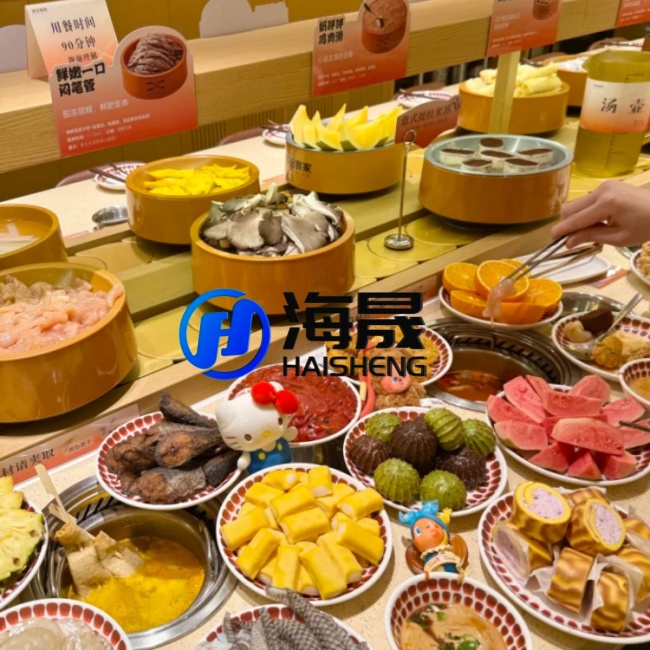
Maintenance cost is the most easily underestimated expense item in rotating hot pot equipment. Chain loosening, tooth skipping, and even jamming after the chain stretches with use are among the most common sources of failure in the industry. HaiSheng has added an adjustable tension device to its equipment. Operators can fine-tune chain tension according to actual operating conditions, rather than waiting for components to fail and then replacing them entirely, directly extending the equipment’s service life and reducing maintenance spending. The rotary chain abandons the traditional metal solution and instead uses acrylic silent material, achieving a balance among smoothness, wear resistance, and noise control. Operating noise is controlled below 45 dB, which is especially friendly to community stores and stores operating in the evening. According to actual operational feedback, the above two improvements have reduced annual maintenance costs per store by more than 30%.
On the delivery efficiency side, HaiSheng’s variable-track intelligent food delivery cart system provides a path different from fixed-track equipment. While moving, the delivery cart can achieve precise table delivery, automatic U-turns, obstacle avoidance, and path correction. After combining variable tracks with conveying technology, delivery efficiency is improved by more than 40% compared with traditional fixed-track equipment. The carrying platform reduces tableware displacement through protective enclosures and flatness optimization. The power control system automatically adjusts acceleration, deceleration, and steering torque for different floors such as ceramic tile, wood flooring, and carpet, suppressing spillage risks caused by sudden acceleration, deceleration, and sharp turns at the source. The system also includes a ventilation and air-exchange design, which, combined with regular cleaning procedures for tracks and carrying platforms, reduces the possibility of residual odors and flavor cross-contamination inside the equipment. The appearance of the delivery cart can be customized into IP images such as trains and spaceships, providing a perceptible memory point for the dining scene beyond functionality.
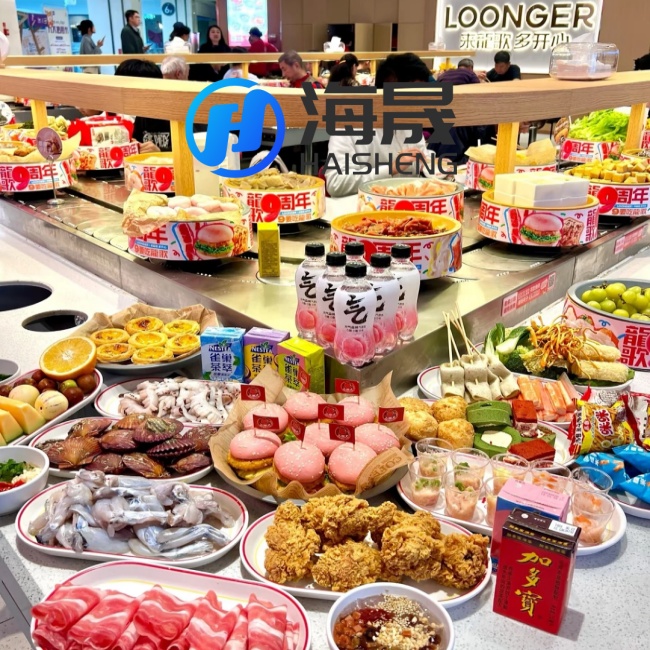
Market choice validation comes from the customer structure. More than 280 of Shengxiangting’s 320-plus stores nationwide use HaiSheng rotating systems; Yiwei Beef Hot Pot operates more than 100 stores in over 30 cities, with some stores generating daily revenue of more than USD 3,500; Longge Buffet Hot Pot opened 360 new stores in one year, reaching 500 stores in total, and its equipment iteration has moved from standard stainless steel chains to silent polymer chains and double-layer smoke exhaust configurations. Brands such as Haidilao, Little Sheep, Xijia Buffet Hot Pot, and Maguangguang Rotating Hot Pot also maintain long-term cooperation with HaiSheng. These brands have different requirements for equipment—some pursue table turnover speed, some are constrained by compact premises, and some need to control installation cycles during rapid store opening—but they all point to the same judgment: the value of Rotating Hot Pot Equipment is no longer defined by “whether it rotates,” but by whether the chain is still quiet in the third year, whether the frame remains stable under an average of ten hours of operation per day, and whether there are few enough maintenance work orders. As rotating hot pot moves from incremental expansion to stock operations, the engineering depth of equipment suppliers is becoming an inconspicuous yet unavoidable variable in the expansion rhythm of chain brands.