

Industry Shift: Smart Fixed-Point Delivery Is Replacing Traditional Conveyor Belts
In 2025, the global rotating sushi market reached US$3.805 billion and is projected to grow to US$5.224 billion by 2032, with a CAGR of approximately 4.7%. Behind this growth, however, the store operating model itself is undergoing a fundamental change.
At FABEX Tokyo 2026, renovation orders for rotating sushi restaurants in Japan increased 41.7% year on year, with 72% of these projects adopting point-to-point Sushi Fixed-Point Conveyor Belt Equipment rather than traditional full-loop conveyor belts. Meanwhile, more than 60% of newly opened sushi restaurants in Japan’s Kanto and Kansai regions are now equipped with smart rail delivery carts.
This change comes from three pressures: continued labor shortages in major restaurant markets, frontline service staff costs rising 7% to 12% annually, and higher consumer expectations for hygiene on open conveyor belts. Previous food safety incidents affected customer trust in traditional conveyor belts.
Leading brands are also adjusting. Sushiro has expanded its DIGIRO digital sushi system to about 170 stores worldwide, replacing traditional conveyor belts with large interactive screens while retaining a dedicated high-speed delivery track for orders. Kura Sushi has installed AI cameras in all stores to monitor unusual plate handling on conveyor belts. The traditional model is shifting toward a more precise, on-demand delivery architecture.
HaiSheng Intelligent Technology has been providing manufacturing support for this transition rather than following passively. The company has 16 years of professional production experience, a 10,000-square-meter manufacturing factory, and a technical engineering team of more than 100 people. It provides Rotating Sushi Equipment, Commercial Sushi Train Equipment, sushi fixed-point conveyor belts, and complete back-of-house equipment including sushi machines, fryers, and griddles.
Stability and Durability: Structural Strength
Whether a rotating sushi system is reliable depends on its structural foundation. HaiSheng equipment adopts Japanese craftsmanship and an innovatively upgraded double-layer stable frame structure. This design evenly distributes operating pressure across the frame, significantly reducing vibration and deformation even when plates are densely placed during peak hours.
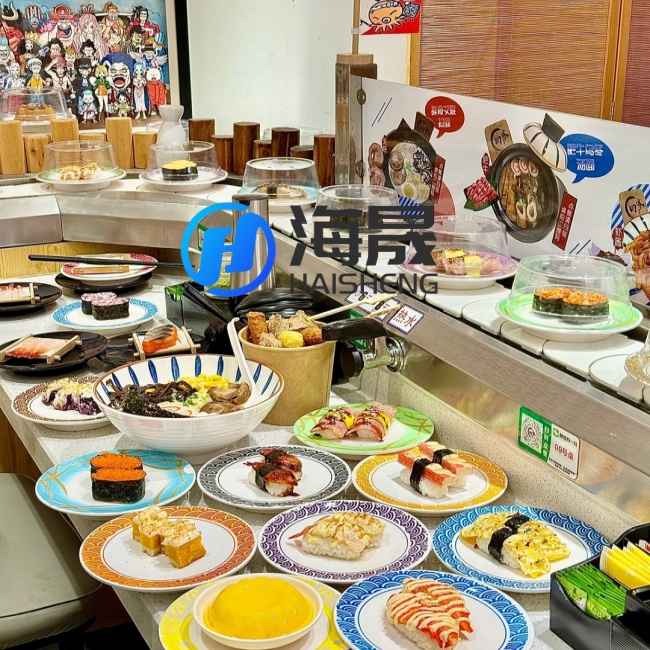
The main body uses thickened 2.0mm food-grade 304 stainless steel, and each load-bearing point can support up to 20 kg. Structural joints are reinforced with welding to keep the system aligned during high-intensity operation, resisting shaking and spillage.
The conveyor chain uses a high-toughness acrylic silent material. After polishing, it runs smoothly without easy jamming and offers strong wear resistance. Combined with a low-noise drive motor, operating sound can be controlled at ≤50 dB, about 30% quieter than conventional systems. Guests can converse during meals without mechanical noise interference.
HaiSheng’s independently developed adjustable tension device is a major highlight. This structure compensates for the natural stretching of the conveyor chain after long-term use and prevents chain loosening or jamming. As a result, service life is extended by about 25%, and annual maintenance costs are reduced by nearly 30%.
The modular structural design further simplifies transportation, installation, and future expansion. Tracks, supports, motors, and drive systems can be installed and replaced independently, increasing installation efficiency by 40%. Restaurants can adjust the system for circular, L-shaped, or U-shaped layouts without large-scale renovation.
For stores that need to replicate well-known brand formats, HaiSheng can customize Hama-Sushi-style sushi belt equipment, Sushiro-style equipment, Kura-style rotating sushi equipment, and Sushi Jiang-style sushi equipment. Track dimensions, countertop materials, and color schemes can all be adjusted according to restaurant space, customer flow, and investment budget.
Intelligent Delivery Integration: More Than a Rotating Conveyor Belt
Modern sushi restaurants need more than a conveyor belt. HaiSheng’s Commercial Sushi Train Equipment can integrate multiple intelligent modules, turning the delivery system into a complete service platform.
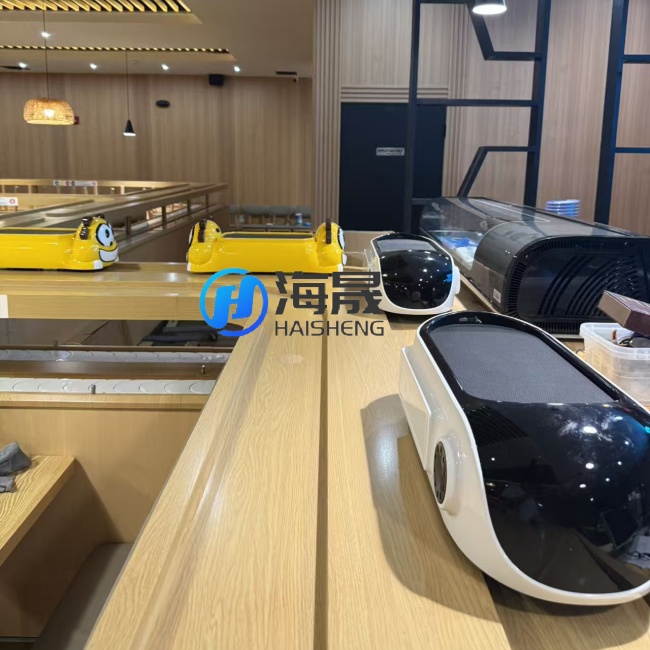
Variable-Rail Intelligent Delivery System. The smart delivery cart combines advanced rail-changing and conveyor technology to deliver accurately, make U-turns, avoid obstacles, and automatically correct errors. The carrying platform uses anti-slip and anti-tilt design. By adding protective guardrails and optimizing countertop flatness, it reduces plate displacement during movement. The system’s automatic calculation function plans the best route based on delivery location, improving delivery efficiency while reducing spills caused by sudden acceleration, deceleration, or sharp turns.
Smart Cart Design. The delivery cart optimizes its power control system to ensure smooth starts, stops, and turns while reducing body vibration. It automatically adjusts operating parameters for different floor conditions and maintains a stable posture in complex scenarios. Cart styling can be customized into train, spaceship, or other IP characters, adding fun to the dining experience.
Ventilation and Odor Control. The system is equipped with reasonable ventilation devices to promote air circulation, discharge residual odors in time, keep internal air fresh, and reduce the conditions that cause flavor transfer.
Complete System Integration. Rotating sushi equipment can be paired with gacha machines, hot water systems, plate return systems, constant-temperature freshness preservation systems, overpass systems, freshness detection systems, large-screen self-ordering systems, and automated checkout and settlement systems. Rotary hot pot equipment can be paired with variable-rail smart delivery cart systems, ambient light strips, upward exhaust systems, and multi-functional drawers.
Typical operations use a dual-layer delivery logic: about 70% of regular dishes circulate on the main line for self-service, while tablet-ordered dishes are delivered via the upper express track. The kitchen prepares food on demand, reducing waste caused by over-preparing food on the conveyor belt.
The entire system breaks away from the monotonous rotating conveyor belt model of traditional rotating sushi restaurants. After customers place orders on smart tablets, dishes are delivered by smart rail delivery carts without personnel contact, saving labor and improving hygiene and safety.
Global Certifications and Export Compatibility
For restaurant operators purchasing equipment across borders, certification is a key threshold. HaiSheng’s Rotating Sushi Equipment has EU CE certification, U.S. NSF food hygiene certification, and UL safety certification.
CE certification ensures compliance with EU market safety standards; NSF certification verifies that materials and design meet U.S. food-contact equipment hygiene requirements; UL certification ensures electrical safety and is an important mandatory requirement for the U.S. market. Fewer than 8% of sushi conveyor manufacturers worldwide hold all three certifications simultaneously. This qualification can reduce acceptance risks for overseas restaurant owners.
The equipment supports a wide voltage range of 110V–240V and is compatible with major global power grid standards. It can be connected directly without an additional transformer. Whether for the 110V/60Hz markets of the United States and Canada or the 220–240V systems in Europe and Australia, it can adapt.
HaiSheng products have been exported to more than 20 countries and regions, including the United States, Canada, Mexico, New Zealand, Australia, Malaysia, Thailand, France, the United Kingdom, Germany, Spain, and Portugal. The company has formed long-term partnerships with chain restaurant brands such as Xin Yi Fan, Wansui, Sushi Jiang, He Ting, He Zhi Xian, and Da Li Xi, accumulating operational experience for high-traffic sushi restaurants.
From design planning, R&D and manufacturing, production testing, to installation and maintenance, HaiSheng provides one-stop service. For restaurant operators expanding into overseas markets, this means fewer coordination gaps and a clearer path from floor plan to opening.