

The End of the "Never-Stopping" Conveyor Belt
For decades, the rotating conveyor belt defined the sushi restaurant experience. Plates circled endlessly, and customers picked what looked appealing as it passed by. That model, however, carries a fundamental inefficiency: a dish keeps moving whether or not anyone takes it, steadily losing freshness before it is finally discarded.
The industry has taken notice. Consumer concerns about hygiene on open conveyor belts, amplified by food safety incidents in recent years, pushed major chains to rethink how food reaches the table. Sushiro, for example, shifted its operational focus toward on-demand delivery through express lanes and digital ordering experiences. The core value of sushi equipment is no longer simply "making plates move" — it is delivering the right dish to the right seat at the right time.
What Modern Restaurants Need from Rotating Sushi Equipment
Today's sushi restaurant operators are looking for more than a motorized belt. They need equipment that supports food safety monitoring, labor efficiency, customizable layouts, and compliance with international market standards. The global conveyor-belt sushi market is expanding rapidly across North America, Europe, Oceania, and Southeast Asia, with major chains such as Sushiro's parent company planning a 75% increase in overseas stores by September 2026 and Hama-sushi targeting 1,000 locations within five years. This expansion brings a dual demand for standardization and customization that directly shapes equipment purchasing decisions.
HaiSheng's Answer: Engineering Strength Behind the Equipment
HaiSheng Intelligent Technology Co., Ltd. has been manufacturing Rotating Sushi Equipment and rotating hot pot conveyor systems since 2010. The company operates a 10,000-square-meter manufacturing plant and employs a technical engineering team of over 100 specialists, covering everything from steel cutting to full system debugging in-house. This vertically integrated production capability allows HaiSheng to offer a complete one-stop service loop: layout design, R&D and manufacturing, factory testing, on-site installation guidance, and long-term after-sales maintenance.
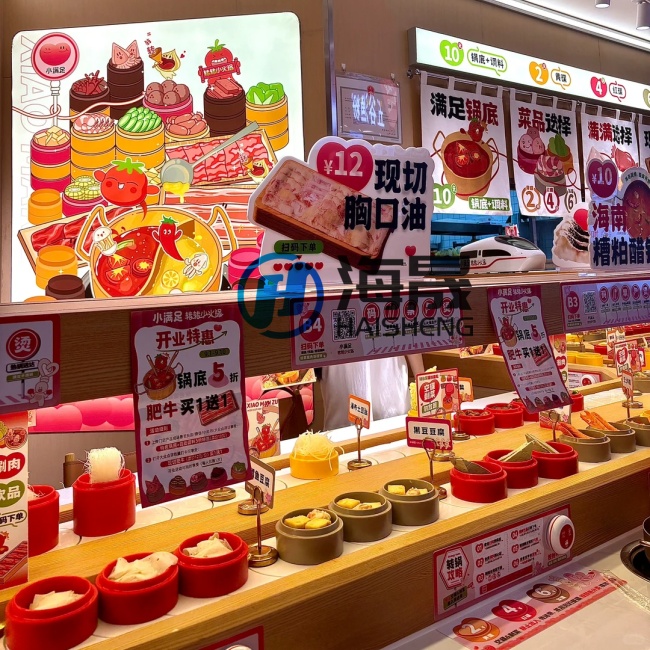
Structural Design Rooted in Japanese Craftsmanship
Every unit of HaiSheng's Rotating Sushi Equipment adopts a double-layer stable frame structure upgraded from Japanese manufacturing techniques. The main frame uses thickened 304 stainless steel, maintaining resistance to deformation under high-frequency continuous operation. Compared with conventional single-layer frames, this structure distributes operating stress more evenly and reduces long-term structural fatigue. The entire system follows a modular construction principle, allowing each functional unit — tracks, supports, and drive systems — to be assembled, replaced, or adjusted independently, which significantly shortens on-site installation time for overseas projects.
Acrylic Silent Chains and Adjustable Tension: Practical Innovations That Matter
HaiSheng's conveyor chains use high-density acrylic silent material instead of traditional metal or plastic chains. This design delivers smooth glide performance, excellent wear resistance, and nearly silent operation — when running at full load, noise levels stay controlled below 45 decibels, suitable for intimate dining spaces and mall store environments alike.
Both the rotating sushi equipment and rotating hot pot equipment lines feature a self-developed adjustable tensioning device. Operators can fine-tune chain tightness based on actual wear conditions, slowing component aging and extending the overall service life of the system. This directly reduces the frequency of on-site component replacement and lowers long-term maintenance costs for store operators — a practical advantage for multi-store chains managing equipment across different locations.
Intelligent Variable-Track Delivery: Beyond the Traditional Belt
The standout feature of HaiSheng's automatic revolving sushi conveyor system is its variable-track intelligent delivery cart technology. These carts achieve precise delivery, automatic U-turns, obstacle avoidance, and intelligent error correction through advanced track-switching and transmission technology. The reinforced anti-slip bearing platform and protective baffles limit tableware displacement during movement, while the optimized power control system keeps the cart running smoothly during starts, stops, and turns.
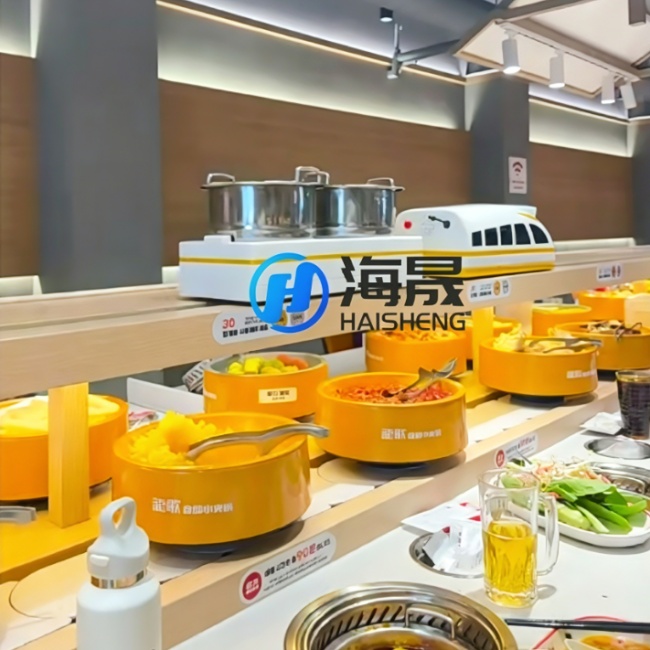
An automatic route calculation system determines the optimal delivery path based on seating position, improving delivery efficiency significantly compared with fixed-track systems. The carts can also be customized with themed IP designs — train shapes, spacecraft forms, and other creative styles — adding an entertainment dimension to the dining experience. Customers place orders on smart tablets, and dishes arrive via the intelligent rail cart without staff contact, saving labor while providing a hygienic, engaging dining experience.
A Complete Equipment Ecosystem for Sushi and Hot Pot Venues
HaiSheng's Rotating Sushi Equipment can be paired with a wide range of auxiliary modules: capsule toy game machines, hot water supply systems, plate recycling units, constant-temperature fresh-keeping systems, bridge crossing tracks, freshness detection systems, self-order touchscreens, and automated checkout terminals. For rotating hot pot establishments, complementary options include variable-track intelligent delivery carts, ambient LED lighting strips, overhead smoke extraction systems, and multi-functional storage drawers.
The equipment can replicate the conveyor specifications of major international sushi chains, including Hamazushi-style belt systems, Sushiro-style layouts, Kura-style revolving setups, and Sushi Craftsman-style configurations. Each project is tailored to the restaurant's specific floor plan, customer flow, and investment budget. Modular design flexibly adapts to circular, U-shaped, S-shaped, L-shaped, and irregular multi-level track layouts, including spaces with load-bearing columns or unusual curved floor plans.
Export Standard Rotating Sushi Conveyor Equipment: Certified for Global Markets
For restaurant operators in North America, Europe, and other international markets, equipment certification is not optional — it is a prerequisite for market access. HaiSheng's products hold EU CE, US NSF, and UL certifications, meeting the food safety and electrical regulations of the United States and the European Union. This triple certification enables smooth customs clearance and licensing across most overseas markets.
HaiSheng's Export Standard Rotating Sushi Conveyor Equipment has been shipped to more than 20 countries and regions, including the United States, Canada, Mexico, New Zealand, Australia, Malaysia, Thailand, France, the United Kingdom, Germany, Spain, and Portugal. The company maintains long-term partnerships with well-known chain restaurant brands such as Xinyifan, Wansui, Sushi-Jiang, Heting, Hezhixian, and Dalixi, accumulating practical experience from hundreds of chain-store equipment projects.
Looking Ahead
The global rotating sushi equipment market is projected to grow from approximately USD 3.8 billion in 2025 to USD 5.2 billion by 2032, driven by chain expansion, labor cost pressures, and rising consumer expectations for hygiene and dining experience. As the industry shifts from simple revolving belts to intelligent, on-demand delivery systems, manufacturers that can combine structural reliability, acoustic performance, modular flexibility, and international certifications will be best positioned to serve this growing demand.
HaiSheng Intelligent Technology Co., Ltd. continues to invest in R&D and production capacity to meet this global shift. Whether you are opening a single sushi restaurant or planning a multi-store chain rollout, our team provides end-to-end support — from layout design and customized manufacturing to installation, commissioning, and ongoing maintenance. For more information about our Rotating Sushi Equipment and Export Standard Rotating Sushi Conveyor Equipment, please contact our team.