

A Global Industry at a Crossroads: From “Circulating” to “Fixed-Point Delivery”
The turning point came in 2023, when “sushi terrorism” incidents — customers tampering with food on open conveyor belts — triggered a crisis of consumer confidence in Japan and beyond. A 2026 survey of 3,000 regular conveyor sushi diners found that 62% of Japanese consumers no longer trust open conveyor belts, and 45% have reduced their visits to conveyor sushi restaurants. Similar concerns have accelerated in European markets, where consumers are already highly sensitive to food safety.
The industry has responded with two different strategies. Sushiro has decisively shifted toward an order-driven model, introducing its “Digiro” digital conveyor system — large screens that replace traditional circulating lanes while retaining express delivery tracks for ordered items. Kura Sushi, by contrast, has chosen to preserve the open rotating belt experience but added transparent antibacterial covers, paired with AI cameras that detect suspicious lid openings and alert headquarters in real time.
This divergence points to a broader trend: the future of conveyor sushi lies not in choosing between “rotating” and “non-rotating,” but in a hybrid architecture that keeps the visual appeal of circulating dishes while ensuring that premium made-to-order items travel through a sealed, monitored delivery path. That hybrid model is exactly what the Sushi Fixed-Point Conveyor Belt System delivers.
What Traditional Conveyor Equipment Gets Wrong in European Operations
Many early-generation conveyor systems installed in European sushi restaurants share a set of limitations: structural shaking during long operating hours, noisy chains that disrupt the dining atmosphere, insufficient international certifications that complicate customs clearance, and non-modular designs that require lengthy on-site assembly with costly local labor.
European operators also face a stricter regulatory environment than most regions. All food contact materials sold in the EU must comply with Framework Regulation (EC) No 1935/2004, which requires that materials do not release harmful substances, do not alter the sensory properties of food, and are manufactured under good manufacturing practices. Conveyor belts fall squarely within this scope as food processing equipment. For any equipment supplier targeting the European market, CE, NSF, and UL certification is not optional — it is an entry ticket.
How HaiSheng’s Sushi Fixed-Point Conveyor Belt Equipment Addresses These Gaps
HaiSheng Intelligent Technology Co., Ltd. enters the European market with equipment designed from the ground up for overseas compliance and operational reliability. The company operates a 10,000-square-meter manufacturing facility and maintains a technical engineering team of more than 100 professionals, providing end-to-end services from design planning and R&D through production testing, installation, and long-term maintenance.
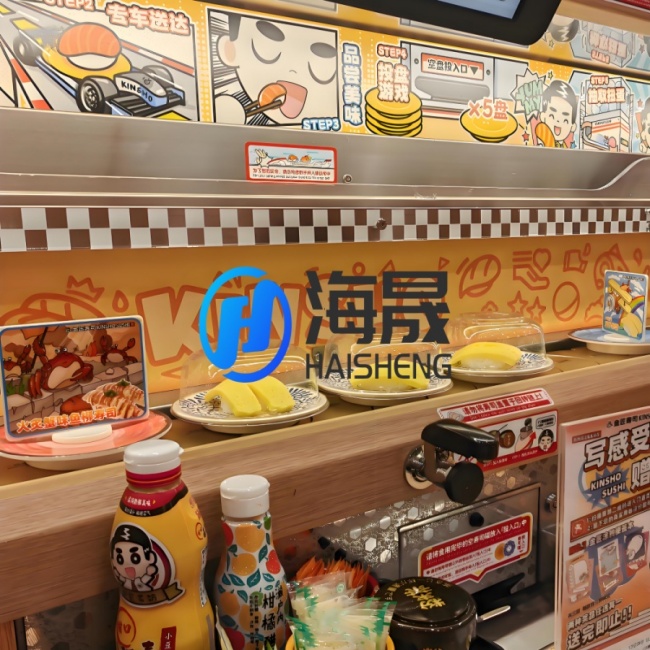
At the core of HaiSheng’s offering is the Sushi Fixed-Point Conveyor Belt System, built on an innovatively upgraded dual-layer stable frame structure inspired by Japanese craftsmanship. The lower layer carries conventional sushi items on a quiet acrylic track, preserving the interactive dining experience customers expect from a conveyor sushi restaurant. The upper layer serves as a dedicated fixed-point delivery lane for made-to-order dishes — sashimi, premium rolls, hot items — ensuring they travel from the kitchen to the designated seat without exposure to the open dining environment.
This dual-layer architecture delivers three operational advantages that directly address European market pain points:
Structural stability under continuous operation. The reinforced double-layer frame significantly reduces deformation, shaking, and plate displacement during long daily service hours, cutting maintenance downtime and extending equipment life.
Modular construction for fast deployment. Standardized modular units ship efficiently in containers and assemble quickly on site, reducing the costly local labor hours that European operators cannot afford to waste.
Full certification compliance. HaiSheng’s core products hold complete EU CE, US NSF, and UL certifications, with full documentation supplied for customs clearance and regulatory inspections across Europe, North America, and Oceania. For European operators navigating the requirements of Regulation (EC) 1935/2004, this documentation package greatly simplifies the compliance process.
Intelligent Delivery Technology That Goes Beyond the Belt
The Sushi Fixed-Point Conveyor Belt Equipment is complemented by HaiSheng’s variable-track intelligent delivery cart system, which uses precise positioning, automatic U-turn, obstacle avoidance, and route correction technology to navigate complex track networks. The system automatically calculates the optimal delivery route, improving operational efficiency by more than 40% compared with conventional manual delivery. Cart bodies can be customized into themed designs — trains, spaceships, and other IP characters — adding an entertainment element that appeals to younger diners.
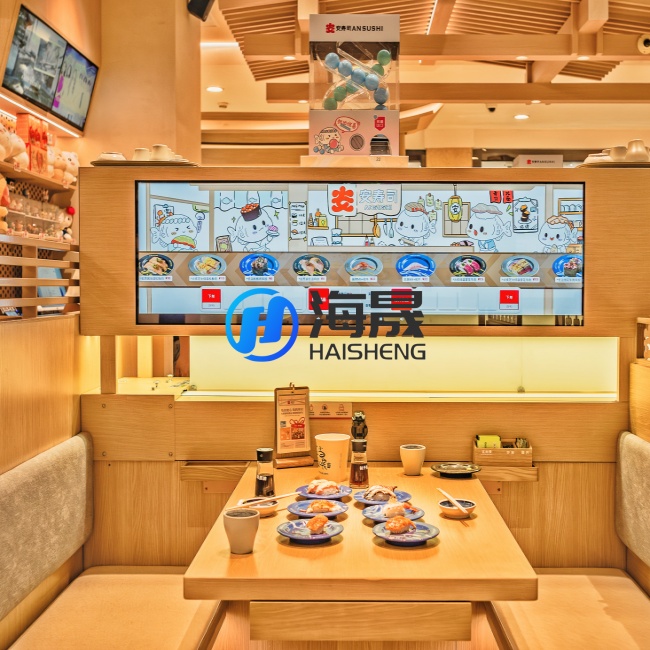
The equipment also integrates an intelligent temperature-preservation system with dual-zone control, maintaining raw fish and sashimi at 2–10°C while keeping hot items at 40–60°C. This goes beyond the IC-chip tracking system used by Sushiro, which relies solely on travel-distance monitoring to determine when a plate should be discarded.
Further Expanding into the European Market
HaiSheng Intelligent Technology’s equipment is already operating in the European market, with installations completed in Madrid and Murcia, Spain, meeting the continent’s strict environmental and food safety standards. The company’s products have been exported to more than 20 countries and regions, including France, the United Kingdom, Germany, Spain, and Portugal.
To get closer to European customers, HaiSheng plans to establish an on-site branch in Europe and has recently sent specialists to conduct on-site visits. In the future, this European service hub will provide chain operators with faster on-site installation support, more timely maintenance and spare-parts response, and direct technical consultation for new store openings or existing store renovations — helping restaurant brands keep equipment installation aligned with opening schedules during European expansion and obtain after-sales service close at hand.
A Complete Equipment Ecosystem for Modern Sushi Operations
Beyond the Sushi Fixed-Point Conveyor Belt System, HaiSheng also provides complete back-of-house and front-of-house equipment for sushi restaurants: rotating hot pot conveyor systems, sushi-making machines, deep fryers, grills, and full kitchen equipment packages. The company’s one-stop service model covers layout design, equipment customization, manufacturing, pre-shipment testing, installation, and ongoing maintenance, allowing chain brands to coordinate kitchen workflows, dining space design, and automated serving systems through a single supplier.
For European chain operators evaluating equipment for new stores or upgrades, certified compliance, modular installation, intelligent delivery technology, and a growing local service network make HaiSheng a practical partner for scalable expansion. As the global conveyor sushi market continues toward USD 5 billion by 2031, leading operators will no longer treat equipment selection as a cost decision, but as the infrastructure backbone for their brand’s next phase of growth.