

Industry Turning Point: From “Everything Rotates” to “Rotate What Should Rotate, Deliver What Should Be Delivered”
The rotating sushi industry is going through a new split in how food is presented. The 2023 consumer misconduct incidents pushed the industry to reconsider the safety logic of open conveyor belts, and Japan even saw systematic questions about conveyor hygiene. Industry data confirms the shift: orders for purely mechanical conveyor belts have fallen significantly, while conveying systems integrated with smart ordering, point-to-point delivery, and automated management have become a basic configuration for new sushi stores.
Data from FABEX Tokyo 2026 further shows that renovation orders for Japanese rotating sushi stores increased by 41.7% year on year. Among them, 72% of projects chose point-to-point direct-delivery equipment rather than traditional full-loop conveyor belts. More than 60% of new stores in the Kanto and Kansai regions were equipped with intelligent track delivery carts. Sushiro’s dedicated “Auto Waiter” direct-delivery lane and Kura Sushi’s deployment of delivery robots in more than 60 US stores point in the same direction: the center of gravity of Rotating Sushi Equipment is moving from “rotating display” to “precise delivery.”
HaiSheng Intelligent Technology Co., Ltd. responds with a dual-layer intelligent conveying architecture. The lower layer keeps the rotating display function, maintaining the “see it and take it” experience for customers. The upper layer is a point-to-point direct-delivery lane, sending ordered dishes from the kitchen directly to a designated seat. The two logics work together, preserving the fun of rotating sushi while keeping the exposure time and waste loss of prepared dishes at a lower level.
Core Equipment Advantage One: Adjustable Tension Device and Acrylic Silent Chain
Traditional rotating equipment commonly develops loose chains, increased noise, and stuck plates after several months of use. HaiSheng has integrated an independently developed adjustable tension device into both its Rotating Sushi Equipment and rotating hot pot equipment lines. Operators can make fine adjustments based on chain wear, maintaining stable tension throughout the equipment’s service life, extending maintenance intervals, and reducing the frequency of parts replacement.
The conveying chain uses a high-density acrylic silent material. Compared with metal chains, it offers three verifiable improvements: operating noise is reduced by more than 40%, and plate shaking during conveying is noticeably reduced. The material does not easily absorb oil or food particles, making cleaning easier and reducing odor accumulation inside the equipment. For the front-of-house environment during peak dining hours, this means lower background noise and a more relaxed customer experience.
Core Equipment Advantage Two: Variable-Track Intelligent Delivery Cart System
This is the most differentiated module of HaiSheng’s new-generation Commercial Sushi Train Equipment. Based on a combination of variable-track and conveying technologies, the delivery cart can achieve precise positioning, U-turns, obstacle avoidance, and intelligent error correction during delivery. The system automatically calculates the optimal delivery route according to the target seat position, reducing ineffective movement.
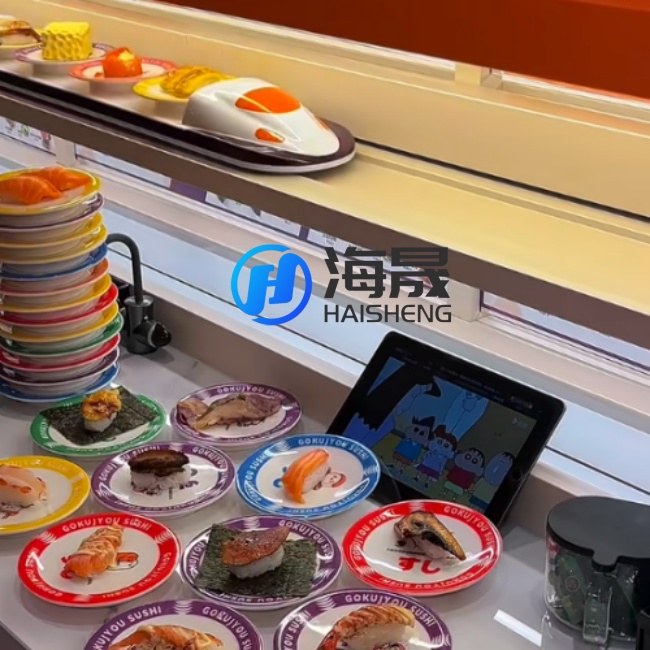
In terms of carrying stability, the delivery cart strengthens the anti-slip and anti-tilt design of the platform. By adding protective guards and optimizing surface flatness, it reduces the displacement of tableware during movement. The optimized power control system keeps the cart smooth during start-stop and turning, reduces body vibration, and automatically adjusts operating parameters for different floor conditions, maintaining a stable operating posture in complex scenarios. The cart’s appearance can be customized into IP images such as trains and spaceships, turning the delivery process into part of the dining experience.
Structural Design and Global Adaptability: Dual-Layer Stable Frame and Modular Installation
The mechanical structure is optimized according to Japanese manufacturing standards. HaiSheng’s dual-layer stable frame structure improves overall rigidity and reduces structural deformation during long continuous operation. All conveying sections follow modular design principles. Tracks, supports, and drive systems can be assembled and replaced independently, which facilitates container transport and significantly shortens on-site installation time for overseas stores.
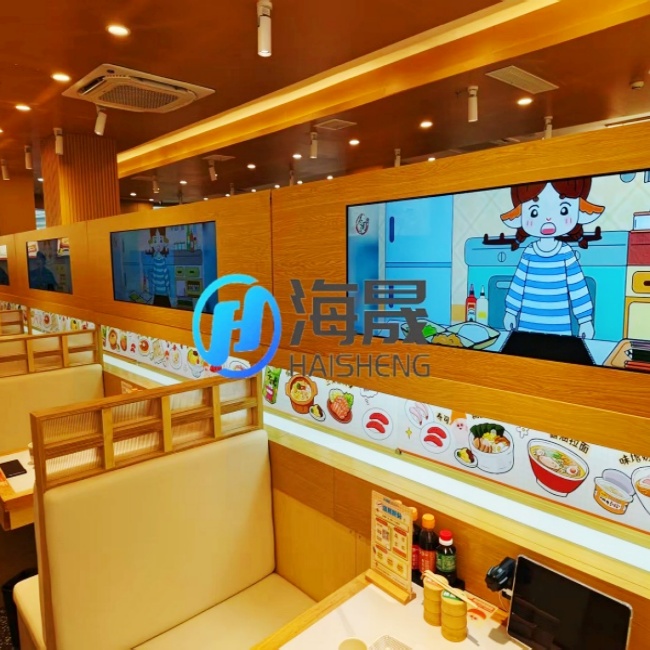
The company holds EU CE, US NSF, and UL certifications. Its equipment supports wide voltage adaptation from 110V to 240V and can be directly connected to the power grid standards of major markets in North America, Europe, and Australia. Products have been exported to the United States, Canada, Mexico, New Zealand, Australia, Malaysia, Thailand, France, the United Kingdom, Germany, Spain, Portugal, and more than 20 other countries and regions. It has formed long-term partnerships with leading chain restaurant brands such as Xinyifan, Wansui, Sushi Jiang, Heting, Hezhixian, and Dalixi. Equipment can be customized according to restaurant needs, spatial structure, and investment budget, including Hamazushi-style sushi belt equipment, Sushiro-style equipment, Kura-style Rotating Sushi Equipment, and Sushi Jiang-style sushi equipment.
Supporting Ecosystem and One-Stop Delivery
Rotating Sushi Equipment can be paired with gachapon machines, hot water systems, plate return systems, temperature-controlled freshness preservation systems, bridge transfer systems, freshness detection systems, automatic ordering screen systems, and automated checkout and settlement systems. The freshness detection module senses how long a dish has stayed in the conveying channel and automatically reminds staff to replace it when time is exceeded, moving quality control of prepared dishes from manual experience to system judgment.
HaiSheng has a 10,000-square-meter manufacturing plant and a technical engineering team of more than 100 people. It provides full-process services from design planning, R&D and manufacturing, production testing, to installation and maintenance. For chain brands planning new stores or renovating existing ones, this means certification, voltage, transport, and installation conditions are considered at the design stage rather than adjusted temporarily on site.
Smart Dining Experience: New Trunk Line Track Delivery System
The intelligent dining system breaks away from the monotonous rotating conveyor belt model of traditional rotating sushi stores. It introduces advanced restaurant equipment systems and adopts a smart Shinkansen-style track delivery system, creating a fresh visual impact. The entire delivery system has a unique shape and offers an unprecedented intelligent experience for rotating sushi restaurants. At the same time, this new delivery system brings customers more convenient and efficient service. Customers only need to order on a smart tablet, and dishes are delivered by the intelligent track delivery cart. The entire process involves no human contact. It saves a large amount of labor and also enhances health and safety for customers.
As the rotating sushi industry evolves from “open rotation” to “precise delivery,” the measure of equipment is no longer whether the carousel is turning, but whether delivery is on time, operation is quiet, and the system remains stable three years after opening. HaiSheng Intelligent Technology Co., Ltd.’s Rotating Sushi Equipment and Commercial Sushi Train Equipment are built around these real operating indicators.