

The global conveyor-belt sushi market is projected to grow from approximately USD 3.8 billion in 2025 to USD 5.2 billion by 2032, with a compound annual growth rate of 4.7%. This growth is largely driven by the aggressive overseas expansion of major Japanese sushi chains. Sushiro’s parent company, FOOD & LIFE COMPANIES, plans to increase its overseas store count by 75% to 320 locations by September 2026, while Hama-sushi targets 1,000 stores within five years.
Behind this expansion wave lies a fundamental shift in what restaurants need from their Rotating Sushi Equipment. The traditional “set it and forget it” conveyor belt — where plates circle endlessly regardless of whether anyone takes them — is being replaced by intelligent, on-demand delivery systems that prioritize food freshness, operational efficiency, and customer experience.
From Endless Rotation to Intelligent Track Delivery
Consumer concerns about hygiene on open conveyor belts, amplified by food safety incidents in recent years, have pushed major chains to rethink how food reaches the table. Sushiro has shifted toward on-demand delivery through express lanes and digital ordering, while Kura Sushi maintains its rotation model but reinforces it with AI camera systems and antibacterial sushi covers. The core value of sushi equipment is no longer simply “making plates move” — it is delivering the right dish to the right seat at the right time.
This is where HaiSheng Intelligent Technology Co., Ltd. has positioned itself as a critical manufacturing partner for the industry. Based in Guangdong, China, the company operates a 10,000-square-meter production facility staffed by a technical engineering team of over 100 specialists, covering everything from steel cutting to full-system debugging in-house.
Engineering That Addresses Real Operational Pain Points
What differentiates HaiSheng’s Rotating Sushi Equipment from conventional systems begins with the structural design. Each unit adopts a double-layer stable frame structure refined from Japanese manufacturing techniques, using thickened 304 stainless steel to maintain resistance to deformation under high-frequency continuous operation. Compared with single-layer frames, this structure distributes operating stress more evenly and reduces long-term structural fatigue. The modular construction principle allows each functional unit — tracks, supports, and drive systems — to be assembled, replaced, or adjusted independently, significantly shortening on-site installation time for overseas projects.
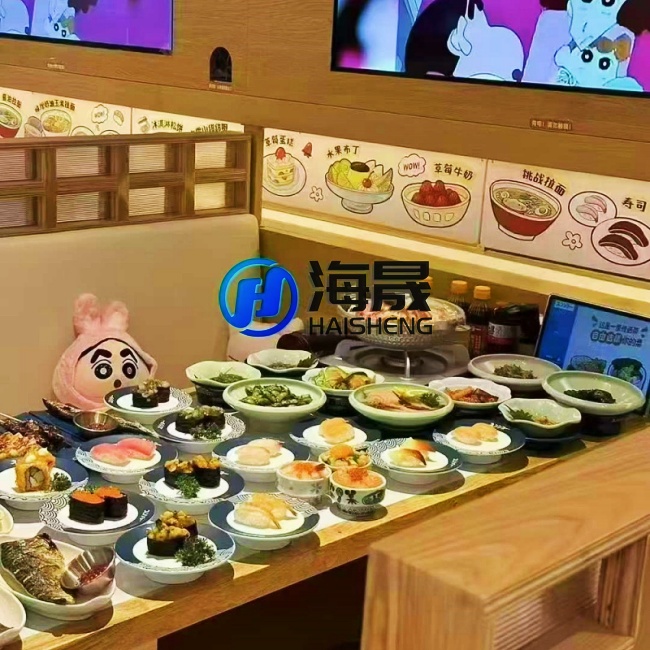
The conveyor chain itself represents another significant upgrade. HaiSheng uses high-density acrylic silent material instead of traditional metal or plastic chains, delivering smooth glide performance, excellent wear resistance, and nearly silent operation — noise levels stay controlled below 45 decibels, suitable for intimate dining spaces and mall store environments alike.
Perhaps most practically for multi-store operators, both the rotating sushi equipment and rotating hot pot equipment lines feature a self-developed adjustable tensioning device. Operators can fine-tune chain tightness based on actual wear conditions, slowing component aging and extending the overall service life of the system. This directly reduces the frequency of on-site component replacement and lowers long-term maintenance costs — a tangible advantage for chains managing equipment across different locations.
Custom Solutions for Every Brand Identity
HaiSheng’s customization services cover three levels: spatial layout, functional modules, and brand-specific design. The company offers multiple conveyor layout options including straight-line, L-shape, U-shape, dual-line parallel, and multi-level configurations. For irregular spaces featuring columns, split-levels, or other architectural challenges, the technical team conducts on-site measurements and creates exclusive design plans.
Beyond basic conveying functions, the Rotating Sushi Conveyor With Plate Return System can be flexibly equipped with over a dozen intelligent auxiliary modules: temperature-controlled freshness preservation systems, plate return and counting systems, self-ordering large-screen systems, automated checkout systems, bridge-pass systems connecting separate conveyor sections, and real-time freshness detection systems.
HaiSheng can tailor equipment to match each restaurant’s actual requirements, offering Hama-sushi-style belt systems, Sushiro-style smart conveyor systems, Kura-style rotating sushi systems, and Sushi-sho-style custom conveyors. This capability has attracted long-term partnerships with chain brands including Xinyifan, Wansui, Sushi Jiang, Heting, Hezhixian, and Dalixi.
Plate Return and Gamification: Building a Complete Dining Loop
The plate return system addresses one of the most persistent operational challenges in conveyor-belt sushi: manual plate counting and clearing. HaiSheng’s automatic plate return system features a dedicated plate slot at each dining position. After finishing their meal, customers insert empty plates directly into the slot. Inside the system, a water-circulation conveyor carries the plates to the kitchen automatically. Each inserted plate is scanned and counted, with consumption data instantly synced to the ordering tablet for automatic bill generation.
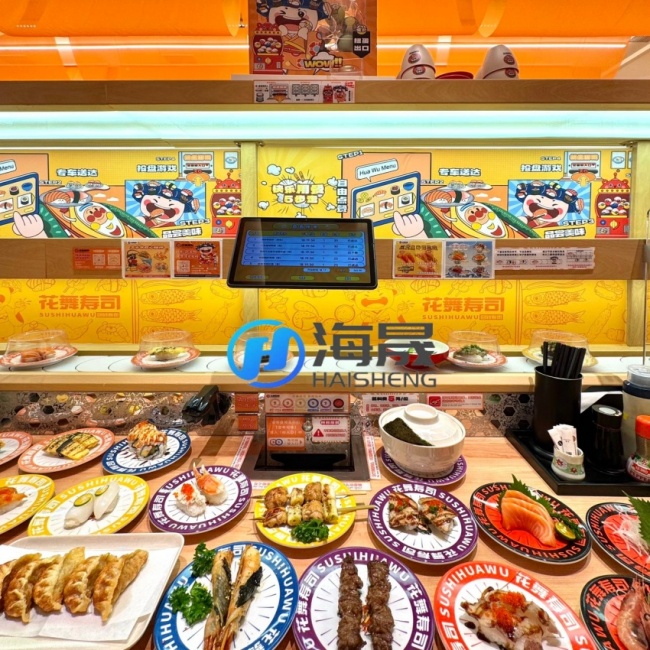
The efficiency gains are substantial: servers no longer need to weave between tables clearing and counting plates, saving one to two labor positions per store. Dining tables stay consistently tidy, and automatic billing eliminates counting errors.
HaiSheng has also integrated a disc-insert gaming system — a market-proven model pioneered by Kura Sushi’s “BIKKURA-PON” gacha game — which is deeply interconnected with the plate return system. Every time a customer inserts a set number of empty plates, the tablet triggers a game animation. Game formats are flexible, including gacha draws and interactive screen games, with capsules that can contain customized mini-gifts, IP-collaboration merchandise, or restaurant vouchers.
Intelligent Variable-Track Delivery: The Next Step in Automation
The standout feature of HaiSheng’s automatic revolving sushi conveyor system is its variable-track delivery capability. The intelligent food delivery cart can automatically calculate the optimal route and accurately deliver to the designated seat, execute U-turns, avoid obstacles, and perform intelligent error correction.
The system’s smoothness has been carefully engineered. By optimizing the power control system, the cart maintains stable operation during start-stop and turning maneuvers, reducing vibration amplitude. The load-bearing platform is reinforced with anti-slip and anti-tilt features, while protective guards and improved surface flatness reduce plate displacement during movement. The cart can also adjust operating parameters for different floor conditions, maintaining stability even in complex environments.
For restaurant operators seeking differentiation, the delivery cart’s appearance can be customized into train, spaceship, or other IP-themed designs, adding an element of entertainment that appeals to families and younger demographics. The entire process is triggered through tablet ordering, with dishes delivered contactlessly — saving labor while reinforcing hygiene standards.
Global Certifications and Export-Ready Manufacturing
HaiSheng’s equipment holds EU CE, U.S. NSF, and UL certifications — international endorsements covering electrical safety and food-contact material safety that serve as the company’s passport to global markets. Products are exported to more than 20 countries and regions, including the United States, Canada, Mexico, New Zealand, Australia, Malaysia, Thailand, France, the United Kingdom, Germany, Spain, and Portugal.
This global reach is supported by a complete one-stop service loop: layout design, R&D and manufacturing, factory testing, on-site installation guidance, and long-term after-sales maintenance. HaiSheng offers free store planning and equipment scheme design, with full-process support from concept through installation and beyond.
For restaurant operators evaluating Rotating Sushi Equipment for new locations or refurbishments, HaiSheng provides a rare combination: Japanese-influenced engineering depth, modular flexibility for diverse store layouts, internationally recognized safety certifications, and proven partnerships with established chain brands. As the industry continues its transition from traditional conveyor belts to intelligent track-based systems, manufacturing partners with genuine engineering capability will define which brands can scale successfully.