

In 2025, the global rotating hot pot market reached $1.85 billion and is expected to grow to $3.965 billion by 2034, with a steady compound annual growth rate of 8.8%. North America stands out in particular. In 2025, the regional market reached $563 million, and the United States is expected to become the world’s largest single market for rotating hot pot by 2034. Europe reached $657 million in 2025, with Germany expected to become the leading market in the region by 2034. Asia recorded $387 million in 2025, with a CAGR of 9.14%, maintaining its position as the fastest-growing region globally.
Behind these market figures is a shift in how overseas restaurant operators approach equipment procurement. In the past, overseas buyers of Rotating Hot Pot Equipment often focused only on the conveyor itself. Today, front-of-house delivery, back-of-house processing, tableware collection and settlement systems are all included in the same planning blueprint. For chain brands preparing to open rotating hot pot stores overseas, equipment purchasing has evolved from “buying a product” to “obtaining a replicable store-opening solution.”
Three Practical Barriers to Overseas Store Openings
When Chinese restaurant brands enter markets in North America, Europe, Oceania and Southeast Asia, the first obstacle is the certification requirements that local food safety regulations impose on commercial equipment. EU CE, US NSF and UL certifications are the minimum access standards in many markets. Without valid certification documents, customs clearance and opening inspections can be directly affected. Second, overseas labor costs are high and on-site construction windows are limited. Traditional non-modular equipment requires lengthy on-site assembly, which extends the opening cycle and increases labor costs. Third, cross-border after-sales support is difficult to arrange locally. Once equipment fails, the repair response cycle can stretch to several weeks.
These three barriers point to the same need: equipment must complete as much integration as possible at the factory before shipment, so that it can be installed and put into operation in the shortest possible time after arrival.
How Modular Design Shortens Overseas Installation Cycles
HaiSheng Intelligent Technology’s response is to extend modularity to the very end of the delivery chain. The tracks, support structures and drive systems of its Rotating Hot Pot Equipment are designed as standardized modules that can be installed and replaced independently. Installation efficiency is improved by 40% compared with traditional structures. After the equipment is shipped overseas in containers, the site only needs to complete module docking and fixation. Large-scale civil engineering modifications are not required, and the system can adapt to circular, L-shaped or U-shaped store layouts. For chain brands accelerating their overseas opening pace, this modular delivery capability directly affects the controllability of each store’s opening cycle.
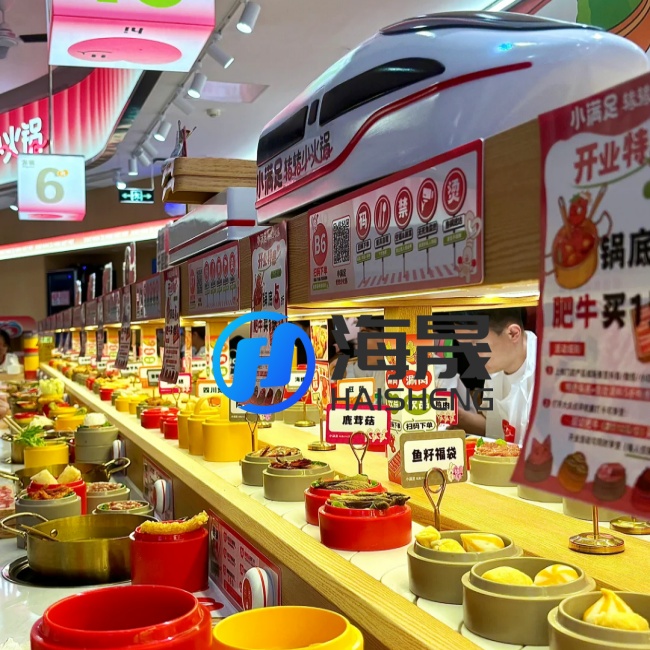
At the structural level, HaiSheng combines Japanese craftsmanship with an upgraded double-layer stable frame. The main frame uses thickened 2.0 mm food-grade 304 stainless steel, and each load-bearing point can support 20 kg. Reinforced welding ensures that the equipment does not shake, shift or skip plates when trays are densely arranged during peak hours. The factory pass rate reaches 99.8%. The conveyor chain uses high-toughness food-grade acrylic silent material. Combined with a low-noise drive motor, operating noise is controlled below 50 decibels, about 30% lower than traditional systems. The adjustable tensioning device prevents the chain from loosening or jamming, extends service life by about 25%, and reduces annual maintenance costs by nearly 30%.
From “Equipment Arrival” to “Operational Readiness”
Overseas delivery involves more than installation. HaiSheng provides a full-process service that covers pre-sales communication, on-site measurement and customized solution development, factory pre-assembly and stability testing, real-time online installation guidance, on-site commissioning by dispatched engineers, and regular remote maintenance and upgrades. When overseas customers purchase equipment separately from different brands, installation interfaces, voltage standards and after-sales responsibilities can easily become fragmented. A unified manufacturing standard and service system eliminates these connection problems and shortens the transition from equipment arrival at port to store opening.
HaiSheng’s Rotating Hot Pot Equipment currently holds EU CE, US NSF and UL certifications and has been exported to more than 20 countries and regions, including the United States, Canada, Mexico, New Zealand, Australia, Malaysia, Thailand, France, the United Kingdom, Germany, Spain and Portugal. In the domestic market, the company maintains long-term cooperation with brands such as Shengxiangting, Yiwei Fatty Beef, Longge Mini Hot Pot, Xijia Self-service Mini Hot Pot, Maguangguang Rotating Hot Pot, Haidilao and Little Sheep. The operational feedback accumulated from these projects continues to drive the equipment’s iteration in stability and spatial adaptability.
The growth momentum of the global rotating hot pot market shows no sign of slowing. For restaurant brands planning to enter or expand in overseas markets, choosing a set of Rotating Hot Pot Equipment that has already completed certification compliance, modular integration and installation process optimization means reducing the uncertainty of the equipment phase to a minimum. Supported by 16 years of manufacturing experience, a 10,000-square-meter smart workshop and a technical engineering team of more than 100 people, HaiSheng Intelligent Technology provides overseas chain brands with one-stop delivery capability from design planning to installation and maintenance. To learn more about a Hot Pot Buffet Equipment Installation solution for your market, please contact our overseas project team.