

For overseas customers customizing rotating sushi equipment, the challenge has never been only about the equipment itself. The same chain brand may face 110V voltage and NSF hygiene requirements in a U.S. store, CE certification and local environmental regulations in a European store, and irregular columns, ceiling height, shipping container dimensions, and on-site installation conditions in an Australian or Southeast Asian store. In 2024, China’s domestic rotating catering equipment market exceeded RMB 2 billion, with a compound annual growth rate of 12%, while global rotating sushi sales continue to grow. As chain brands accelerate their overseas expansion, equipment suppliers must answer one question: how can Rotating Sushi Equipment be quickly deployed and reliably operated in different countries and different stores?
The central theme of HaiSheng Intelligent Technology Co., Ltd. is precisely “Global Stores, Local Fit.” Since its founding in 2010, the company has focused on manufacturing rotating catering equipment. It has a modern 10,000-square-meter factory and a technical engineering team of more than 100 people. Its products are exported to more than 20 countries and regions, including the United States, Canada, Mexico, New Zealand, Australia, Malaysia, Thailand, France, the United Kingdom, Germany, Spain, and Portugal, and it has formed long-term cooperation with chain restaurant brands such as Xin Yifan, Wansui, Sushijiang, Heting, Hezhixian, and Dalixi. For overseas customers, this means certification, voltage, transportation, and installation are considered from the design stage, rather than being modified on site at the last minute.
Overseas Customization Hurdle One: Spatial Adaptation and Compliance Certification
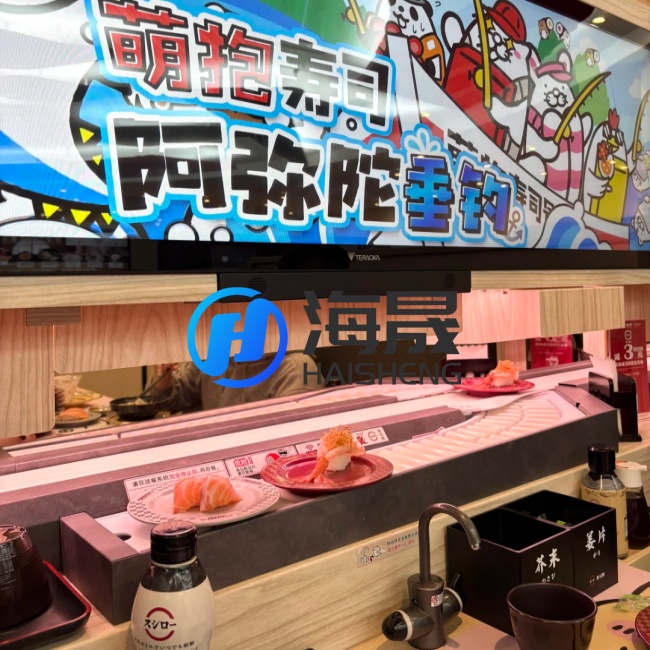
Overseas commercial-district stores also face issues such as irregular columns, non-standard layouts, and limited dimensions. HaiSheng supports seven layout types: straight, L-shaped, U-shaped, loop, curved, irregular, and double-line. It can provide 1:1 customized design based on column grid distribution and wall structure, with track splicing accuracy controlled within ±1 mm, helping stores activate idle space and increase effective seating by more than 40%. The equipment adopts Japanese craftsmanship and an innovatively upgraded double-layer stable frame structure. Modular design allows the track, supports, and drive system to be independently assembled and replaced, which facilitates container shipping and shortens overseas on-site installation time. The rotating chain uses acrylic silent material, which is smooth, wear-resistant, quiet, and stable. Both rotating sushi equipment and rotating hot pot equipment are equipped with adjustable tension devices, allowing operators to adjust chain tension according to wear conditions, extending service life and reducing maintenance costs. The company has obtained EU CE, U.S. NSF, and UL certifications. The equipment supports a wide voltage range of 110V to 240V and can directly adapt to the power grid standards of major markets such as North America, Europe, and Australia.
Overseas Customization Hurdle Two: Chain Standardization and Rapid Delivery
For overseas chain expansion, the biggest concerns are inconsistent multi-store image and loss of control over delivery schedules. HaiSheng responds to this need with its 4S Custom Delivery Framework: Spatial Adaptation, Standardized Replication, Speed Delivery, and Service Support. While keeping equipment style and functional modules consistent, the solution adapts to spatial differences in stores across different countries, ensuring a consistent brand image. Relying on its own factory and full-chain integrated capabilities, the delivery cycle for non-standard projects is significantly shorter than the industry average, with the full process from survey to acceptance completed in as fast as 15 days. For batch expansion, priority production scheduling can be coordinated to help brands avoid losses caused by delayed openings in high-rent locations. The source-factory direct supply model reduces intermediate links, making overall procurement costs more controllable under the same configuration. The company can also provide customized sushi belt equipment similar to Hamazushi, equipment similar to Sushiro, rotating sushi equipment similar to Kura, and sushi equipment similar to Sushijiang according to restaurant needs, spatial structure, and investment budget, and supports customized equipment solutions with quality comparable to Zhengxian.
Overseas Customization Hurdle Three: Intelligent Delivery and Back-of-House Support
Intelligence has become a core requirement for rotating sushi stores. HaiSheng’s track-switching intelligent delivery cart system integrates track-switching and conveying technologies to achieve precise delivery, U-turns, obstacle avoidance, and intelligent error correction. The automatic calculation system plans the best route based on delivery location, improving work efficiency. The carrying platform is enhanced with protective guards and optimized surface flatness to improve anti-slip and anti-tilt performance and reduce tableware displacement. The power control system has been specially optimized for smooth starts, stops, and turns, reducing body vibration and spills. For different floor environments, the system can automatically adjust operating parameters to maintain a stable operating posture. After users place orders via an intelligent tablet, dishes are delivered by the intelligent rail delivery cart without contact, saving labor and helping protect customer health and safety. The delivery cart shape can be customized into IP images such as trains and spaceships, adding fun to the dining experience.
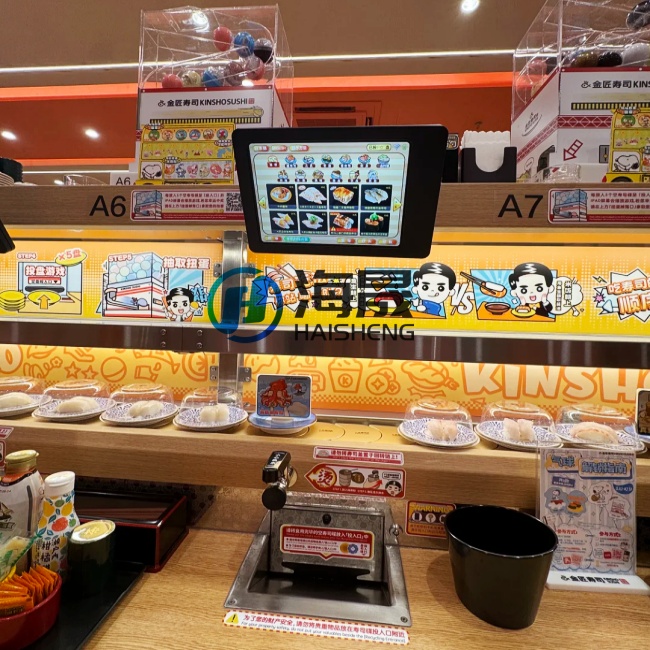
Rotating Sushi Conveyor Equipment can also be paired with gashapon machines, hot water systems, plate return systems, constant-temperature freshness preservation systems, bridge systems, freshness detection systems, automatic ordering large-screen systems, and automated checkout and settlement systems. Rotating hot pot equipment can be paired with variable-track intelligent delivery cart systems, ambient light strips, overhead smoke exhaust systems, multi-function drawers, and more. The equipment system is equipped with ventilation and air exchange devices to promote air circulation. Combined with regular cleaning of conveying channels and carrying platforms, this reduces odor accumulation and the possibility of cross-odor.
From design planning, R&D and manufacturing, production testing, to installation and maintenance, HaiSheng provides one-stop service for overseas customers. A 24/7 response mechanism and direct after-sales connection with the original design and production team reduce communication links and minimize the impact of equipment downtime on store operations. For chain brands expanding overseas, choosing a Rotating Sushi Equipment manufacturer with complete international certifications, wide-voltage compatibility, modular shipping, spatial customization, and global service experience is an important foundation for opening on schedule and maintaining stable long-term operations.