

Scale Is Growing, but Elimination Is Accelerating
The rotating hot pot sector is undergoing a phase of structural growth. As of November 2025, the number of mini hot pot stores nationwide exceeded 50,000, with the market size approaching RMB 40 billion and year-on-year growth of 14%, significantly higher than the overall hot pot industry. Globally, the rotating hot pot market was valued at approximately USD 1.85 billion in 2025 and is projected to grow to USD 3.965 billion by 2034, with a CAGR of 8.8%. Conveyor-belt hot pot equipment held the largest market share in 2025.
But another set of data deserves equal attention: the overall closure rate of rotating mini hot pot restaurants reached 24%, higher than the restaurant industry average. Some stores closed less than 100 days after opening. Leading brands such as Weila Mini Hot Pot opened more than 1,000 new stores in 2025, while Longge Buffet Mini Hot Pot added 360 stores in a year. At the same time, many homogenized small stores are exiting quickly.
Behind this divergence, equipment selection is an underestimated variable. A set of Rotating Hot Pot Conveyor Belt Equipment ranges from RMB 50,000 to RMB 200,000, accounting for 15% to 25% of initial investment. But its impact goes far beyond procurement cost—operational stability determines table turnover efficiency, hygiene design determines customer trust, and intelligence level determines labor allocation. The following four metrics are truly worth measuring during selection.
Metric One: Can the Drive System Withstand High-Frequency Operation?
The operating logic of rotating hot pot is “equipment never stops, customer flow never stops.” From lunch service to late-night operations, conveyor chains often run more than 10 hours a day. The reliability of the drive system directly affects whether a stable serving rhythm can be maintained during peak hours.
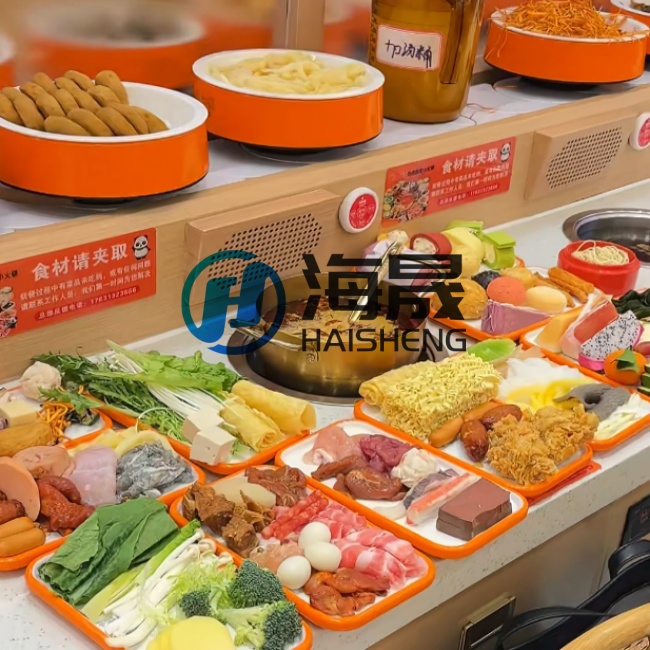
Traditional metal chains tend to develop increased noise and tension relaxation after long-term operation, leading to more frequent maintenance. HaiSheng's acrylic silent-material rotary chain offers clear improvements in smoothness, wear resistance, and noise control. More importantly, the adjustable tension device allows chain tension to be adjusted according to actual use, extending equipment service life and reducing long-term maintenance costs. For a Commercial Rotating Hot Pot Conveyor Belt with high daily turnover and almost nonstop operation, the operational economy of this design becomes apparent after six months of operation.
Metric Two: Does the Delivery System Have Precision Delivery Capability?
The conveyor belt solves the problems of food display and self-service pickup, but the “last leg” of made-to-order dishes from kitchen to table still relies on manual labor. This is where intelligent delivery systems stand out.
The track-switching intelligent delivery cart system deeply integrates track-switching technology with conveyor systems. The cart achieves precise delivery, automatic U-turns, obstacle avoidance, and intelligent error correction during operation. The system automatically calculates the optimal route based on the delivery location. The carrying platform, optimized with protective enclosures and surface flatness, reduces tableware displacement during movement. Power control system tuning ensures smooth starts, stops, and turns, reducing the risk of soup spillage. For different floor environments, the system automatically adjusts operating parameters to maintain a stable operating posture in complex scenarios.
From an industry trend perspective, manual labor delivers about 200 plates per day, while mature delivery robots can deliver 400 to 600. For the selection of Rotating Hot Pot Conveyor Belt Equipment, the intelligence level of the delivery system has become one of the core dimensions distinguishing equipment tiers.
Metric Three: Is Hygiene Design Embedded into the Equipment Structure?
Hygiene in rotating hot pot has always been a sensitive point for consumers. In 2025, several rotating buffet mini hot pot restaurants in Nantong were exposed for hygiene issues, with communal tongs proving virtually useless, prompting the industry to re-examine equipment hygiene design capabilities. Relying on store operations management to compensate for equipment structural defects is often ineffective.
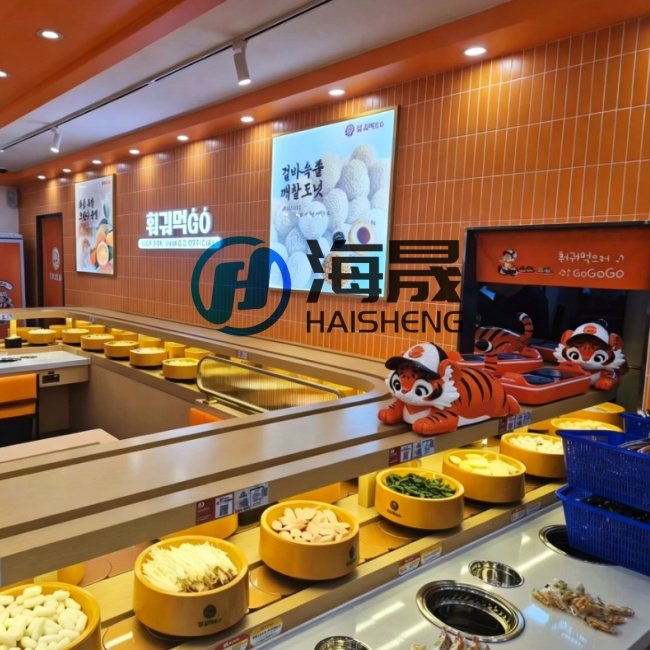
At the equipment level, hygiene design must be considered from two aspects. First, ease of cleaning food-contact surfaces: countertops with anti-slip texture design, smooth and burr-free joints, and reduced spaces where food residue can linger. Second, air management inside the equipment: reasonable ventilation design promotes air circulation, timely discharges residual odors, and reduces the environmental basis for odor transfer. Conveyor channels and carrying platform components are also optimized for regular thorough cleaning. These design details directly affect daily operational efficiency.
Metric Four: Does the Supplier's Delivery Capability Match Expansion Pace?
For operators planning multi-store expansion or overseas deployment, supplier delivery capability and certification qualifications are equally critical. HaiSheng Intelligent Technology Co., Ltd. has 16 years of equipment manufacturing experience and a 10,000-square-meter intelligent workshop. Its technical engineering team of more than 100 people covers the full process from design planning, R&D and manufacturing, production testing, to installation and maintenance. Products have obtained EU CE, US NSF, and UL certifications and are exported to more than 20 countries and regions worldwide, including the United States, Canada, Mexico, Australia, New Zealand, France, the United Kingdom, Germany, Spain, and Portugal. The company has formed long-term partnerships with brands such as Haidilao, Little Sheep, Shengxiangting, Yiwei Fat Beef, and Longge Mini Hot Pot. Among Shengxiangting's more than 320 stores nationwide, more than 280 use HaiSheng's rotary systems.
The essence of equipment selection is finding a configuration that matches one's business model among stability, intelligence, hygiene standards, and delivery capability. Price is an outcome, not the starting point.