

As the global sushi dining market continues to expand, one undeniable trend is reshaping the entire industry: overseas markets are imposing increasingly strict – and in some cases, almost demanding – requirements on ingredient freshness. From US FDA freezing standards to new EU regulations, from Japanese consumer preferences to relentless regulatory tightening by food safety authorities worldwide, "freshness" is no longer a marketing slogan. It is a fundamental requirement that determines whether a sushi restaurant can succeed in overseas markets.
Just How Much Do Overseas Markets Value Freshness?
Let's start with consumer behavior. In 2025, one of Japan's largest seafood companies, Maruha Nichiro, released a Consumer Survey on Conveyor-Belt Sushi, surveying 3,000 consumers who visit kaitenzushi (rotating sushi) restaurants at least once a month. The results showed that "fresh ingredients" ranked as the second most important factor (27.0%) in choosing a sushi restaurant, trailing only "affordable price" (35.1%). In other words, for consumers, freshness is almost as critical as price – even the cheapest sushi will not win customers if the ingredients are not fresh.
Now look at the regulatory side. The US Food and Drug Administration (FDA) explicitly requires that fish intended for raw consumption must undergo specific freezing treatments to kill parasites: freezing at -4°F (approx. -20°C) for at least 7 days, or at -31°F (approx. -35°C) for 15 hours. Notably, the FDA does not have an official "sushi-grade" certification – that label is actually a marketing term created by the seafood industry, not a government standard. Therefore, responsible sushi operators cannot rely on a supplier's "sushi-grade" label; they must depend on their own food safety systems and equipment to ensure ingredient quality.
The European Union has also been tightening its regulations. In 2025, the EU published Delegated Regulation (EU) 2025/1449, amending Annex III of Regulation (EC) 853/2004, further tightening freezing conditions for tuna intended for direct human consumption. This regulation took effect on January 27, 2026, requiring that all tuna for raw consumption (including sashimi, sushi, tuna steaks, etc.) must be frozen at a core temperature of -18°C or lower. The background to this stricter standard is that previous inspections found some fishing vessels freezing tuna only in brine at about -9°C, then placing it on the market as "fresh" or "unprocessed" – a practice deemed commercial fraud by the EU, with associated histamine accumulation risks that can cause scombroid poisoning.
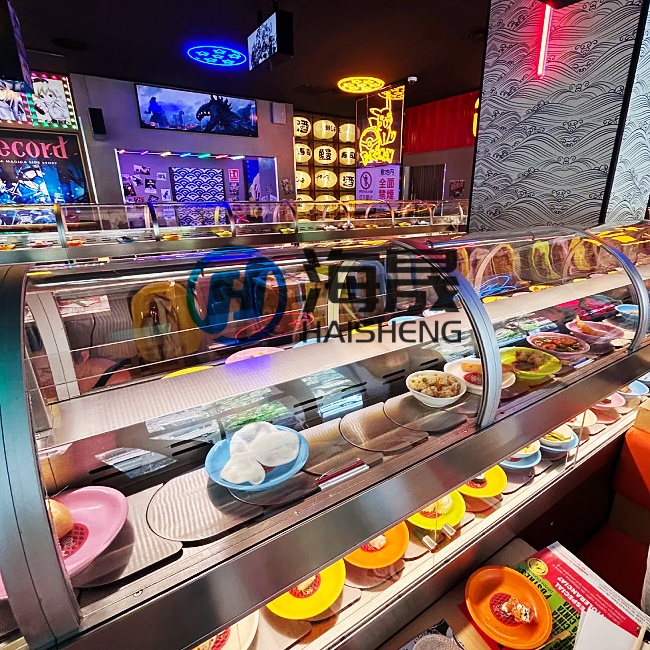
Japan, as the birthplace of conveyor-belt sushi and a global benchmark market, also maintains extremely strict industry standards. For example, the well-known chain Sushiro imports most of its ingredients from Japan and enforces rigorous kitchen hygiene, including hourly sanitation checks. All plates are tracked and automatically discarded after traveling more than 350 meters on the conveyor to ensure freshness. Another major player, Kura Sushi, uses freshness covers that meet ISO 22196 antibacterial standards, combined with AI camera systems to monitor plate counts on the conveyor in real time and track customer behavior.
HaiSheng Intelligent Technology: Professional Preservation Equipment for Overseas Markets
Faced with such stringent freshness requirements in overseas markets, sushi restaurant operators need not only a high-quality ingredient supply chain, but also rotating sushi equipment that can preserve freshness throughout the entire service process. HaiSheng Intelligent Technology Co., Ltd. is dedicated to meeting this need, providing professional preservation solutions for sushi restaurants worldwide.
Constant-Temperature Freshness System: Precise Temperature Control Locks in Freshness
One of the core advantages of HaiSheng's rotating sushi equipment is its built-in constant-temperature freshness system, which features two independent temperature zones:
Refrigeration Control (2-10°C) : For sashimi, raw fish, nigiri, and other ingredients that require cold storage, the equipment maintains a precise refrigeration environment between 2°C and 10°C, effectively extending preservation time. Australia's Food Standards Code Standard 3.2.2 explicitly requires that sushi must be kept at 5°C or below, or 60°C or above, during transport, storage, and display. HaiSheng's refrigeration zone fully complies with this standard, ensuring ingredients remain within a safe temperature range throughout service.
Heating Control (40-60°C) : For tempura, grilled items, warm dishes, and other hot foods, the equipment provides an independent heating zone at 40-60°C to maintain optimal taste and temperature. This dual-zone design allows restaurants to serve both cold and hot items on the same rotating sushi equipment without additional investment.
Sealed Freshness Cover: Reduced Oxidation, Cleaner and More Hygienic
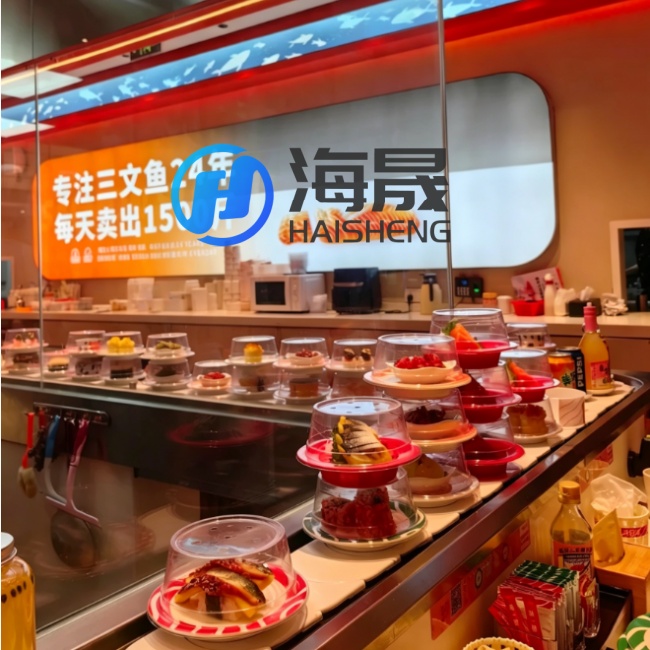
HaiSheng's rotating sushi equipment is equipped with sealed freshness covers that create a closed display environment for ingredients. These covers significantly reduce air exposure, slowing oxidation while preventing airborne dust and contaminants from settling on the food. The covers are manufactured from custom food-grade aluminum sheet materials that meet the general requirements of health authorities in EU countries. This design concept aligns with the preservation approaches of leading international brands like Kura Sushi – using physical isolation to ensure hygiene and freshness during conveyor transport.
Intelligent Freshness Management: Quantifiable and Traceable Preservation
Beyond hardware-level preservation features, HaiSheng's rotating sushi equipment can be equipped with an intelligent freshness detection system. This system monitors the time each plate spends on the conveyor in real time; when a plate exceeds a preset safety time limit, the system automatically alerts staff for prompt handling. This functions similarly to Sushiro's "350-meter automatic discard" mechanism, ensuring that no ingredient compromises quality or creates food safety risks due to prolonged exposure.
International Certifications: Smooth Market Access for Overseas Expansion
For sushi restaurants planning to enter overseas markets, whether the equipment meets target-market certification standards is critical. HaiSheng's rotating sushi equipment holds three important international certifications: EU CE certification, US NSF certification, and UL certification. NSF certification specifically addresses the safety and hygiene of food-contact equipment, while CE and UL certifications cover electrical safety and compliance. These three certifications ensure that HaiSheng's rotating sushi equipment can smoothly enter North American, European, and other major global markets, meeting both food safety and electrical regulatory requirements for market access. Currently, HaiSheng's products are successfully operating in more than 20 countries and regions, including the United States, Canada, Mexico, New Zealand, Australia, Malaysia, Thailand, France, the United Kingdom, Germany, Spain, and Portugal.
From Source to Table: A Comprehensive Preservation Philosophy
HaiSheng understands that true freshness preservation goes beyond the equipment itself – it must encompass the entire process from placing ingredients on the belt to delivering them to the customer. Therefore, HaiSheng's rotating sushi equipment integrates multiple auxiliary preservation and efficiency-enhancing features:
- Plate Return and Counting Systems: automatically return empty plates and reduce manual contact, keeping the conveyor area clean and organized.
- Intelligent Food Delivery Cart Systems: point-to-point direct delivery, reducing the exposure time of ingredients on the conveyor.
- Modular Design: facilitates easy cleaning and maintenance, ensuring the equipment remains in optimal hygienic condition over the long term.
- Acrylic Silent Chains and Adjustable Tension Devices: smooth and quiet operation (full-load noise below 45 decibels), reducing vibration impact on ingredients, while extending equipment life and lowering maintenance costs.
Conclusion
Overseas markets' strict requirements for food freshness are not a passing trend – they are a long-term direction driven by consumer expectations, regulatory frameworks, and industry standards. From FDA freezing standards to the EU's new -18°C tuna regulation, from Japanese consumers' "freshness first" mindset to continuous tightening by food safety agencies worldwide, every requirement reminds sushi restaurant operators: freshness is a baseline, not an option.
With 16 years of experience in manufacturing rotating sushi equipment, a 10,000-square-meter modern factory, and a technical engineering team of over 100 professionals, HaiSheng Intelligent Technology Co., Ltd. is committed to providing professional equipment that meets international preservation standards for sushi restaurants worldwide. From constant-temperature freshness systems to sealed freshness covers, from intelligent freshness monitoring to CE/NSF/UL certifications, HaiSheng's rotating sushi equipment offers comprehensive preservation solutions that help restaurants confidently meet the most demanding overseas requirements.
Whether you are a sushi brand planning to expand into overseas markets or an operator looking to improve ingredient freshness in your existing restaurant, HaiSheng Intelligent Technology is ready to support your global culinary business with professional equipment and extensive experience. Contact HaiSheng Intelligent Technology Co., Ltd. today to learn how our rotating sushi equipment can help your restaurant meet the world's strictest freshness standards.