

Rotating mini hot pot reached 50,000 stores and a market size of RMB 40 billion in 2025. During the same period, conveyor-belt hygiene incidents appeared repeatedly in public view: at a rotating mini hot pot store in Chongqing, rats were seen moving along the conveyor among food trays and gnawing on ingredients; the store was closed and the shopping mall carried out full disinfection. The tension between scale and trust is forcing the equipment side to respond.
One response has already been implemented: stop asking a single conveyor belt to carry every function. As the rotating model expanded from sushi to hot pot, noodles and Sichuan cuisine, the single “circular self-service loop” is splitting into two layers of logic—the conveyor core handles food display and self-service pickup, while an intelligent direct-delivery track handles hot pots, à la carte dishes and deliveries with time requirements. The two operate in parallel, forming a hybrid configuration of Rotating Hot Pot Conveyor Belt Equipment.
This hybrid configuration has already taken clear shape in actual stores. For Haidilao’s Malaysia location, HaiSheng designed a solution that adds a variable-track delivery cart rail above the conveyor core, equipped with six variable-track delivery carts that flexibly choose routes based on the target table. One cart can replace two staff members, matching the realities of large store areas and high labor costs overseas. Shengxiangting’s Wuhan MakeMao store turned “intelligent fixed-point delivery + rotating conveyor” into a dual system visible in the front of house: a rotating platform of more than 97 meters with 84 seats, equipped with five intelligent delivery carts. The conveyor handles self-service pickup, while the carts handle fixed-point replenishment. A custom solution for a U.S. client further formalizes the layered logic: the lower-level conveyor is used for self-service pickup, the upper-level track provides positioned delivery, and individually ordered items are delivered directly by table number. When a cart arrives, a voice announcement prompts the customer to take the food; after pickup, the cart automatically moves forward or returns.
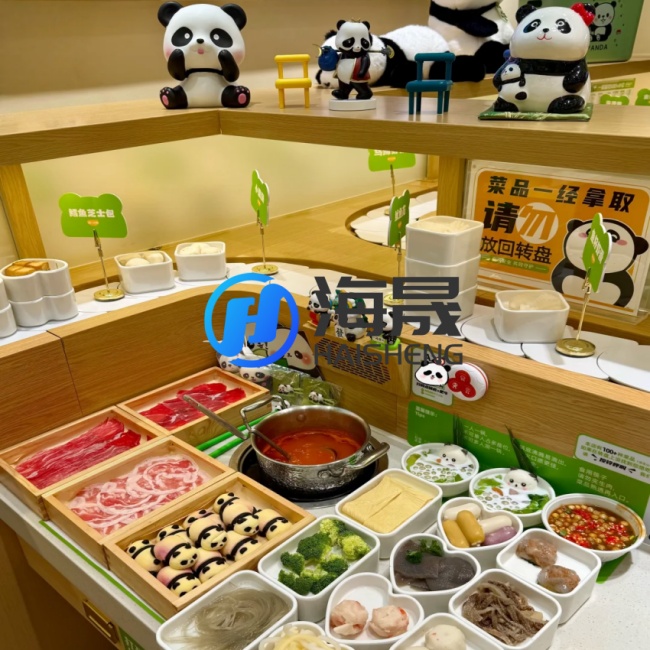
What the three cases share is not “adding one more cart,” but a re-division of equipment roles. The efficiency of a traditional full-loop conveyor is built on “coverage”—all dishes pass every seat along the loop and customers help themselves. But in hot pot scenarios, hot pots and some à la carte items are not suited to circulating on a public track for long periods. At the same time, the longer the circular route in a large store, the more obvious the problem of fixed-track delivery carts being forced to run the entire route. This is where the engineering value of the variable-track system lies: positioning chips are embedded at track turning points, and delivery carts automatically calculate the optimal route based on destination. They can turn around midway and return without going back to the starting point before setting off again. Industry data shows that combining variable-track and conveyor technology improves delivery efficiency by more than 40% compared with traditional fixed-track equipment; in a store where a track-based solution requires ten carts, four variable-track carts can achieve the same output.
Hybrid configuration also addresses a structural weakness at the hygiene level. A full-loop open conveyor keeps dishes continuously exposed on a public track. The risk of cross-contamination from dust, droplets and close customer contact is one of the equipment-level root causes behind repeated hygiene incidents. When hot pots and à la carte dishes move from the conveyor to enclosed or semi-enclosed direct-delivery tracks, exposure area and exposure time are reduced; the conveyor returns to what it does best—display and self-selection of standardized ingredients. Each route performs its own function, instead of asking one belt to simultaneously handle “display, circulation and delivery.”
For operators evaluating Automatic Rotating Hot Pot Conveyor Belt For Commercial Use, the selection logic for hybrid configuration can be reduced to a set of division-of-labor questions: which categories go on the conveyor for self-service display, which categories go on the direct-delivery track for fixed-point handover, how many parallel routes the store area and seat layout can support, and whether the direct-delivery system needs variable-track capability to match the corners and long routes of a large store. HaiSheng’s equipment path covers both ends of this set of questions: the conveyor core continues the double-layer stable frame, acrylic silent chain and adjustable tension device, while the delivery end uses the variable-track delivery cart system for precise delivery, turning, obstacle avoidance and route calculation. The load platform is specifically engineered for anti-slip and anti-tilt performance and smooth start-stop. Sixteen years of manufacturing experience, CE/NSF/UL certification and export scenarios across more than 20 countries allow the same hybrid logic to be parameter-adjusted for different store conditions and labor cost structures, rather than pushing one fixed configuration into every market.
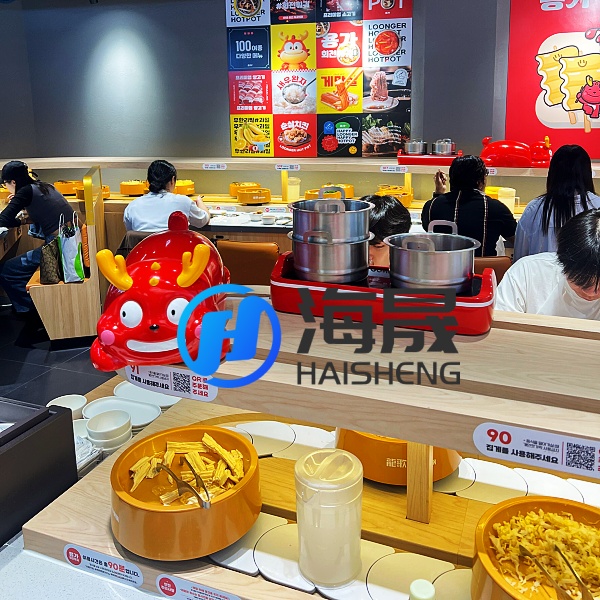
As the rotating model moved from sushi to hot pot, and then from hot pot to noodles, barbecue and Sichuan cuisine, “rotating” itself is no longer a category boundary but a language of spatial flow. Once that flow language is mature enough, equipment competition is no longer about “whose belt is longer,” but about “who can get the right dish to the right place in the right way.” Hybrid configuration is the current answer to that question, and a clear signal that rotating hot pot equipment is moving from single-product purchasing toward system-level selection.