

From “Opening Stores” to “Operating Stably”: The Rotating Hot Pot Sector Enters a Phase of Equipment Performance Competition
The scaling of rotating hot pot continues, but the underlying logic of the market has changed. As of the first half of 2025, the total number of rotating mini hot pot stores in China remained around 23,000, with stores in cities below tier three accounting for more than 61.6%. County-level markets have become a core growth engine. At the same time, the industry closure rate reached 24%, higher than the restaurant industry average, meaning that the category dividend alone is fading and the ability to sustain operations has become the real dividing line.
This divergence is especially visible on the equipment side. For chain brands, the stability of a Restaurant Rotating Hot Pot Conveyor Belt directly affects peak-hour service rhythm, manual intervention frequency, and long-term maintenance spending. Traditional metal or ordinary plastic chains tend to become noisy, worn, and loose after prolonged operation. Frequent chain replacement and on-site maintenance are becoming cost items that cannot be ignored. Industry requirements for equipment have shifted from “it can run” to “it runs long, runs quietly, and runs economically.”
Growth in overseas markets has further amplified this demand. The share of Chinese-exported rotating hot pot equipment in the North American market jumped from 18% in 2023 to 67% in 2026. When chain brands expand across borders, they face different voltage standards, food safety regulations, and space conditions. Whether equipment supports modular installation and holds international certifications directly determines how quickly a project can be completed. In this wave of overseas expansion, manufacturers with complete certification systems and fast response capabilities are gaining more procurement preference from chain brands.
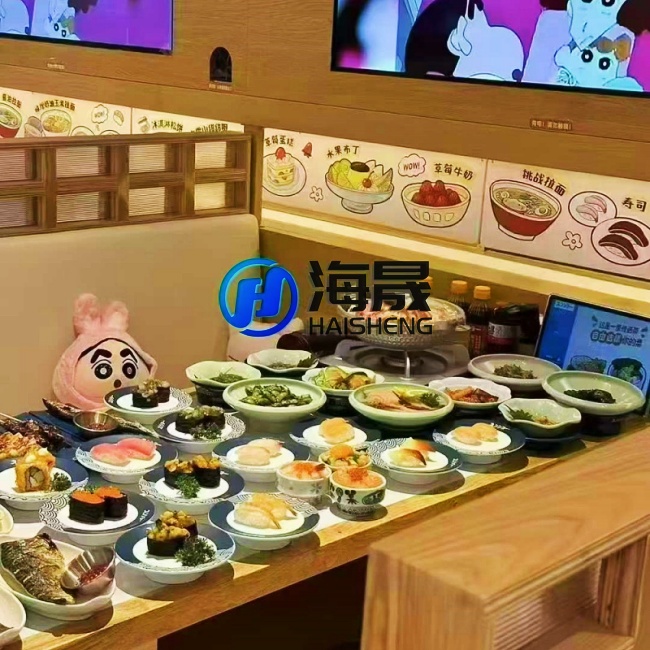
Chains, Structures, and Delivery Logic: Three Technical Facets of Rotating Hot Pot Equipment
At the equipment level, what truly creates a gap is often not appearance, but several technical details that are “invisible but consumed every day.”
The material choice for the conveyor chain is a typical dividing line. Traditional solutions mostly use metal chain plates or ordinary engineering plastics. The former becomes noticeably noisy after long-term operation, while the latter tends to produce powder and looseness after wear. HaiSheng uses acrylic silent chains with surface hardening treatment. While maintaining smooth operation, they significantly reduce front-of-house noise. Combined with an independently developed adjustable tension device, stores only need regular simple tension adjustments to effectively slow chain wear, turning maintenance from “periodic parts replacement” into “routine micro-adjustment.” For a store operating more than 12 hours a day, this difference accumulates into a considerable cost gap over a two-year cycle.
The stability of the frame structure determines how equipment performs under high-intensity use. The conveyor system in a rotating hot pot store operates almost continuously. If the frame lacks sufficient rigidity, local deformation and track deviation can occur after long-term use, affecting delivery precision. HaiSheng introduces Japanese manufacturing standards, adopts a double-layer stable frame structure, and uses modular design to break the conveyor section into standard units. This shortens on-site installation time and makes it easier to adjust locally if the store layout changes. For chain brands that need to open stores in multiple cities or even multiple countries simultaneously, the assembly efficiency brought by modularization is a concrete operational advantage.
The introduction of smart delivery systems is changing the precision boundary of “track-based delivery.” The track-switching smart delivery cart is one of the most technology-intensive modules in HaiSheng’s product system. Its core capability is not simply “making the cart move,” but a series of system designs for spill prevention and smooth operation: the carrying platform is optimized for anti-slip and anti-tilt performance; protective guards and improved tabletop flatness reduce the displacement of tableware during movement; the power control system smooths startup, stop, and turning processes, reducing body vibration; automatic route calculation plans the optimal route based on the delivery destination and adjusts operating parameters for different floor conditions, reducing spill risks caused by sudden acceleration and sharp turns. For equipment cleaning and maintenance, regular deep cleaning of the conveyor channels and carrying platforms, combined with built-in ventilation and air exchange design, helps reduce food residue accumulation and odor retention. The appearance of the delivery cart can be customized into train, spaceship, or other IP shapes, adding a memorable visual element to the store.
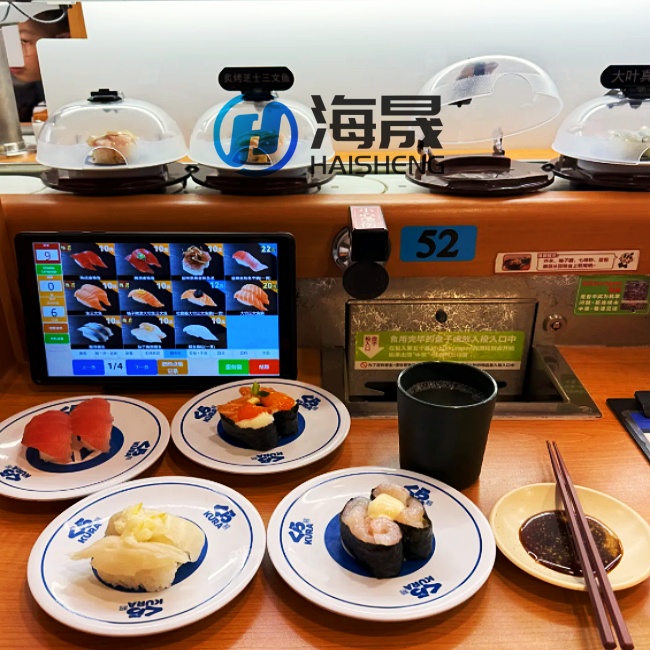
Certification and Service Capability: The “Entry Ticket” for Global Cooperation
For chain brands targeting overseas markets, equipment certification is not a bonus—it is a threshold. For Rotating Hot Pot Conveyor Belt Equipment to enter European and American markets, it must meet multiple compliance requirements, including electrical safety and hygiene standards for food-contact materials. HaiSheng’s rotating hot pot equipment has obtained EU CE, US NSF, and UL certifications, covering key testing dimensions such as metal materials, circuit insulation, fire ratings, and food-contact surface materials. This allows it to enter the procurement systems of North American and European chain restaurants directly.
Beyond product capability, the value of a one-stop service model is even more prominent in cross-border projects. HaiSheng has more than 10,000 square meters of intelligent workshop space and an engineering team of over 100 people. Its service chain covers the entire process from design planning, R&D and manufacturing, production testing, to installation and maintenance. Based on a restaurant’s spatial structure, traffic flow, and investment budget, the company can provide rotating hot pot equipment solutions with the same specifications as mainstream brands, and support optional modules such as ambient light strips, upper exhaust systems, and multi-functional drawers. Its equipment has been exported to more than 20 countries and regions, including the United States, Canada, Mexico, New Zealand, Australia, Malaysia, Thailand, France, the United Kingdom, Germany, Spain, and Portugal. It has also formed long-term partnerships with leading rotating hot pot and mini hot pot restaurant brands such as Shengxiangting, Yiwei Fatty Beef, Longge Mini Hot Pot, Xijia Buffet Mini Hot Pot, and Maguangguang Rotating Hot Pot.
The rotating hot pot sector is moving from “model innovation” to “operational refinement.” For restaurant brands planning to expand or go overseas, the logic of equipment selection is also changing: price is no longer the only decision dimension. Chain durability, long-term frame stability, delivery system precision, and the manufacturer’s support in certification and after-sales service are forming a more complete evaluation framework. Under this framework, choosing a supplier for Restaurant Rotating Hot Pot Conveyor Belt is essentially locking in the operational foundation of a store for the next two to three years.