

The Efficiency Revolution in Hot Pot Restaurants: How HaiSheng's Intelligent Revolving System Solves Peak-Hour Delivery Challenges with a "Dual-Track System"
The "Invisible Pressure" in Hot Pot Restaurants, Hidden in Every Table's Wait Time
Hot pot restaurants represent a typical dining format characterized by high customer traffic, rapid dish turnover, and demanding service requirements. During peak dining hours, kitchen output pressure surges dramatically as front-of-house staff navigate between tables, juggling order taking, food delivery, broth refills, table clearing, and various customer requests. If any hiccup occurs in the delivery process—congestion, wrong orders, or spills—it doesn't just impact turnover efficiency; it directly affects the customer experience.
In such a scenario, ensuring that dishes "move fast, move steady, and move accurately" becomes a core challenge that hot pot restaurant operators must address.
HaiSheng Intelligent Technology Co., Ltd., with 16 years of deep expertise in revolving equipment manufacturing, integrates intelligent delivery technology into its Restaurant Rotating Hot Pot Conveyor Belt system. Using a "dual-track coordination" solution, it provides hot pot restaurants with an efficient link from kitchen to table.
I. Improving Delivery Efficiency: Dual Tracks Running in Parallel, No More "Traffic Jams" During Peak Hours
Traditional hot pot restaurant delivery models rely heavily on manual labor. During peak hours, a chain reaction often occurs: "not enough food runners, dishes piling up at the pass, customers constantly asking about their orders."
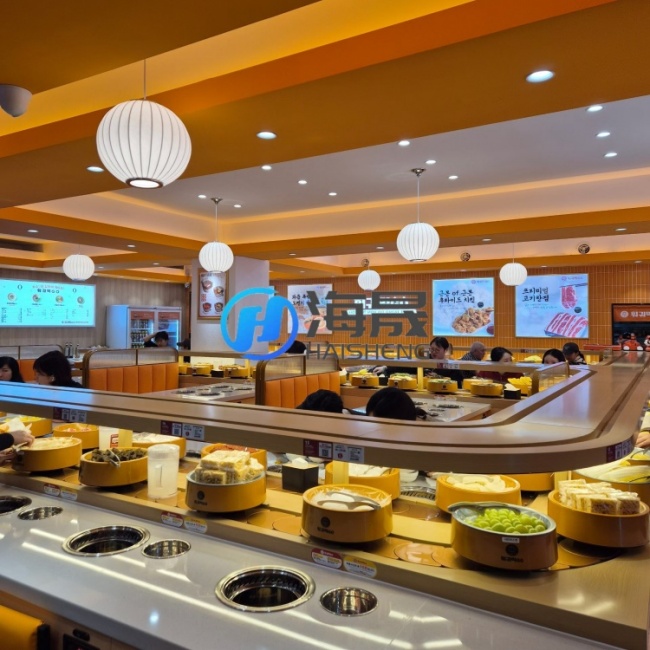
HaiSheng's Rotating Hot Pot Conveyor Belt Equipment adopts a dual-track design:
Lower track: A traditional revolving belt where customers can help themselves to high-frequency items
Upper track: A dedicated lane for intelligent delivery vehicles, supporting point-to-point precise delivery
The core of this system lies in variable-track technology—delivery vehicles can automatically switch tracks based on system commands, moving from the main line to branch lines leading to specific seats. The automatic calculation system plans the optimal path in real time based on delivery location and track occupancy, avoiding congested points to ensure each dish reaches its destination in the shortest possible time.
Equipment Highlights Explained:
Dual-Layer Independent Control System: The upper and lower tracks can independently control operating speed and start/stop timing. During peak hours, both layers run at full speed; during off-peak hours, the upper channel can be shut down or the lower track speed reduced to achieve energy savings. The two layers operate without interfering with each other, preserving the traditional "browsing and eating" experience while adding an intelligent channel for precise delivery.
Intelligent Scheduling Algorithm: The system's built-in automatic calculation system goes beyond simple "nearest-first" logic. It comprehensively considers multiple factors—track occupancy rate, real-time delivery vehicle positions, order sequence at each table—to dynamically allocate delivery tasks. When multiple delivery vehicles operate simultaneously, the system automatically coordinates dispatch order to prevent "traffic jams."
Modular Track Expansion: The track system uses modular design, allowing flexible layout based on the restaurant's actual spatial configuration. Whether linear, L-shaped, U-shaped, or circular layouts, seamless splicing is achievable. Single tracks can extend up to 50 meters or more, suitable for medium to large hot pot establishments.
Precision Positioning Technology: Each dining seat is equipped with an independent sensing device. When a delivery vehicle reaches its designated position, the system automatically identifies and precisely stops with an error margin within 1 centimeter. Combined with audible and visual prompts, customers can easily retrieve their food without bending over or reaching awkwardly.
Actual measurement data shows that hot pot restaurants using this system under comparable customer flow conditions experience approximately 30% improvement in delivery efficiency, significantly reduced customer wait times, and correspondingly increased table turnover rates.
II. Optimizing Service Experience: Stability, Accuracy, and Fun—Three Pillars
Beyond efficiency, experience is another key factor for hot pot restaurants to retain customers.
HaiSheng's intelligent delivery vehicles incorporate multiple technical optimizations for stability:
- Non-slip surface treatment + protective barriers on the carrying platform effectively reduce utensil displacement during movement
- Fine-tuned power control system enables smooth starts and stops, preventing spills caused by sudden acceleration or deceleration
- Intelligent obstacle avoidance detects obstacles on the track in advance, automatically rerouting or pausing to ensure operational safety
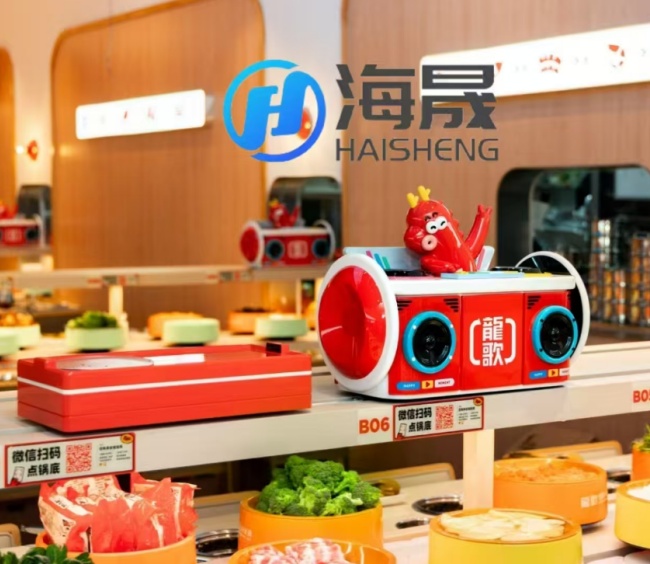
Additionally, delivery vehicle exteriors support personalized customization—they can be designed as trains, spaceships, or other IP-themed characters, adding fun and interactivity to the dining experience while fulfilling delivery tasks. This "practical yet entertaining" design resonates particularly well with younger consumer demographics.
III. Enhancing Hygiene and Safety: Reducing Contact, Minimizing Risks
Hot pot restaurants primarily handle perishable ingredients—fresh meats, seafood, vegetables—making hygiene during the delivery process critically important.
HaiSheng's Restaurant Rotating Hot Pot Conveyor Belt system fully considers hygiene requirements in its design:
- The delivery process minimizes direct manual contact with dishes, reducing contamination risks
- The track system reserves interfaces for ventilation equipment, which, combined with regular cleaning, effectively expels residual odor molecules from inside the equipment, preventing flavor transfer
- Conveyor channels, carrying platforms, and other components can undergo standardized cleaning and disinfection, keeping the equipment interior fresh
For consumers, "visible cleanliness" and "unnoticeable odor transfer" together form the foundation of trust in a restaurant's hygiene standards.
IV. Reducing Operating Costs: Saving on Labor, Waste, and Maintenance
From a long-term operational perspective, the return on investment from intelligent equipment manifests in multiple areas.
Labor Costs: Intelligent delivery vehicles handle repetitive delivery tasks, allowing front-of-house staff to focus on higher-value activities such as order consultation and post-meal service. Feedback from partner brands indicates that adopting this system can reduce front-of-house staffing by approximately 30% per location.
Waste Control: Smooth operational performance minimizes waste from food spills; precise delivery paths reduce the incidence of wrong orders and dish returns. With less food waste, costs become more manageable.
Maintenance Costs: HaiSheng equipment features modular design—components are pre-assembled and tested at the factory, making on-site installation as simple as "building with blocks." The chains use acrylic silent material for smooth operation and durability. The innovatively developed adjustable tension device allows quick tension adjustments even after prolonged operation, extending the equipment's service life and reducing maintenance frequency and costs.
Conclusion: Intelligence Is Not Just a Buzzword—It's Genuine Efficiency
From efficiency to experience, from hygiene to cost, HaiSheng's Rotating Hot Pot Conveyor Belt Equipment is helping an increasing number of hot pot brands build more efficient, stable, and competitive operational systems.
Sixteen years of manufacturing experience, a 10,000-square-meter intelligent factory, an engineering team of over 100 technical professionals, and three major international certifications—EU CE, US NSF, and UL—these aren't just numbers on a brochure; they represent the foundation ensuring the stable operation of every piece of equipment.
If you're also seeking a rotating hot pot equipment system that genuinely "saves money for the restaurant, peace of mind for the manager, and satisfaction for the customers", HaiSheng might be worth exploring further.